| Piú viste - Mars from Orbit (from July 2009) |
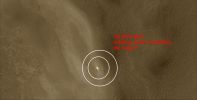
Unusually-looking_Surface_Feature-S22-00831d-00.jpgPossible Surface Anomaly (CTX Frame - False Colors)85 visiteDa un frame "2001 - Mars Odyssey", il Dr Gianluigi Barca ha estrapolato questo dettaglio, assolutamente affascinante, difficile da cogliere e - come quasi sempre accade - davvero inesplicabile.
Una piccola zona superficiale appare possedere - come lo stesso Dr Barca fa correttamente notare - una albedo semplicemente straordinaria: altissima, cioè. L'albedo propria del ghiaccio, nel caso di specie.
Ma come giustificare, scientificamente e razionalmente, un "appezzamento di ghiaccio" all'interno di un'area totalmente desertica?
In passato, a proposito di alcuni "confusi bagliori" simili a geysers e ripresi sia orbitalmente, sia dalla superficie (e MAI spiegati dalla NASA), avevamo lanciato l'idea degli "estrusi": sacche d'acqua di varie dimensioni le quali, spinte da forze mareali (o da sismi?), sorgono dalle profondità di Marte e quindi, una volta giunte in superficie, "esplodono", letteralmente, formando una pozza d'acqua che in parte evapora ed in parte ghiaccia quasi istantaneamente.
Che questa "chiazza bianca" sia un "estruso"?
|
|
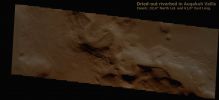
Channels-AuqakuhVallis-PCF-LXTT1.jpgAuqakuh Vallis (Natural Colors; credits for the additonal process. and color.: Dr Paolo C. Fienga - Lunexit Team)85 visiteIl letto asciutto (ma caratterizzato dalle "dunette" che, come sapete, sono presenti - a nostro parere - oltre che all'interno di innumerevoli crateri, ovunque vi sia stata e/o vi sia ancora dell'acqua) di un Fiume Marziano che attraversava questa grande Valle dal nome impronunciabile (e sul cui significato ci pare opportuno fornire qualche chiarimento).
Per gli amanti dell'origine dei nomi delle Valli Marziane, quindi, ecco un interessante supporto fornitoci da Wikipedia: in realtà, tutte le maggiori Valli di Marte sono state battezzate con il nome...Marte, in diverse lingue.
Qui di seguito alcune delle opportune traduzioni:
Ares -> Marte in Latino;
Al-Qahira -> Marte in Arabo, Indonesiano e Malese;
Auqakuh -> Inca;
Bahram -> Persiano/Farsi;
Hrad -> Armeno;
Kasei -> Giapponese, Maja e Nepalese;
Mangala -> Sanscrito;
Mawrth -> Gallese;
Ma'adim -> Ebraico;
Nirgal -> Babilonese.MareKromium
|
|
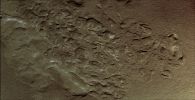
Ridges-PCF-LXTT.jpgRidges (Natural Colors; credits for the additional process. and color.: Dr Paolo C. Fienga - Lunexit Team)85 visiteCaption NASA:"The Ridges on the Floor of this Unnamed Crater are made of a more resistant material that their surroundings and therefore the erosional processes are first removing the less resistant material".
Coord.: 19,4° South Lat. and 66,3° East Long.MareKromium
|
|
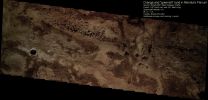
Meridiani_Planum-20080130a.jpgGeology of Meridiani Planum (Absolute Natural Colors; credits for the additional process. and color.: Dr Paolo C. Fienga - Lunexit Team)85 visitenessun commentoMareKromium
|
|
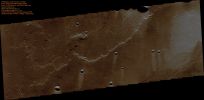
Windstreaks-PIA13633.jpgWindstreaks (Absolute Natural Colors; credits for the additional process. and color.: Dr Paolo C. Fienga - Lunexit Team)85 visitenessun commentoMareKromium
|
|
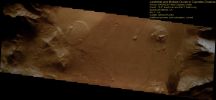
Landslide-Coprates_Chasma-20080421a.jpgLarge Landslide in Coprates Chasma (Absolute Natural Colors; credits for the additional process. and color.: Dr Paolo C. Fienga - Lunexit Team)85 visitenessun commentoMareKromium
|
|
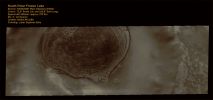
Craters-Unnamed_Crater-V13506008.jpgUnnamed Crater with Frozen Dunefield (Absolute Natural Colors; credits for the additional process. and color.: Dr Paolo C. Fienga - Lunexit Team)85 visitenessun commentoMareKromium
|
|

Landslides-Jus_Chasma-PIA13778.jpgLarge Landslide in Jus Chasma (Absolute Natural Colors; credits for the additional process. and color.: Dr Paolo C. Fienga - Lunexit Team) 85 visitenessun commentoMareKromium
|
|

Aeolian_Features-Yardangs-PIA15310-PCF-LXTT.jpgYardangs in Northern Gordii Dorsum (Enhanced Absolute Natural Colors; credits for the additional process. and color.: Dr Paolo C. Fienga - Lunexit Team)85 visiteOrbit Number: 44508
Latitude: 12,32° North
Longitude: 212,46° East
Instrument: VIS
Captured: December, 27th, 2011MareKromium
|
|
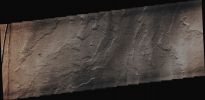
Volcanic_Regions-Tharsis-Lava_Flows-PIA15362-PCF-LXTT.jpgLava Fields between Echus Chasma and Tharsis (Slightly Saturated Absolute Natural Colors; credits for the additional process. and color.: Dr Paolo C. Fienga - Lunexit Team)85 visiteOrbit Number: 44743
Latitude: 11,6303° North
Longitude: 276,1480° East
Instrument: VIS
Captured: January, 15th, 2012
Mars Local Solar Time: 09:59 (Middle Morning Hours)
MareKromium
|
|

North_Polar_Regions-North_Polar_Erg-PIA17865-PCF-LXTT-IPF.jpgSpring over the North Polar Erg (Absolute Natural Colors; credits for the additional process. and color.: Dr Paolo C. Fienga - Lunar Explorer Italia/Italian Planetary Foundation)85 visiteIn this VIS image, taken by the NASA - Mars Odyssey Orbiter on December, 1st, 2013, and during its 53.076th orbit around the Red Planet, we can see the Erg (---> Sea/Ocean of Dunes) that surrounds the North Polar Cap of Mars. It is Springtime, now, at the North Pole (---> in the Northern Hemisphere of Mars) and the Dunes are starting to lose their Frost cover. As the season continues towards Summer, the Dunes will appear darker and darker, as the Frost sublimates.
The bright (and round, as we have found out using other frames) spot visible on the upper side of the picture should be just a patch of Permanent Ice which is located (and therefore, somehow, protected) inside a relatively shallow Depression of the Surface - possibly (but we have no way to be sure), an almost rimless and very old Impact Crater. You can take a look, if you wish to get a few more visual information about this area, at the APOD of April, 1st, 2013.
Latitude (centered): 80,267° North
Longitude (centered): 157,439° East
Instrument: VIS
This image (which is an Original Mars Odyssey Orbiter b/w and Map-Projected frame published on the NASA - Planetary Photojournal with the ID n. PIA 17865) has been additionally processed, magnified, contrast enhanced, Gamma corrected and then colorized in Absolute Natural Colors (such as the colors that a human eye would actually perceive if someone were onboard the NASA - Mars Odyssey Orbiter and then looked down, towards the Surface of Mars), by using an original technique created - and, in time, dramatically improved - by the Lunar Explorer Italia Team.MareKromium
|
|

Craters-Unnamed_Craters-PIA07330.jpg"Picasso" on Mars84 visitenessun commento
|
|
| 1003 immagini su 84 pagina(e) |
 |
|
|
|
|
40 | |
|
|
|
|





