| Piú viste - Mars from Orbit (from July 2009) |
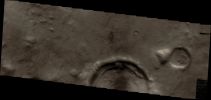
Craters-Unnamed_Crater-Terra_Sirenum-MO-PCF-LXTT.jpgUnnamed Crater with Dunefield in Terra Sirenum (Absolute Natural Colors; credits for the additional process. and color.: Dr Paolo C. Fienga - Lunexit Team)136 visitenessun commentoMareKromium
|
|

Dunes-Terra_Cimmeria-PIA14139.jpgDunes in Terra Cimmeria (Enhanced Natural Colors; credits: Dr Paolo C. Fienga - Lunexit Team)136 visitenessun commentoMareKromium
|
|
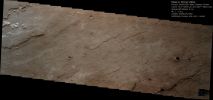
Channels-Simud_Valles-20080716a-PCF-LXTT~0.jpgFeatures of Simud Valles (Natural Colors; credits for the additional process. and color.: Dr Paolo C. Fienga - Lunar Explorer Italia)136 visitenessun commentoMareKromium
|
|

Clouds-PIA14965-PCF-LXTT.jpgClouds over Charlier Crater (Absolute Natural Colors; credits for the additional process. and color.: Dr Paolo C. Fienga - Lunexit Team)136 visiteOrbit Number: 43473
Latitude: 68,057° South
Longitude: 190,213° East
Instrument: VIS
Captured: October, 2nd, 2011
Mars Local Time (M.L.T.): 19:45 (Early Evening Hours)
MareKromium
|
|

Clouds-PIA13386.jpgNorth Polar Clouds (Natural Colors; credits for the additional process. and color.: Dr Paolo C. Fienga - Lunexit Team)135 visiteCaption NASA:"Clouds are common near the North Polar Cap throughout the entire Spring and Summer. The Clouds typically cause a haze over the extensive Dunefields forming the North Polar Erg.
This VIS image shows the edge of the Cloud-front".MareKromium
|
|

Craters-Unnamed_Crater_with_Small_Dunefield-PCF-LXTT.jpgUnnamed Crater with Dunefield (Absolute Natural Colors; credits for the additional process. and color.: Dr Paolo C . Fienga - Lunar Explorer Italia)135 visiteCaption NASA:"The Floor of this Unnamed Crater, located to the East of Proctor Crater, contains two types of Dunes. To the North (Sx), there are coalescing small Individual Dunes. At the Southern end of the group of small Dunes, then, there is a large Linear Dune that is becoming a Sand-Sheet".MareKromium
|
|
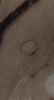
Craters-Unnamed_Crater-Deuteronilus_Mensae-PIA08472-01.jpgAlmost Buried Unnamed Crater in Deuteronilus Mensae (Absolute Natural Colors; credits for the additional process. and color.: Dr Paolo C. Fienga - Lunexit Team)135 visiteCaption NASA originale:"This Unnamed Crater appears to be in the process of being covered over by downslope movement of material. These large slopes of material are common in Deuteronilus Mensae".
Image information: VIS instrument;
Latitude: 41,1° North;
Longitude: 17,8° East;
Resolution: 19 meter/pixel. MareKromium
|
|
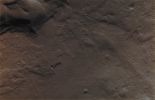
Channels-Auqakuh_Vallis-PIA08465-03.jpgFeatures of Auqakuh Vallis (Absolute Natural Colors; credits for the additional process. and color.: Dr Paolo C. Fienga - Lunexit Team) 135 visiteMareKromium
|
|

Craters-Richardson_Crater-PIA13774.jpgDunes on Richardson Crater's Floor (Absolute Natural Colors; credits for the additional process. and color.: Dr Paolo C. Fienga - Lunexit Team)134 visiteMareKromium
|
|
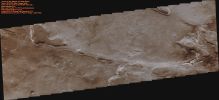
Layers-PIA14365-PCF-LXTT.jpgLayered Ridge (Natural Colors; credits for the additional process. and color.: Dr Paolo C. Fienga - Lunexit Team)134 visiteCaption NASA:The Layered Ridge and Mesas visible in this VIS image are located on the Northern Margin of the Hellas Basin".
MareKromium
|
|

Clouds_over_Vastitas_Borealis-20080610a-PCF-LXTT.jpgClouds over Vastitas Borealis (Natural Colors; credits for the additional process. and color.: Dr Paolo C. Fienga - Lunexit Team)133 visiteCaption NASA:"Northern Springtime means clouds. These clouds are close enough to the surface to be affected by this crater".
Nota Lunexit: se quanto la NASA scrive nella caption fosse completamente corretto, allora - molto probabilmente - ciò che si vede in questo frame NON SAREBBERO nuvole (almeno NON nel senso "terrestre" del termine), bensì delle nebbie molto fitte.
Se Vi piace, potremmo magari parlare di Evidenze di Umidità in aree prossime al Datum, insomma, e non di "nuvole basse" (anzi: bassissime!)...
Coord.: 74,4° North Lat. and 290,0° East Long.MareKromium
|
|

Lycus_Sulci-PIA18236-PCF-LXTT-IPF.jpgLycus Sulci in broad Daylight (Absolute Natural Colors; credits for the additional process. and color.: Elisabetta Bonora and Marco Faccin/LXTT/IPF)133 visiteIn this VIS image, taken by the NASA - Mars Odyssey Orbiter on February, 26th, 2014, and during its 54.147th orbit around the Red Planet, we can see a very small (but well illuminated) portion of the Martian Region known as Lycus Sulci: a Complex Region - mostly covered by Ridges - thst is located on the Northern Side of the largest and tallest Mountain of the Solar System: the Shield-Volcano known as Olympus Mons.
On the illuminated Slopes of the Ridges, a number of Dark Striations (perhaps Seeps, or maybe simple Dust-Slides) can be easily spotted and, furthermore, if you look carefully at the picture, you will also be able to see, in between the Ridges themselves, a complex network of tiny Sand Ripples, Out of curiosiity, the term "Sulci" (from the Latin word "Sulcus") means a System of Sub-Parallel Furrows (---> long and narrow Trenches) and Ridges.
Latitude (centered): 31,6354° North
Longitude (centered): 220,3990° East
Instrument: VIS
This image (which is a crop taken from an Original Mars Odyssey Orbiter b/w and Map-Projected frame published on the NASA - Planetary Photojournal with the ID n. PIA 18236) has been additionally processed, magnified to aid the visibility of the details, contrast enhanced and sharpened, Gamma corrected and then colorized in Absolute Natural Colors (such as the colors that a human eye would actually perceive if someone were onboard the NASA - Mars Odyssey Orbiter and then looked down, towards the Surface of Mars), by using an original technique created - and, in time, dramatically improved - by the Lunar Explorer Italia Team.MareKromium
|
|
| 1003 immagini su 84 pagina(e) |
 |
|
|
|
|
24 | |
|
|
|
|





