| Piú viste - Titan: The "Foggy" Moon |

Titan-W00012695.jpgTitans... (2)57 visiteOriginal caption:"W00012695.jpg was taken on December 26, 2005 and received on Earth December 27, 2005. The camera was pointing toward TITAN that, at the time, was approximately 25.404 Km away.
Te image was taken using the CL1 and RED filters".
|
|

Titan_and_Tethys-N00048632.jpgDancing in the dark: Tethys and Titan57 visitenessun commento
|
|

Titan-N00055567.jpgWhat's happening on Titan? (4)57 visiteCaption NASA:"N00055567.jpg was taken on March 20, 2006 and received on Earth March 20, 2006. The camera was pointing toward Titan that, at the time, was approximately 973.393 Km away.
The image was taken using the P0 and BL2 filters".
Nota: e se non si trattasse di un photoartifact, che cosa potrebbe essere il "punto" che abbiamo evidenziato?
|
|

Titan-N00055570.jpgWhat's happening on Titan? (7)57 visiteE come l'Anomalìa era apparsa (improvvisamente), così essa scompare, dopo essere stata ripresa per svariati frames.
La "sparizione" sarà dipesa dal cambio di filtro o da altre motivazioni che, al momento, ci sfuggono? Voi che ne dite? Che cosa abbiamo realmente guardato?...
Caption NASA:"N00055570.jpg was taken on March 20, 2006 and received on Earth March 20, 2006. The camera was pointing toward Titan that, at the time, was approximately 974.967 Km away.
The image was taken using the P120 and GRN filters".
|
|

Titan-Lakes-Unnamed_North_Polar_Lakes-00-PIA08630.jpgTitanian Northern Lakes (1)57 visiteCaption NASA originale:"The Cassini spacecraft, using its radar system, has discovered very strong evidence for hydrocarbon lakes on Titan.
Dark patches, which resemble terrestrial lakes, seem to be sprinkled all over the high latitudes surrounding Titan's North Pole.
Scientists have speculated that liquid methane or ethane might form lakes on Titan, particularly near the somewhat colder Polar Regions. In the images, a variety of dark patches, some with channels leading in or out of them, appear. The channels have a shape that strongly implies they were carved by liquid. Some of the dark patches and connecting channels are completely black, that is, they reflect back essentially no radar signal, and hence must be extremely smooth. In some cases rims can be seen around the dark patches, suggesting deposits that might form as liquid evaporates. The abundant methane in Titan's atmosphere is stable as a liquid under Titan conditions, as is its abundant chemical product, ethane, but liquid water is not".
|
|

Titan-Dunes-PIA09115.jpgTitanian Dunes57 visiteCaption NASA:"This radar image of Titan's well-known dunes is distinctive because it may show an age relationship between different classes of features on the surface of this frigid world.
Taken by Cassini's radar mapper on Jan. 13, 2007, during a flyby of Titan, three kinds of terrain can be seen. Throughout the image, the fine striping has been identified as dunes, possibly made from organic material and formed by wind activity. Dunes are a common landform on Titan.
The bright material at the lower right of the image is interpreted as being topographically higher than the dunes that go around it, and several circular features seen at the top center may be craters that are slowly being buried by the dunes. Since the dunes seem to lie over the craters, the dune activity probably occurred later in time.
This image was taken in synthetic aperture mode and has a resolution of approx. 350 mt (1150 feet).
North is toward the top left corner of the image, which is approx. 160 x 150 Km wide".MareKromium
|
|
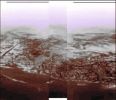
Titan-Huygens_Landing_Site-03-IMG002628-br500.jpgCoastline on Titan57 visiteThe deposits form when solar ultraviolet radiation and charged particles react at high altitudes with Titan’s abundant methane to produce carbon- and hydrogen-bearing (hydrocarbon) molecules like ethane and acetylene, and more complex nitrogen-bearing molecules generally called tholins. These products drift down to the surface as aerosols much in the same way smog particles on Earth form and coat surfaces. On Titan however these deposits may accumulate to thicknesses of hundreds of metres deep.
The dunes are composed of sand-sized material that agglomerated, either during its descent or when reworked by geological processes on the surface. The ice and organic landforms are as different from one another as they are spectacular. To the north of Huygens’ landing site are the bright highlands, displaying channels in a very ramified pattern, branching four or five times as they climb into the hills.
Stereoscopic images from the Descent Imager/Spectral Radiometer (DISR) camera on Huygens have now been analysed and show that some of the ridges between the channels rise to 150 - 200 metres in height, with slopes of thirty degrees. “This is extremely rugged terrain,” says Soderblom. The shape suggests that they are drainage channels, cut by liquid methane falling as rain.
MareKromium
|
|

Titan-Regions-Omacati_Macula_Region-01-LS28_PSS_LASoderblom_VIMSRADAR20070323.jpgDunes in the "Omacati Macula" Region57 visiteThe first two images of Titan (from the top) were obtained by Cassini’s SAR radar and the VIMS imager, respectively. They cover an area about 300 by 1000 Km wide and centred at 20° North and 45° West in the Omacatl Macula Region.
Dunes are generally rare in this area, even if some of them can still be seen in the enlargement provided by the bottom right radar image (blue arrow). These dunes are correlated to the brown spot visible in the VIMS image.
The green arrows linking the lower left radar image with the VIMS image illustrate that in this region the dark blue units are correlated to with sinuous channels and flow features.MareKromium
|
|

Titan-Huygens_Landing_Site-02-LS28_PSS_LASoderblom_VIMSRADAR20070323.jpgHuygens Probe Landing Site57 visiteThese images of the Huygens Landing Site on Titan were obtained by Cassini’s SAR radar (1st and 3rd rows) and VIMS (2nd and 4th rows) instruments, and are correlated in this composite view.
The 4 upper images show the Region of the Sinlap Crater in the Huygens Landing Site Region. The area shown is about 850 by 1150 Km wide.
The 4 lower images are colour-mapped as: red, to indicated solid dunes; yellow, to indicate a partial dune coverage; and green to indicate not mappable areas.MareKromium
|
|

Titan-N00091161.jpgTitan57 visiteCaption NASA:"N00091161.jpg was taken on September 02, 2007 and received on Earth September 03, 2007. The camera was pointing toward TITAN that, at the time, was approximately 1.313.086 Km away, and the image was taken using the CL1 and UV3 filters. This image has not been validated or calibrated".MareKromium
|
|

Titan-PIA09833-01.jpgTitan, from 213.000 Km (2 - natural colors; credits: NASA)57 visiteCaption NASA:"Images taken using red, green and blue spectral filters were combined to create this natural color view. The images were taken with the Cassini spacecraft wide-angle camera on Jan. 5, 2008". MareKromium
|
|

Titan-PIA09833-00.jpgTitan, from 213.000 Km (1 - RAW b/w; credits: NASA)57 visiteCaption NASA:"Titan's hazy orange globe hangs before the Cassini spacecraft, partly illuminated - a world with many mysteries yet to be uncovered.
North on Titan is up and rotated 30° to the right. The moon's North Pole tilts slightly away from the Spacecraft here.
This view was obtained at a distance of approx. 213.000 Km (such as about 133.000 miles) from Titan and at a Sun-Titan-Spacecraft, or phase, angle of 128°.
Image scale is roughly 13 Km (about 8 miles) per pixel".MareKromium
|
|
| 426 immagini su 36 pagina(e) |
 |
|
|
|
|
25 | |
|
|
|
|





