| Piú viste - Titan: The "Foggy" Moon |

Titan-Close Up 1.jpgTitan's fly-by "A" - Close-up 159 visiteLe primissime immagini del Passaggio Ravvicinato (fly-by) "A" della Sonda Cassini-Huygens accanto a Titano. Non abbiamo i dati telemetrici relativi a questa immagine, ma certamente siamo ancora molto lontani dal punto di maggior vicinanza fra i due corpi (in questo momento ci troviamo, probabilmente, fra i 400 ed i 500.000 Km di distanza da Titano). Il "passaggio radente" (si fa per dire...) di Cassini-Huygens accanto a Titano per questo primo fly-by (contraddistinto dalla lettera "A") avverrà con il transito della Sonda ad una distanza di circa 1.200/1.300 Km dalla "Luna Nebbiosa" (Hazy-Moon). Un "niente", effettivamente, laddove paragonato alle distanze che Cassini-Huygens ha coperto (e sta ancora coprendo) per fare questa "passeggiata" nel Regno di Saturno...
|
|
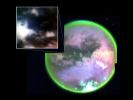
Titan-PIA06983_modest.jpgTitan (false colors) + the Huygens' probe landing site59 visiteCaption NASA originale:"This image taken by Cassini's visual and infrared mapping spectrometer clearly shows surface features on Titan. It is a composite of false-color images taken at three infrared wavelengths: 2 microns (blue); 2.7 microns (red); and 5 microns (green). A methane cloud can be seen at the south pole (top of image). This picture was obtained as Cassini flew by Titan at altitudes ranging from 100.000 to 140.000 Km (88.000 to 63.000 miles), less than two hours before the spacecraft's closest approach. The inset picture shows the landing site of Cassini's piggybacked Huygens probe".
|
|

Titan-Undefined_Surface_Features-Radar_Image-PIA06992_modest.jpgTitan - Radar image and false color image59 visiteCaption NASA originale: "In the new color image, brighter areas may correspond to rougher terrains, slopes facing the radar, or different materials. The pink colors enhance smaller details on the surface, while the green color represents smoother areas. Winding linear features that cut across dark areas may be ridges or channels, although their nature is not yet understood. A large dark circular feature is seen at the western (top left) end of the image, but very few features on Titan resembling fresh impact craters are seen.
The area shown is in the northern hemisphere of Titan and is about 150 Km wide by 300 Km long.
The image is a part of a larger strip created from data taken on Oct. 26, 2004, when the Cassini spacecraft flew approximately 1.200 Km above Titan's surface".
|
|

Titan-Undefined_Surface_Features-Radar_View-PIA06995_modest.jpgAnother "radar view" from Titan: the "arrow"59 visiteOccorre la Caption NASA originale per tentare di capire qualcosa di questa "oscura" (da tutti i punti di vista) immagine radar di Titano: "...the (arrow-like) "feature" is approximately 30 Km across and it is formed from 2 straight lines that intersect. Looking more closely, one can distinguish other linear features that seem to follow the left side of the "arrow" and perhaps interact in some way with a dark spot. Straight lines may represent fractures or faults in the icy crust, or they may form from material that has flowed or has been shaped by wind, either recently or in the distant past.
The area shown is about 115 Km wide and 170 Km high and is located near 52° North latitude and 73° West longitude. This radar image is part of a larger strip of data acquired on Oct. 26, 2004, as Cassini passed Titan at a distance of 1.200 Km".
Secondo noi il rilievo che alla NASA chiamano "freccia" potrebbe essere una sorta di ciglio roccioso ma, come vedete Voi stessi, con un'immagine così...ogni ipotesi è buona!
|
|

Titan-W00003639.jpgClouds around Titan59 visiteImmagine di Titano ripresa da circa 29.000 Km. Oltre alle nuvole (sempre bianche e vaporose) non si riesce a distinguere alcun dettaglio della superficie di questa luna.
|
|

Titan-Huygens_Landing_Site-09-PIA06172_modest.jpgHuygens' descent map (1)59 visiteCaption NASA originale:"This map illustrates the planned imaging coverage for the Descent Imager/Spectral Radiometer (DISR), onboard the Huygens probe during the probe's descent toward Titan's surface on Jan. 14, 2005. The DISR is one of two NASA instruments on the probe. The colored lines delineate regions that will be imaged at different resolutions as the probe descends. On each map, the site where Huygens is predicted to land is marked with a yellow dot. This area is in a boundary between dark and bright regions. This map was made from the images taken by the Cassini spacecraft cameras on Oct. 26, 2004, at image scales of 4 to 6 Km per pixel. The images were obtained using a narrow band filter centered at 938 nanometers - a near-infrared wavelength (invisible to the human eye) at which light can penetrate Titan's atmosphere to reach the surface and return through the atmosphere to be detected by the camera. The images have been processed to enhance surface details".
|
|

Titan-Surface-30.jpgOn the surface of Titan59 visiteCaption ESA originale:"This raw image was returned by the ESA Huygens DISR camera after the probe descended through the atmosphere of Titan. It shows the surface of Titan with ice blocks strewn around. The size and distance of the blocks will be determined when the image is properly processed". Dunque Huygens ce l'ha fatta: è scesa su Titano! E la qualità di queste prime immagini supera le nostre più rosee aspettative: la visibilità è buona e questa parte di Titano sembra ricordarci - vagamente - la superficie di Venere, così come ripresa dalle Sonde Sovietiche "Venera".
|
|

Titan-Shoreline_and_Drainage_Channels-00.jpgShoreline and Drainage Channels' Network on Titan 59 visiteCaption ESA originale:"This is one of the first raw images returned by the ESA Huygens probe during its successful descent. It was taken from an altitude of 16,2 Km with a resolution of approximately 40 metres per pixel. It apparently shows short, stubby drainage channels leading to a shoreline".
Il profilo di un tratto costiero, dunque: montagne (o colline), una fitta rete di canali ed una porzione di "mare" alla vista. Mare.
Già, ma un mare fatto di cosa?...
|
|

Titan-Shoreline_and_Drainage_Channels-04.jpgShoreline and Drainage Channels (Mosaic)59 visiteCaption ESA originale:"This composite was produced from images returned yesterday, 14 January 2005, by ESA's Huygens probe during its successful descent to land on Titan. It shows a full 360-degree view around Huygens. The left-hand side, behind Huygens, shows a boundary between light and dark areas. The white streaks seen near this boundary could be ground 'fog' of methane or ethane vapour, as they were not immediately visible from higher altitudes. As the probe descended, it drifted over a plateau (centre of image) and was heading towards its landing site in a dark area (right). This dark area is possibly a drainage channel which might still contain liquid material. From the drift of the probe, the wind speed has been estimated at around 6-7 mt per second. These images were taken from an altitude of about 8 Km with a resolution of about 20 mt per pixel".
|
|

Titan-Channels-Drainage_Channels-PIA07236-01.jpgWater Ice and Methane Springs on Titan59 visiteCaption NASA originale:"A single Huygens DISR image that shows two new features on the surface of Titan. A bright linear feature suggests an area where water ice may have been extruded onto the surface. Also visible are short, stubby dark channels that may have been formed by 'springs' of liquid methane rather than methane rain".
Come mai, qualcuno si è chiesto, gli idrocarburi di Titano non sono completamente ghiacciati? Come mai - almeno a quanto ci è dato vedere - i "fiumi" e le "sorgenti" di idrocarburi di Titano, rispettivamente, scorrono e zampillano? Che cosa permette alla superficie di Titano di essere sufficientemente calda da consentire a questo incredibile mondo di essere - da un certo punto di vista - "vivo e vitale"?
|
|

Titan-Atmosphere-PIA06182.jpgOver the Clouds of Titan59 visiteCaption NASA originale:"This image was taken during Cassini's 3rd close approach to Titan on Feb. 15, 2005.
The image was taken with the Cassini spacecraft narrow angle camera through a filter sensitive to wavelengths of polarized infrared light centered at 338 nanometers. The image was acquired at a distance of approximately 151.000 Km (approx. 94.000 miles) from Titan and at a phase angle of 20°.
Resolution in the image is about 900 meters (approx. 3.000 feet) per pixel".
|
|

Titan-PIA06220.jpgA New Continent on Titan (from 130.000 up to 146.000 Km)59 visiteCaption NASA originale:"This view of Titan uncovers new territory not previously seen at this resolution by Cassini's cameras. The view is a composite of 4 nearly identical wide-angle camera images, all taken using a filter sensitive to wavelengths of infrared light centered at 939 nnmts. The individual images have been combined and contrast-enhanced in such a way as to sharpen surface features and enhance overall brightness variations. Some of the territory in this view was covered by observations made by the Cassini synthetic aperture radar in October 2004 and February 2005. At large scales, there are similarities between the views taken by the imaging science subsystem cameras and the radar results, but there also are differences. For example, the center of the floor of the approximately 80-kilometer-wide (50-mile) crater identified by the radar team in February (near the center in this image, see PIA07368 for the radar image) is relatively bright at 2.2 centimeters, the wavelength of the radar experiment, but dark in the near-infrared wavelengths used here by Cassini's optical cameras. This brightness difference is also apparent for some of the surrounding material and could indicate differences in surface composition or roughness".
|
|
| 426 immagini su 36 pagina(e) |
 |
|
|
|
|
17 | |
|
|
|
|





