| Piú viste - Titan: The "Foggy" Moon |

Titan-N00055569.jpgWhat's happening on Titan? (6)59 visiteCaption NASA:"N00055569.jpg was taken on March 20, 2006 and received on Earth March 20, 2006. The camera was pointing toward Titan that, at the time, was approximately 974.790 Km away.
The image was taken using the P120 and BL2 filters".
|
|

Titan-Craters-Unnamed_Crater-PIA08737.jpgTitanian Crater59 visiteCaption NASA originale:"This image from Cassini's radar instrument shows an impact crater with a diameter of about 30 Km (19 miles) on the surface of Saturn's moon Titan. Cassini data have only revealed 3 definite impact craters on Titan so far, so each new discovery adds significantly to our body of knowledge. Impact craters are particularly important, as their shapes give scientists insight into the structure of the crust beneath Titan's surface. The difference in overall appearance between this crater, which has a central peak, and those without, such as Sinlap, indicates variations in the conditions of impact, thickness of the crust, or properties of the meteorite that made the crater. The dark floor indicates smooth or highly absorbing materials.
This image was acquired by the Cassini radar instrument in synthetic aperture mode during a Sept. 7, 2006, flyby of Titan.
This image is centered at 70° West Long.; 10° North Lat. and measures about 145 Km high by 180 Km wide (such as approx. 93 by 118 miles). The smallest details in this image are about 500 mt (approx. 550 yards) across".
|
|

Titan-Clouds-White_Clouds-PIA08736.jpgThe "White Clouds" of Titan59 visiteCaption NASA originale:"This image depicts Saturn's moon Titan as seen by the Visual and Infrared Mapping Spectrometer (VIMS) after the closest approach of July 22, 2006 (fly-by n. 16).
The image was generated using the 5 micron wavelength for red, the 2 micron wavelength for green and the 1,2 micron wavelength for blue. The clouds are of the same type seen previously and reported in the journal "Science".
The image shows the clouds spreading out along the 40° South Latitude line.
This image was taken from a distance of about 160.000 Km (roughly 99.000 miles) from Titan".
|
|

Titan-Regions-Shangri_La_Region-PIA08971.jpgShangri-la and other Equatorial Regions of Titan59 visiteCaption NASA:"This view of Titan's surface highlights NorthWestern Shangri-la - a large, Equatorial Dark Region revealed by radar observations to be covered in longitudinal dune fields. The bright, circular feature right of center is a potential impact crater - few of which have been spotted on Titan thus far.
North on Titan is up and rotated about 15° to the right. This view was created by combining multiple images taken using a combination of spectral filters sensitive to wavelengths of infrared light centered at 938 and 619 nanometers.
The images were taken with the Cassini spacecraft narrow-angle camera on May 13, 2007 at a distance of approx. 125.000 Km (about 77.000 miles) from Titan. Image scale is roughly 1 Km (0,6 miles) per pixel. Due to scattering of light by Titan's hazy atmosphere, the sizes of surface features that can be resolved are a few times larger than the actual pixel scale".MareKromium
|
|

Titan_and_Rhea-PIA12599.jpgTitanian Encounters...59 visiteCaption NASA:"The moon Rhea moves behind Saturn's largest moon, Titan, in this Mutual Event imaged by the Cassini Spacecraft.
Mutual Event sequences, in which one moon passes close to or in front of another, help scientists refine their understanding of the orbits of Saturn's moons. Part of Rhea's Southern Hemisphere is also visible here through the haze of Titan's Atmosphere.
Titan has been brightened by a factor of 1.5 relative to Rhea. This view looks toward the anti-Saturn side of Titan and the Trailing Hemisphere of Rhea.
The image was taken in Visible green Light with the Cassini spacecraft narrow-angle camera on Nov. 27, 2009. The view was obtained at a distance of approx. 1,2 MKM (about 746.000 miles) from Titan and from about 2,3 MKM (approx. 1,4 MMs) from Rhea.
Image scale in the original image was roughly 14 Km (approx. 9 miles) per pixel on Titan and about 27 Km (approx. 17 miles) per pixel on Rhea. The image has been magnified by a factor of two and contrast-enhanced to aid visibility".MareKromium
|
|

Titan-PIA14663-PCF-LXTT-IPF.jpgFensal, Aztlan and Kraken Mare (Absolute Natural Colors; credits for the additional process. and color.: Dr Paolo C. Fienga/Lunar Explorer Italia/Italian Planetary Foundation)59 visiteAlthough it is almost completely hidden from human eyes, the NASA - Cassini Spacecraft can still spot a few dark Features on the Surface of Titan thanks to its special Near-InfraRed Filters. The Surface Features visible here, near the Equatorial Belt, have been dubbed "Fensal" and "Aztlan" by Planetary Scientists and they are believed to be vast (---> large and very long) Dunes made of Particles of Dust (mixed-up with, most likely, other Elements) that precipitated out of the Atmosphere of Titan (but some other possibilities about their origin and composition can also be well considered); on the other hand, near the North Pole of Titan, it is also well visible the largest body of liquids existing on this fascinating Saturnian moon, such as the Kraken Mare.
Furthermore, just barely visible right on top of the South Pole, the huge Vortex that was spotted quite some time ago and that keeps Planetary Scientists busy trying to understand the actual reasons that caused its sudden formation, as well as and the amount of time during which it will still remain active (obviously assuming that such a Vortex is just a seasonal and not a - now - permanent phenomenon).
This view looks toward the Saturn-facing Hemisphere of Titan; North is up and rotated 32° to the right (Dx) and the image was taken with the NASA - Cassini Spacecraft Narrow-Angle Camera on April 13, 2013 using a Spectral Filter sensitive to Wavelengths of Near-InfraRed Light centered at 938 nanometers. The view was acquired at a distance of approximately 1,2 Million Miles (such as about 1,93 Million KiloMeters) from Titan and at a Sun-Titan-Cassini Spacecraft, or Phase, Angle of 4°. The image scale is roughly 7 miles (such as about 11,26 Km) per pixel.
This picture (which is an Original NASA - Cassini Spacecraft b/w frame published on the NASA - Planetary Photojournal and identified by the n. PIA 14663) has been additionally processed, magnified and then colorized, according to an educated guess carried out by Dr Paolo C. Fienga (LXTT-IPF), in Absolute Natural Colors (such as the colors that a human eye would actually perceive if someone were onboard the NASA - Cassini Spacecraft and then looked outside, towards the Saturnian moon Titan), by using an original technique created - and, in time, dramatically improved - by the Lunar Explorer Italia Team. Different colors, as well as different shades of the same color, mean, among others, the existence of different Elements present in the Atmosphere of Titan, each having a different Albedo (---> Reflectivity) and Chemical Composition.
Note: it is possible (but we, as IPF, have no way to be one-hundred-percent sure of such a circumstance), that the actual luminosity of the Clouds and Hazes (as well as the luminosity of Titan itself) seen in this frame would appear, to an average human eye, way lower than it has been shown (or, better yet: interpreted) here.MareKromium
|
|
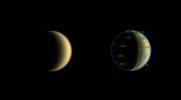
Titan-Crescent-01.jpgTitan from approx. 790.000 Km58 visitenessun commento
|
|

Titan-Shoreline_and_Drainage_Channels-03.jpgShoreline and Drainage Channels58 visiteCaption ESA originale:"This is one of the first raw images returned by the ESA Huygens probe during its successful descent.It was taken at an altitude of 8 Km with a resolution of 20 metres per pixel. It shows what could be the landing site, with shorelines and boundaries between raised ground and flooded plains".
|
|

Titan-Atmosphere-N00027972.jpgThe "Foggy" Limb of Titan58 visitenessun commento
|
|

Titan-Channels-Unnamed_Channels-Radar_Mapping-PIA07009.jpgChannels on Titan or just Windstreaks?58 visiteCaption NASA originale:"Running across the image (about 300 Km across) are a series of roughly parallel, mostly east-west dark linear features that join and separate, which are not seen in the previous radar images. They may be formed by the action of eastward-flowing winds, or geologic processes acting on the crust itself. In places they cut through adjacent terrain, while elsewhere the lineaments seem to be interrupted by brighter material, appearing again on the other side. Seams between radar segments are visible as horizontal, sawtooth-shaped lines. Bright material in radar images may be rough or sloped toward the radar (which is observing from the top in this frame). Also, some of what is seen may in fact be below the surface, revealed as the radio waves penetrate overlying, radar-transparent material".
|
|

Titan-1-PIA06228.jpgTitan in three different wavelenghts: the monochrome Titan (1)58 visiteCaption NASA originale:"This image composite was created with images taken during the Cassini spacecraft's closest flyby of Titan on April 16, 2005. Cassini's cameras have numerous filters that reveal features above and beneath the shroud of Titan's atmosphere.
This monochrome view shows what Titan looks like at 938 nnmts, a near-infrared wavelength that allows Cassini to see through the hazy atmosphere and down to the surface. The view was created by combining 3 separate images taken with this filter, in order to improve the visibility of surface features. The variations in brightness on the surface are real differences in the reflectivity of the materials on Titan. North on Titan is up and tilted 30° to the right".
|
|

Titan-Atmosphere-PIA06236.jpgThe Atmosphere of Titan58 visiteCaption NASA originale:"This natural color image shows Titan's upper atmosphere: an active place where methane molecules are being broken apart by solar ultraviolet light and the byproducts combine to form compounds like ethane and acetylene. The haze preferentially scatters blue and ultraviolet wavelengths of light, making its complex layered structure more easily visible at the shorter wavelengths used in this image. Lower down in the atmosphere, the haze turns into a globe-enshrouding smog of complex organic molecules. This thick, orange-colored haze absorbs visible sunlight, allowing only perhaps 10% of the light to reach the surface. The thick haze is also inefficient at holding in and then re-radiating infrared (thermal) energy back down to the surface. Thus, despite the fact that Titan has a thicker atmosphere than Earth, the thick global haze causes the greenhouse effect there to be somewhat weaker than it is on Earth".
|
|
| 426 immagini su 36 pagina(e) |
 |
|
|
|
|
14 | |
|
|
|
|





