| Piú viste - Phobos: the "Doomed" Moon |

PHOBOS-Image022-417-20081008-5889-6-src-01-PhobosSeries_H1.jpgStaring at Phobos' Limb69 visiteThis image of Phobos’s was obtained by the Super Resolution Channel (or SRC, a part of the High Resolution Stereo Camera experiment) on board ESA’s Mars Express on 3 August 2008 (orbit 5889).
The distance from the moon’s centre was approx. 656 Km, and the image resolution is 6 mt/pixel. The original image has been corrected for mirror distortion.MareKromium
|
|
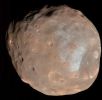
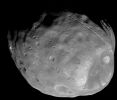
PSP_007769_9010_IRB.jpgPhobos (Natural Colors; credits: NASA)68 visiteHiRISE acquired 2 dramatic views of the Martian moon, Phobos, on 23 March 2008. Observation PSP_007769_9010, acquired at a distance of 6800 Km from Phobos, provides surface detail at 6,8 mt/pixel scale and a object diameter of about 3200 pixels.
The second observation, PSP_007769_9015, providing a closer look at 5800 Km, views the surface at slightly more detail (5,8 mt/pixel with an object diameter of about 4000 pixels).
The 2 images were taken within 10' of each other and show roughly the same features, but from a different angle so that they can be combined to yield a stereo view.
The illuminated part of Phobos visible in the images is about 21 Km across. Images from previous spacecraft have been of smaller pixel scale (for example, Mars Global Surveyor got data at 4 mt/pixel, because this spacecraft came closer to Phobos), but the HiRISE images have greater signal-to-noise, making the new data some of the best ever for Phobos.MareKromium
|
|
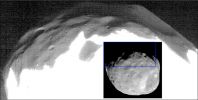
PSP_007769_9015_MarsShine.jpgIn the Mars-Shine... (credits: NASA)68 visiteThis is a close-up and enhanced part of image PSP_007769_9015. In the original image, detail in the black, un-illuminated portion is not apparent. However, seen in enhanced detail here, craters are clearly visible.
This faint illumination is from reflected light off of Mars (“Marsshine”). This is directly analogous to “Earthshine,” where reflected sunlight from our planet illuminates the dark side of the Moon.
The ability to see features on Phobos illuminated by Marsshine demonstrates the high sensitivity of the HiRISE camera.MareKromium
|
|
PSP_007769_9015_RED.jpgPhobos (RAW Frame; credits: NASA)67 visitenessun commentoMareKromium
|
|

Phobos-MEXP-2-h3868_0000_H.jpgPhobos, the "Doomed Moon", from Mars Express (MULTISPECTRUM; credits: Lunexit)66 visiteCaption ESA:"An image of Phobos by the High-Resolution Stereo Camera on board Mars Express taken on January 10, 2007.
The larger and inner of the two Martian Moons is seen here floating just above the Martian Limb. The image has been enhanced slightly to bring out the detail on the moon".
MareKromium
|
|
|
|
|
| 53 immagini su 5 pagina(e) |
 |
|
5 |
|








