| Piú viste - Phobos: the "Doomed" Moon |
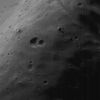
Phobos-PIA01336.jpgHigh-Resolution MOC Image of Phobos' Face74 visiteThis image of Phobos, the inner and larger of the two moons of Mars, was taken by the Mars Global Surveyor on August 19, 1998. The minimum distance between the Spacecraft and Phobos was 1080 Km (about 671 miles).
Phobos was observed by both the Mars Orbiter Camera (MOC) and Thermal Emission Spectrometer (TES). This image is one of the highest resolution images (4 meters or 13 feet per picture element or pixel) ever obtained of the Martian satellite.
The image shows several new features of this lumpy moon -- features that are associated with the prominent crater seen in the upper left quarter of the image. This is the largest crater on Phobos, Stickney, 10 Km (about 6 miles) in diameter. Individual boulders are visible on the near rim of the crater (D), and are presumed to be ejecta blocks from the impact that formed Stickney. Some of these boulders are enormous - more than 50 meters (160 feet) across.
Also crossing at and near the rim of Stickney are shallow, elongated depressions called grooves. This crater is nearly half the size of Phobos and these grooves may be fractures caused by its formation. The far wall of the crater shows lighter and darker streaks going down the slopes (C). The presence of material of different brightness on the far crater slopes and in some of the grooves shows that the satellite is heterogeneous (that is, it is made of a mixture of different types of materials). The motion of debris down slopes is guided by gravity, which is only about 1/1000th that of the Earth -- e.g., a 68-Kg (150- pound) person would weigh only about 57 gr (2 ounces) on Phobos.
Previous images from the Viking Spacecraft in the 1970's were not of sufficient resolution to show the effectiveness of gravity on Phobos in moving material down slopes.MareKromium
|
|
|
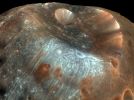
PSP_007769_9010-Stickney-0.jpgStickney Crater (Natural Colors; credits: NASA)71 visiteThe most prominent feature here is the large impact crater Stickney. With a diameter of 9 Km, it is the largest feature on Phobos. A series of grooves and crater chains is obvious on the other parts of the moon.
Although many appear radial to Stickney, previous studies show that the grooves radiate from a different point on Phobos. Hypotheses for their formation vary.
Some scientists believe the grooves and crater chains are related to the formation of Stickney, whereas others think they may have formed from ejecta from impacts on Mars that later collided with Phobos.
The lineated textures on the walls of Stickney and other large craters are landslides formed from materials falling into the crater interiors in the weak Phobos gravity (less than 1/1000th the gravity on Earth).MareKromium
|
|

PHOBOS-Image014-412-20081008-5861-6-all_row-PhobosSeries_H1.jpgPhobos' Sequence71 visitenessun commentoMareKromium
|
|
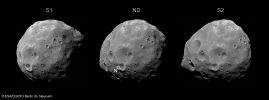
PHOBOS-Image013-411-20081008-5870-6-s12_nd-01-PhobosSeries_H1.jpgViews of Phobos71 visiteThis sequence of images was obtained by the High Resolution Stereo Camera (HRSC) on board ESA’s Mars Express on 26 July 2008 (orbit 5861), at a distance of about 2295 Km from the moon’s centre, and provides a striking impression of the encounter.
These imagee was taken using all 9 imaging channels of the camera. The resolution shown here is 92 mt/pixel for each image.
HRSC is a so-called push-broom camera, building up images in a ‘scanning’ mode while the spacecraft passes over the surface. Its nine channels, or scanning lines, are oriented in different directions that spread from 18,9° behind the nadir viewpoint (corresponding to a vertical line of sight), to 18,9° ahead of the nadir. This gives the camera its stereo-viewing capacity.MareKromium
|
|
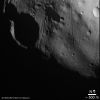
PHOBOS-Image025-417-20081008-5889-6-src-04-PhobosSeries_H1.jpgPhobos' Terminator71 visiteThis image of Phobos’s surface was obtained by the Super Resolution Channel (or SRC, a part of the High Resolution Stereo Camera experiment) on board ESA’s Mars Express on 3 August 2008 (orbit 5889).
The distance from the moon’s centre was approx. 656 Km, and the image resolution is 6 mt/pixel. The original image has been corrected for mirror distortion.MareKromium
|
|
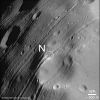
PHOBOS-Image023-417-20081008-5889-6-src-02-PhobosSeries_H1.jpgPhobos' North Polar Regions70 visiteThis image of Phobos’s surface was obtained by the Super Resolution Channel (or SRC, a part of the High Resolution Stereo Camera experiment) on board ESA’s Mars Express on 8 August 2008 (orbit 5908).
The distance from the moon’s centre was approx. 1024 Km, and the image resolution is 9 mt/pixel. The original image has been corrected for mirror distortion.MareKromium
|
|

Phobos_Deimos-PIA10117.jpgCRISM Views Phobos and Deimos69 visiteThese 2 images taken by the Compact Reconnaissance Imaging Spectrometer for Mars (CRISM) show Mars' 2 small moons, Phobos and Deimos, as seen from the MRO's low orbit around Mars. Both images were taken while the spacecraft was over Mars' night side, with the spacecraft turned off its normal nadir-viewing geometry to glimpse the moons. The image of Phobos, shown at the top, was taken at 01:19 UTC on October 23, 2007 (19:19 EDT on Oct. 22), and shows features as small as 400 mt (1320 feet) across. The image of Deimos, shown at the bottom, was taken at 20:16 UTC (00:16 EDT) on June 7, 2007, and shows features as small as 1,3 Km (0,8 miles) across.
Both CRISM images were taken in 544 colors covering 0.36-3.92 micrometers and are displayed at twice the size in the original data for viewing purposes.
Phobos and Deimos are about 21 and 12 Km (13,0 and 7,5 miles) in diameter and orbit Mars with periods of 7 hours, 39,2 minutes and 1 day, 6 hours, 17,9 minutes respectively. Because Phobos orbits Mars in a shorter time than Mars' 24 hour, 37.4-minute rotational period, to an observer on Mars' surface it would appear to rise in the West and set in the East. From Mars' surface, Phobos appears about one-third the diameter of the Moon from Earth, whereas Deimos appears as a bright star. The moons were discovered in 1877 by the astronomer Asaph Hall, and as satellites of a planet named for the Roman God of War, they were named for Greek mythological figures that personify fear and terror.
The first spacecraft measurements of Phobos and Deimos, from the Mariner 9 and Viking Orbiter spacecraft, showed that both moons have dark surfaces reflecting only 5 to 7% of the sunlight that falls on them. The first reconstruction of the moons' spectrum of reflected sunlight was a difficult compilation from 3 different instruments, and appeared to show a flat, grayish spectrum resembling carbonaceous chondrite meteorites. Carbonaceous chondrites are primitive carbon-containing materials thought to originate in the outer part of the Asteroid Belt. This led to a commonly held view among planetary scientists that Mars' moons are primitive asteroids captured into Martian orbit early in the Planet's history. More recent measurements have shown that the moons are in fact relatively red in their color, and resemble even more primitive D-type asteroids in the outer Solar System.
Those ultra-primitive bodies are also thought to contain carbon as well as water ice, but to have experienced even less geochemical processing than many carbonaceous chondrites.
The version of the CRISM images shown here were constructed by displaying 0.90, 0.70, and 0.50 micrometer wavelengths in the red, green, and blue image planes. This is a broader range of colors than is visible to the human eye, but it accentuates color differences. Both moons are shown with colors scaled in the same way.
Deimos is red-colored like most of Phobos. However, Phobos' surface contains a second material, grayer-colored ejecta from a 9-Km (5,6-mile) diameter crater.
This crater, called Stickney, is located at the upper left limb of Phobos and the grayer-colored ejecta extends toward the lower right.
These CRISM measurements are the first spectral measurements to resolve the disk of Deimos, and the first of this part of Phobos to cover the full wavelength range needed to assess the presence of iron-, water-, and carbon-containing minerals.MareKromium
|
|
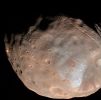
PSP_007769_9015_IRB.jpgPhobos (Natural Colors; credits: NASA)69 visitePhobos, and the second Martian moon, Deimos, are interesting for several reasons. Both objects are small, with average diameters of just 22 and 12 Km, respectively.
At this size, their gravity is insufficient (less than 1/1000th of Earth) to pull them into spherical shapes, in contrast to the larger moons and planets in the Solar System.
Both moons are tidally locked to Mars, meaning, like our own moon relative to Earth, they present the same side to Mars all the time. The small size and composition (determined from spectroscopy) of Phobos and Deimos make them very similar to some asteroids.
Most asteroids are located in a belt between Mars and Jupiter, with others having orbits that cross that of Mars. Therefore, it is possible that Phobos and Deimos are captured asteroids.
Other hypotheses are that they formed with Mars in the early Solar System, or are composed of material blasted off of Mars by impacts.MareKromium
|
|
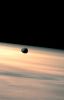
Phobos-MEXP-1-h3909_0000_H.jpgPhobos, the "Doomed Moon", from Mars Express (False Colors; credits: Lunexit)69 visiteCaption ESA:"An image of Phobos by the High-Resolution Stereo Camera on board Mars Express taken on January 22, 2007.
The larger and inner of the two Martian Moons is seen here floating just above the Martian Limb. The image has been enhanced slightly to bring out the detail on the moon".MareKromium
|
|
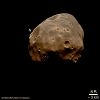
PHOBOS-Image031-420-20081008-6042-6-src-02-PhobosSeries_H1.jpgApproaching Phobos (natural colors; credits: Lunexit)69 visiteThis image of Phobos was obtained by the Super Resolution Channel (or SRC, a part of the High Resolution Stereo Camera experiment) on board ESA’s Mars Express on 15 September 2008 (orbit 6042).
The distance from the moon’s centre was 3718 km, and the image resolution is 34 m/pixel.
The original image has been corrected for mirror distortion.
MareKromium
|
|
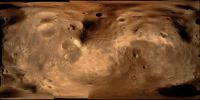
000-Phobos-Global_Map-ESA.jpgPhobos: Global Map (False Colors)69 visiteCaption ESA:"This mosaic image is composed by 53 pictures obtained by the Super Resolution Channel (or SRC, a part of the High Resolution Stereo Camera experiment) on board ESA’s Mars Express.
The SRC images covered 70% of the moon's surface. The remaining area is filled with 16 images previously obtained by NASA’s Viking mission.
The mean resolution is 12 mt/pixel". MareKromium
|
|
| 53 immagini su 5 pagina(e) |
 |
|
4 |
|








