| Piú viste - Phobos: the "Doomed" Moon |

z-Phobos-20130301_gusev2_f840.jpgPhobos' shadow over Gusev Crater102 visitenessun commentoMareKromium
|
|

w-Phobos_shadow-233-150206-2345-4-nd-01-PhobosShadow.JPGPhobos' shadow100 visitenessun commentoMareKromium
|
|

w-Phobos_Shadow_-_1.jpgPhobos' penumbral shadow99 visitenessun commentoMareKromium
|
|

w-Phobos_shadow-7507188_Mariner_9.jpgWhat a shadow!96 visitenessun commentoMareKromium
|
|

x-Viking_Orbiter_1_Phobos_shadow_p101a_(1).jpgPhobos' shadow from Viking Orbiter 195 visiteTutte ombre "molto" simili (ellissoidi), eppure tutte molto diverse. Certo, le variabili in gioco sono tante, a cominciare dalla qualità intrinseca dei frame, però...MareKromium
|
|

w-Phobos_Shadow_-_2.JPGPhobos' shadow...again!94 visitenessun commentoMareKromium
|
|

PHOBOS-Image000-409-20081008-5870-6-nd3-02-PhobosSeries_H1.jpgGeometry of the Phobos fly-by87 visitenessun commentoMareKromium
|
|
|
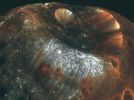
PSP_007769_9010-Stickney-1.jpgStickney Crater (Natural Colors + MULTISPECTRUM; credits: NASA & Lunexit)76 visitenessun commentoMareKromium
|
|
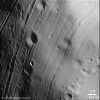
PHOBOS-Image024-417-20081008-5889-6-src-03-PhobosSeries_H1.jpgThe Surface of Phobos: the "Striations"76 visiteThis image of Phobos’s surface was obtained by the Super Resolution Channel (or SRC, a part of the High Resolution Stereo Camera experiment) on board ESA’s Mars Express on 3 August 2008 (orbit 5889).
The distance from the moon’s centre was approx. 656 Km, and the image resolution is 6 mt/pixel. The original image has been corrected for mirror distortion.MareKromium
|
|

PHOBOS-Image002-415-20081008-5861-6-src-01-PhobosSeries_H1.jpgPhobos: close-up, from Mars Express75 visiteThis striking close-up image of Phobos was obtained by the Super Resolution Channel (or SRC, a part of the High Resolution Stereo Camera experiment) on board ESA’s Mars Express on 26 July 2008 (orbit 5861). The distance from the moon’s centre was 2295 Km, and the image resolution is 20 mt/pixel.
The Super Resolution Channel (SRC), is an additional camera sharing HRSC’s processing electronics. Unlike HRSC, SRC is a framing camera, taking a complete image during a single exposure like a conventional pocket camera. Its 975 mm Maksutov-Cassegrain telescope gives it a pixel-resolution about four times higher than that of HRSC.
Early in the mission, the thermal conditions of the instrument in space caused a distortion in its precision optics. This resulted in a performance lower than expected, with some blur and ghosting visible in the raw images.
However, a significant part of the degradation has now been compensated for by analysing the effect of the distortion on test images (with point-like stars as target) and applying a corrective processing.MareKromium
|
|
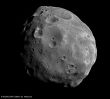
PHOBOS-Image001-409-20081008-5870-6-nd3-02-PhobosSeries_H1.jpgPhobos, from Mars Express74 visiteThis image was obtained by the High Resolution Stereo Camera (HRSC) on board ESA’s Mars Express on 28 July 2008 (orbit 5870), at a distance of 351 Km from the moon’s centre. The image was taken using the camera’s nadir channel, at a resolution of 14 mt/pixel.
The origin of Phobos is debated. While its density, lower than the density of the Martian Surface rocks, make it appear to belong to "D-Class" Asteroids, the moon appears to share many surface characteristics with the class of carbonaceous "C-Type" asteroids, which suggests it might have been captured from this population.
However, it is difficult to explain either the capture mechanism or the following evolution of its orbit into the Equatorial Plane of Mars.
An alternative hypothesis is that it formed in its present position, and is therefore a remnant from the planetary formation period.MareKromium
|
|
| 53 immagini su 5 pagina(e) |
 |
3 | |
|








