| Piú viste - 433-Eros: Pictures, Facts and Legends |

N-M0132559028F4-3d-2.jpgRocky Outcrop on 433-Eros (3D - credits: Dr G. Barca - Lunexit Team)57 visitenessun commentoMareKromium
|
|

N-M0134030614F4-d3-2.jpgRocky Outcrop on 433-Eros (3D - credits: Dr G. Barca - Lunexit Team)57 visitenessun commentoMareKromium
|
|
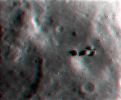
N-M0137673879F4-3d-2.jpgRocky Outcrop on 433-Eros (3D - credits: Dr G. Barca - Lunexit Team)57 visitenessun commentoMareKromium
|
|

N-M0137673654F4.pngRocky Outcrop on 433-Eros (3D - credits: Dr G. Barca - Lunexit Team)57 visitenessun commentoMareKromium
|
|

Q-Closure-433Eros-MF-HD3D.jpgRocky Outcrop on 433-Eros (High-Def3D - credits: Dr Marco Faccin - Lunexit Team)57 visitenessun commentoMareKromium
|
|

19981105.jpgThe "First Image" of Eros56 visiteThis first image of the Asteroid 433 Eros was acquired by the Multispectral Imager on the Near Earth Asteroid Rendezvous (NEAR) Spacecraft on November 5, 1998, at a distance of 2,5 MMS (about 4 MKM) from the Asteroid.
Eros, located at the center of the image and circled, appears against the star background in a single illuminated pixel.
At the time of the image, NEAR was located 200 MMs (about 321 MKM) from Earth, and the radio signal which transmitted the image from the Spacecraft, took nearly 18 minutes to reach Earth.
The image is a part of a 5,3-hour sequence of images that show Eros over one full rotation.
Repeated imaging of Eros through January, 1999, were used to refine knowledge of NEAR's trajectory relative to the Asteroid and to plan firings of the Spacecraft's engines to slow the craft and place it into orbit.
At the time, NEAR was approaching Eros at a rate of 2100 mph (945 meters per second). Three firings of NEAR's engines, which begun on December 20, 1998, slew the Spacecraft velocity relative to the Asteroid to approx. 10 miles per hour (such as 5 meters per second), until the orbit insertion, which occurred on January 10, 1999.MareKromium
|
|

20000307.jpgLooking at "The Saddle" (natural colors; credits: Lunexit)56 visiteThis image of the interior of Eros' "Saddle Area", taken at a range of 204 Km (about 127 miles), displays a paucity of craters compared to the surface on the right hand side of the image. The Saddle displays many interesting structural features. Visible on the left wall are a series of closely spaced grooves that follow the terrain downslope. Opposite, on the upper right wall, trending towards the back of the saddle is a prominent ridge. Boulders are visible throughout this image.
Features as small as 20 meters (65 feet) are discernable.
(Image 0127521108)MareKromium
|
|

20000320.jpgThe North Polar Region of 433-Eros (natural colors; credits: Lunexit)56 visiteOn March 11, 2000, this image of Eros' North Polar Region was acquired by the imager on the NEAR Shoemaker Spacecraft, from a range of 206 Km (127 miles).
The area shown in the image is 10 Km (6,2 miles) across. Most of the North Polar Region is heavily cratered but the region to the left (part of the "Saddle") has a lower crater density, indicating that the surface has been modified since it first formed.
Eros' rotational axis lies nearly parallel to its orbital plane, much as with the planet Uranus, giving the asteroid exaggerated "seasons".
Now, it is Northern Summer and the North Pole is in continuous sunlight. The Sun will set there this June, at Eros' equivalent of Earth's Autumnal Equinox. At that time, Eros' South Pole will begin 12 months of continuous illumination while the North Pole shall remain in darkness.
(Image 0128166012)MareKromium
|
|

20000411.jpgEros' North Polar Region (natural colors; credits: Lunexit)56 visiteFor much of the past five weeks, imaging activities on the NEAR Shoemaker Spacecraft have focused on the high Northern Latitudes of Eros.
The point at which the Sun is directly overhead - known as the "subsolar point" - has been steadily moving from Eros' Northern Regions toward the Equator as the Asteroid's seasons progress.
As this happens, the Northern Hemisphere is illuminated less and less, and previously dark Southern Latitudes progressively come into view.
In this image, taken March 19, 2000, from a range of 205 Km (approx. 127 miles), the asteroid's North Pole is in the upper right of the frame. The whole scene is 7,4 Km (4,6 miles) across.
(Image 0128883708)MareKromium
|
|

20010206full.jpgBoulders, Outcrops and the "Skyline" of 433-Eros56 visiteUn frame - semplicemente - bellissimo, ad elevata risoluzione (osservate i macigni che si trovano a ridosso dell'orizzonte e del Terminatore se volete apprezzare pienamente la qualità - ALTA! - del frame).MareKromium
|
|

N-M0133107786F4.pngRocky Outcrop on 433-Eros (3D - credits: Dr G. Barca - Lunexit Team)56 visitenessun commentoMareKromium
|
|

N-M0141908526F4.pngRocky Outcrop on 433-Eros (3D - credits: Dr G. Barca - Lunexit Team)56 visitenessun commentoMareKromium
|
|
| 45 immagini su 4 pagina(e) |
 |
3 |
|





