| Piú viste - 433-Eros: Pictures, Facts and Legends |

20000322.jpg433-Eros in HR (True Colors; credits: NASA)62 visiteAs the NEAR Shoemaker spacecraft descends into lower orbits around Eros, it continually returns higher spatial resolution images of the asteroid. The true color image at left was taken February 12, 2000, from a range of 1748 Km (about 1083 miles), and shows details only as small as 180 meters (590 feet) across.
It was taken two days before orbit insertion, as part of an image sequence designed to provide moderate-resolution color mapping of Eros at a near-constant viewing geometry.
The true color image inset at right was taken February 29 from a range of 283 Km (about 175 miles) and shows much smaller details only 27 meters (89 feet) across.
The higher spatial resolution (by a factor of 6) brings out a whole class of surface details that were either invisible or at the margin of visibility in the earlier images. For example, the bright material on the wall of the large crater in the inset image is barely evident in the lower-resolution image at left, but by virtue of its limited spatial coverage the inset image lacks information on the crater's regional geologic setting. NEAR Shoemaker's imaging strategy makes use of both types of images, with lower-resolution images providing "context" for higher-resolution images that bring specific features into sharper focus.
(Product of images 0125748893, 0125748895, 0125748897, 0127229466, 0127229468, 0127229470)
MareKromium
|
|

20000217c.jpg433-Eros From orbit: the Giant Gouge (natural colors; credits: Lunexit)60 visiteThis picture was taken from NEAR on February 15, 2000, while the Spacecraft was passing directly over the large gouge that creates Eros's characteristic peanut shape.
It is a mosaic of individual images showing features as small as 120 feet (35 meters) across. Although most of the asteroid is in shadow, we are able to see inside the gouge. Many narrow parallel troughs closely follow the shape of the gouge. Although they appear curvilinear from this view, they are most likely oriented parallel to the length of the asteroid.
The strong lighting contrast along the terminator (the line separating day from night on Eros) makes it easy to see that most of the surface is saturated with impact craters. Inside the gouge, however, only smaller craters are present, indicating that the area within the gouge is younger than the surface along the terminator.
This implies that the event that caused the gouge must have happened more recently than the formation of the rest of the surface of Eros.
(Mosaic of images 0126023473, 0126023535, 0126023721, 0126023783, 0126023845, 0126023907, 0126024093, 0126024155)MareKromium
|
|

20000217b.jpgOver Eros' horizon (natural colors; credits: Lunexit)60 visiteThis incredible picture of Eros, taken on February 14, 2000, shows the view looking from one end of the asteroid across the gouge on its underside and toward the opposite end. In this mosaic, constructed from two images taken after the NEAR Spacecraft was inserted into orbit, features as small as 120 feet (35 meters) across can be seen.
House-sized boulders are present in several places; one lies on the edge of the giant crater separating the two ends of the asteroid. A bright patch is visible on the asteroid in the top left-hand part of this image, and shallow troughs can be see just below this patch.
The troughs run parallel to the asteroid's long dimension.
(Mosaic of images 0125971425, 0125971487)MareKromium
|
|

20000405.jpgOld Craters (natural colors; credits: Lunexit)59 visiteEros' many craters have a range of ages dating back to the last time the asteroid's surface was "wiped clean" by geologic processes. This NEAR Shoemaker image of the tip of the asteroid, taken March 6, 2000, from a range of 201 Km (about 125 miles), shows craters with a variety of shapes and sizes.
When small craters first form, they typically have sharp rims and round floors. As they age, progressively smaller craters are superimposed, rounding the rims and pitting the walls and floors until the original underlying crater becomes almost unrecognizable.
(Image 0127738155)MareKromium
|
|

20000410.jpgDifferent Lights, Different Visions59 visiteDuring the 28 days the NEAR Shoemaker Spacecraft circled Eros in a 200-Km (such as approx. 124-mile) altitude orbit, it imaged parts of the surface under a variety of lighting and viewing conditions.
The different views of the surface allow study of small-scale morphology, analysis of albedo and color variations, and construction of topographic models from stereo images.
This image, taken April 2, 2000, from a range of 199 Km (about 123 miles), shows the effects of lighting changes. At the bottom of the frame, sunlight illuminates the surface at a grazing angle. The strong shadows bring out subtle landforms like the gentle undulations in the surface, visible at the lower center.
At the top of the frame, sunlight strikes the surface at a high angle and shadows become subdued, bringing out brightness variations like those on the wall of the large, 5,5-Km (3,4-mile) diameter crater at left.
(Image 0130112939)MareKromium
|
|

20000608.jpgThe "Saddle" (Extremely Saturated True Colors; credits: Lunar Explorer Italia)59 visitenessun commentoMareKromium
|
|

19990108.jpg433-Eros58 visiteThis pair of images of the Asteroid 433-Eros was acquired by the Near Earth Asteroid Rendezvous (NEAR) Spacecraft on December 23, 1998, as the Spacecraft flew by the night side of the Asteroid at a distance of about 2300 miles (approx. 3800 Km) at 13:43 EST. These views, taken at 13:44 and 14:05 EST, as the Spacecraft range increased from 2300 miles to 2500 miles (about 4100 Km), show only a tiny portion of the day side of Eros (Phase Angle ~119°).
The smallest resolved detail in this frame is approximately 1300 feet (400 meters) across. MareKromium
|
|

20010119.jpgBright Crater Wall (natural colors; credits: Lunexit)58 visiteNEAR Shoemaker captured this image on January 11, 2001, while orbiting about 38 Km (approx. 24 miles) above Eros.
Material on the inner wall of the crater in the center of the image is brighter than the surrounding regolith and is thought to be subsurface material exposed when overlying, darker regolith slides off.
The whole scene is about 1,2 Km (such approx. 0,7 miles) across.MareKromium
|
|
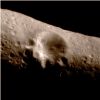
20000306.jpgLarge Crater (natural colors; credits: Lunexit)57 visiteThis image mosaic of the "Large Crater" at Eros' center was taken on March 3, 2000, during an optical navigation imaging sequence from a range of 127 miles (about 204 Km). This same area was imaged following orbit insertion at a range of approx. 210 miles (about 330 Km) on February 14th (Feb 14 G).
This picture resolves features as small as 65 feet (20 meters) across compared to the resolution of 100 feet (30 meters) in the earlier image. The shadow cast by the boulder near the floor of the crater is now visible. The walls of the crater display some distinctive variations in their albedo or reflectivity. The upper part of the walls tend to be bright, while the lower portions of the walls and the crater floor show patches of darker or less reflective materials. These albedo patterns are also visible on other crater walls. To the right of the large crater, two sets of closely spaced orthogonal grooves are visible.
(Mosaic of images 0127531846, 0127531908, 0127532094, 0127532156)MareKromium
|
|

20000428.jpgGroovy!... (natural colors; credits: Lunexit)57 visiteNEAR Shoemaker returns images that reveal not only what makes Eros distinctive, but also what it shares with other asteroids. This image, taken April 8, 2000, from an orbital height of 210 Km (about 131 miles), shows several of the linear troughs or "grooves" that mark the Asteroid's surface.
The largest one in this image, just to the right of the shadowed crater in the lower central part of the frame, is nearly 200 meters (656 feet) across. Grooves are also found on other asteroids and small asteroid-like moons, especially the Martian moon Phobos. They are thought to form when regolith - the loose surface material thrown out of impact craters - drains into subsurface cracks.
(Image 0130614349)MareKromium
|
|

Postcard_from_433-Eros-EB.jpgRocky Outcrop on 433-Eros (Image-Mosaic - credits: Elisabetta Bonora - Lunexit Team)57 visitenessun commentoMareKromium
|
|

N-M0137674104f4_2p_cif_dbl.jpgThe way they come...57 visiteSu richiesta dell'Amico François ("Gurosao"), ecco - da parte del nostro Marco Faccin (Titanio44) - un esempio di come appaiono i frames NEAR all'atto dello scaricamento.
Onestamente, non si percepiscono - rectius: noi/io non vediamo/vedo - distorsioni su alcuno degli assi. MareKromium
|
|
| 45 immagini su 4 pagina(e) |
2 |  |
|





