| Piú viste - Mars, Deimos and Phobos: Maps |

MARS-001.jpgMars from Hubble Space Telescope64 visiteThe Hubble Space Telescope has taken lovely images of Mars, which complement the MOC Atlas Mercator Projection. This image montage is from Mars' 1999 oppoxition.MareKromium
|
|
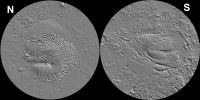
021-Mars_Poles.jpgThe Poles of Mars64 visiteThe Mercator Projection distorts Polar Regions beyond recognition, so Polar Projection Maps are commonly made separately. These MOLA shaded topography images of Mars's North and South Polar Regions are stereographic projections, from Latitudes 72° N and S towards the respective Poles. The line of 0° Longitude is to the bottom of the North Pole images, and toward the top of the South Pole image.
Both Poles are covered by layered ice caps with smooth undulating surfaces. The North Polar Cap sits of a flat plain, while the South Polar Cap sits on heavily cratered land.MareKromium
|
|

019-North_Pole.jpgThe North Pole of Mars (Mercator Projection - credits: NASA/MOLA)64 visitenessun commentoMareKromium
|
|
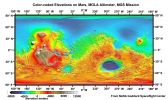
014-Mars_Altitudes.jpgMars "Ups and Downs"...64 visiteThe MOLA Laser Altimeter produced detailed topographic maps and profiles of Mars, and really revolutionized our understanding of Mars.
So much from elevation alone!
These maps show the MOLA altitude data coded into colors - blue is low and red/white are high.MareKromium
|
|

015-Mars_Altitudes.jpgMars "Ups and Downs"... (shaded version)64 visiteHere, the MOLA Altimetry is cast as a 3-D model, a shaded relief map illuminated from the upper right.
BEWARE: this lighting can not ever happen on Mars!
The large volcanos stand out beautifully, as do the impact basins of Hellas and Argyre. Also clear here is how flat the Northern Plains really are (remnants of an ocean basin?), the incredible number of craters on the Highlands, and the distinct difference in elelvations between the Highlands and the Lowlands.MareKromium
|
|
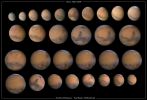
MARS-002.jpgMars in Time64 visiteCaption NASA, da "NASA - Picture of the Day" del 14 Luglio 2008:"Does Mars always appear the same? No.
As both Earth and Mars orbit the Sun, the apparent angular size of Mars changes as viewed from the Earth. Pictured above from Enschede, Holland, Mars was captured in 2007 and 2008 with 30 separate images, all taken with the same magnification.
When Earth and Mars are on opposite sides of the Sun, Mars appears relatively small. Conversely, when Earth and Mars are near each other, Mars looms large and bright. The largest Mars has appeared in recent history was the opposition of August 2003.
Since Mars is always more distant from the Earth from the Sun, Mars never shows a crescent phase to Earthlings. Visible also in the above images are the North Polar Cap of Mars, dark and light soil, clouds, and, in the early images, a Global Dust Storm.
The next opposition, when Earth again passes near to Mars, will occur in early 2010".MareKromium
|
|
|
|
| 54 immagini su 5 pagina(e) |
 |
|
5 |
|








