| Piú viste - Mars, Deimos and Phobos: Maps |

025-Mars_Global_with_Nomenclature.jpgMars Map for Beginners66 visiteUna Mappa semplice ed immediata non guasta mai...MareKromium
|
|
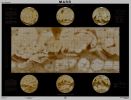
026-Mars_Advanced_Map.jpgAdvanced Mars Global Map66 visitePublisher: Aeronautical Chart and Information Center
Scale: 1:35.000.000
Projection: Mercator MareKromium
|
|

031-Mars-18-PIA09226_fig1.jpgThe "Upper Surface" of the Icy Layers Covering Mars' South Polar Region (Map 3)65 visiteThis map shows the topography of the South Polar Region of Mars. The data were collected by the Mars Orbiter Laser Altimeter aboard NASA's Mars Global Surveyor orbiter between 1997 and 2001. The elevation of the terrain is shown by colors, with purple and blue representing the lowest areas, and orange and red the highest. The total range of elevation shown is about 5 Km. The black line shows the boundary of the South Polar Layered Deposits, an ice-rich geologic unit that was probed by the Mars Advanced Radar for Subsurface and Ionospheric Sounding (MARSIS) aboard the European Space Agency's Mars Express orbiter.
The radar data indicate that the deposit is more than 3,7 Km (about 2,3 miles) thick in places, and that the material consists of nearly pure water ice, with only a small component of dust. The MARSIS team also determined that the total volume of ice in the layered deposits is equivalent to a water layer 11 mt (36 feet) deep, if spread evenly across the Planet. The boundary of the Layered Deposits was mapped by scientists from the U.S. Geological Survey. The dark circle in the upper center is the area poleward of 87° South Latitude, where MARSIS data cannot be collected.
The image covers an area of 1670 by 1800 Km (about 1035 by 1115 miles).
|
|
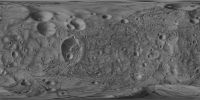
Phobos_Map.jpgPhobos (credits: NASA - USGS)65 visitenessun commentoMareKromium
|
|
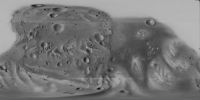
O-Deimos_Map.jpgDeimos (credits: NASA - USGS)65 visitenessun commentoMareKromium
|
|

020-Mars_South_Pole.jpgThe South Pole of Mars (Mercator Projection - credits: NASA/MOLA)65 visitenessun commentoMareKromium
|
|

013-Mars_Visual_Albedo_.jpgMars Visual Albedo through a RED Filter65 visiteThis image of Mars is from the Mars Orbiter Camera (MOC) on the Mars Global Surveyor (MGS) Spacecraft.
The image means the "Visual Brighness" of Mars, meaning how Mars would appear to the human eye through a red filter.
The mosaic is from a short time in 1999, when there was a significant dust storm in Hellas Basin (brigh spot on right side near bottom).
There is no data from the South Pole, because it was in total darkness at the time - and Mars' North Pole was pointed towards the Sun.MareKromium
|
|

001-Mars.jpgMars, according to Schiaparelli65 visiteDal nostro Amico Roberto Tremolada, una bellissima (e "datata"!) Mappa del Pianeta Rosso realizzata dal Grande Schiaparelli.
E quindi, se volete VEDERE e SAPERE di più, Vi invitiamo a consultare la Sezione a Lui dedicata - ed intitolata "Per Ricordare" - dal bellissimo Sito Lunar Explorer Italia (Sez. Liguria e Piemonte), curato dal nostro Grandissimo Amico e Collega, il Dr Gianluigi Barca.
Vi basterà andare su http://www.lunarexplorer.it/, Sez. "Storia", sub-Sezione "Per Ricordare" e poi...Buona Lettura!MareKromium
|
|

027-Mars_Super_Advanced_Map.jpgExtremely Advanced Mars Geologic Global Map65 visitePublisher: U.S. Geological Survey
Scale: 1:25.000.000
Projection: Mercator
MareKromium
|
|

017-Mars_Crustal_Magnetism.jpgMars Crustal Magnetism64 visiteThe Mars Global Surveyor spacecraft carried a Magnetometer, the MAG/ER.
During MGS's aerobraking procedure, the MAG/ER found that Mars does not have a global Magnetic Field like the Earth does, but large areas are strongly magnetic.
There are few good ideas of what this magnetism means, although plate tectonic processes do not seem likely. The area of Magnetic Anomalies seems to make a girdle around Mars, and this is (at least partly) because that's where MGS's orbit took it closest to Mars during aerobraking.MareKromium
|
|

018-Mars_Magnetic_Anomalies.jpgThe Magnetic Anomalies of Mars64 visiteThe Magnetic Anomalies found by the MAG/ER experiment on the Mars Global Surveyor spacecraft are inconveniently bisected by the 180° Longitude line, and so appear at both ends of the standard Mars Mercator Projection.
Here, the MAG/ER team have made hemispheric projections centered on the area of strongest anomalies.
The 3 hemispheres show the 3 components of the Magnetic Field: B(r) is the Radial Field, which is perpendicular to Mars' Surface; B(Θ) is the Polar Field, oriented along lines of Longitude; and B(Φ) is the Circumferential Field, oriented along lines of Latitude. MareKromium
|
|

016-Mars_Altitudes.jpgMars "Ups and Downs"...64 visiteTo complement the MOLA Laser Altimeter Mercator maps of Mars' elevations and topography, the MOLA Team also produced views of selected hemispheres.
These views emphasize specific interesting areas or angles. These maps show altitude data coded into colors - blue is low and red/white are high.
These two hemispheres are centered on the Tharsis Plateau (including the Valles Marineris and the large volcanos) and on the Isidis Impact Basin (with the Hellas Basin to the South).MareKromium
|
|
| 54 immagini su 5 pagina(e) |
 |
|
4 |
|








