| Piú viste - Mars, Deimos and Phobos: Maps |

012-Thermal_Inertia.jpgMars Global Map: Thermal Inertia109 visitenessun commento
|
|

009-Mars_North_East.jpgThe North-Eastern Region of Mars109 visitenessun commento
|
|

005-Surface_Ages.jpgMars Global Map: Age of Main Surface Features107 visitenessun commento
|
|
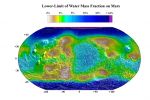
023-Mars_Water-3.jpgMap of Water on Mars105 visiteI raggi cosmici, dopo aver aver raggiunto il Pianeta, interagiscono rapidamente con gli elementi presenti negli strati superficiali del suolo Marziano. Da questo impatto e dalle conseguenti reazioni, scaturisce una (+ o - elevata) dispersione di neutroni. Sapendo che, per quanto maggiore è il quantitativo di H presente in detti strati, tanto minore è la dispersione di neutroni, misurando il loro > o < assorbimento, misuriamo anche il > o < quantitativo di H presente in essi.Sapendo che la forma più probabile in cui si può trovare H in prossimità della superficie di Marte è quella che lo vede aggregato all’O2, deduciamo che, laddove viene rilevata una maggiore presenza di H è altrettanto probabile che vi sia anche una maggiore presenza di H2O.
|
|
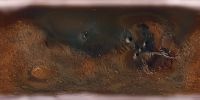
028-Mars_Colors-MF-LXTT2.jpgFull Map of Mars (Approximate Natural Colors; credits: Dr Marco Faccin - Lunexit Team)96 visite...E anche questa è ARTE...MareKromium
|
|

034-Methane_of_Mars.jpgMap of the "Martian Methane"84 visiteCaption NASA:"Why is there Methane on Mars? No one is sure.
An important confirmation that Methane exists in the Atmosphere of Mars occurred last week, bolstering previous controversial claims made as early as 2003. The confirmation was made spectroscopically using large ground-based telescopes by finding precise colors absorbed on Mars that match those absorbed by Methane on Earth.
Given that Methane is destroyed in the open martian air in a matter of years, the present existence of the fragile gas indicates that it is currently being released, somehow, from the Surface of Mars.
One prospect is that microbes living underground are creating it, or created in the past. If true, this opens the exciting possibility that life might be present under the Surface of Mars even today. Given the present data, however, it is also possible that a purely geologic process, potentially involving volcanism or rust and not involving any life forms, is the Methane creator.
Pictured above is an image of Mars superposed with a map of the recent Methane detection".
Nota Lunexit: se la Mappa NASA è realmente accurata ed il quantitativo di Metano presente in Atmosfera è quello "suggerito" dalla Mappa stessa, allora - sempre seguendo la "Logica NASA" - ci troveremmo davanti a due possibili scenari:
1) Scenario Geologico (Metano come prodotto di processi geologici): Marte è ancora soggetto attivo di fenomeni vulcanici tutt'altro che minori e residuali, visti i quantitativi e la distribuzione del Metano nell'Atmosfera del Pianeta Rosso, oppure
2) Scenario Biologico (Metano come sottoprodotto di attività biologiche attuali): Marte è, letteralmente, "brulicante di Vita" - altro che batteri e micro-organismi - visti, come sopra, i quantitativi e la distribuzione del Metano nell'Atmosfera del Pianeta Rosso.
SOTTOLINEIAMO che queste nostre congetture DERIVANO LOGICAMENTE DALL'ANALISI DEI DATI NASA e NON da nostre speculazioni!
Vi suggeriamo, inoltre, di notare la posizione dei maggiori quantitativi di Metano nell'Atmosfera Marziana...MareKromium
|
|

024-Iani_Chaos_and_Ares_Valles.jpgMargaritifer Terra78 visiteCaption ESA originale:"This map shows that the Iani Chaos depression – 180 Km long and 200 Km wide – is connected to the beginning of Ares Vallis by a 100-Km wide Transition Zone, centred around 342,5º East and 3º North".
|
|
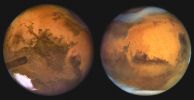
MARS-000.jpgMars: the Orange, Greenish, Bluish, Gray and White Planet (True Colors; credits: NASA)76 visitenessun commentoMareKromium
|
|

030-Mars-17-PIA09225_fig1.jpgThe "Lower Boundary" of the Icy Layers Covering Mars' South Polar Region (Map 2)71 visiteThis map shows the topography of the South Polar Region of Mars, including topography buried by thick deposits of icy material. The map is a combination of surface elevation data acquired by the Mars Orbiter Laser Altimeter aboard NASA's Mars Global Surveyor orbiter, and subsurface elevation data acquired by the Mars Advanced Radar for Subsurface and Ionospheric Sounding (MARSIS) aboard the European Space Agency's Mars Express orbiter.
The black line shows the boundary of the South Polar Layered Deposits, an ice-rich geologic unit that was probed by MARSIS. Elevation values within the black outline, as measured by MARSIS, show the topography at the boundary between the layered deposits and the underlying material, an interface known as the "bed" of the deposits. The elevation of the terrain is shown by colors, with purple and blue representing the lowest areas, and orange and red the highest. The total range of elevation shown is about 5 Km.
The radar data reveal previously undetected features of topography of the bed, including depressions as deep as 1 Km (0,6 miles) shown in purple in the near-polar region.
The boundary of the layered deposits was mapped by scientists from the U.S. Geological Survey. The dark circle in the upper center is the area poleward of 87° South Latitude, where MARSIS data cannot be collected.
The map covers an area of 1670 by 1800 Km (about 1035 by 1115 miles).
|
|

022-Mars_Water-1.jpgWhere is the "Water" of Mars? (Polar Regions)67 visiteWater abundances in the Martian Polar Regions, from the Neutron Spectrometer on Mars Odyssey, are shown here to complement the Mercator Projections of Equatorial Regions.
The North Pole is nearly pure water ice, while the South Pole is water iced mixed with other stuff, most likely dry ice (CO2) and mineral dust.
More details are available in the Los Alamos National Lab press release.MareKromium
|
|
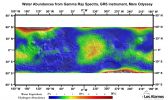
023-Mars_Water-2.jpgWhere is the "Water" of Mars? (Equatorial and Middle Latitude Regions)67 visiteA Neutron Spectrometer on the Mars Odyssey Spacecraft measures the abundances of neutrons of various energies emitted from Mars' Surface.
The ratio of low- to high-energy neutrons is a sensitive test of water abundances within a meter of Mars' surface.
There is LOTS of water. No one had expected any where near this much water near the Martian Surface.
All this is BETTER described in a press release from the Los Alamos National Laboratory, home of the Neutron Spectrometer and the scientists who run it (http://www.lanl.gov/news/releases/archive/03-101.shtml). MareKromium
|
|

029-Mars-16-PIA09224_fig1.jpgThe "Thickness" of Mars' South Polar Layered Deposits (Map 1)66 visiteThis map shows the thickness of the South Polar Layered Deposits of Mars, an ice-rich geologic unit that was probed by the Mars Advanced Radar for Subsurface and Ionospheric Sounding (MARSIS). The MARSIS radar is an instrument on the European Space Agency's Mars Express orbiter. The thickness of the layered deposits was determined by measuring the time delay between radar echoes from the surface and those from the lower boundary, or "bed", of the deposits.
The radar data indicate that the deposit, larger than Texas in area, is more than 3,7 Km (about 2,3 miles) thick in places, and that the material consists of nearly pure water ice with only a small component of dust.
|
|
| 54 immagini su 5 pagina(e) |
 |
3 | |
|








