| Piú viste - From Ashes to Eternity: the Phoenix Mars Mission |
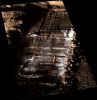
PHOE-SOL134-lg39371-39372-39373-3.jpgThe Frozen Trench: perspective view - Sol 134 (Superdefinition and possible True Colors; credits: Dr G. Barca)65 visitenessun commentoMareKromium
|
|
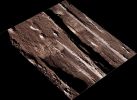
PHOE-SOL138-lg40031-40032-40033-3.jpgThe "Trenches" in Perspective - Sol 138 (Superdefinition and possible True Colors; credits: Dr G. Barca)65 visitenessun commentoMareKromium
|
|

PHOE-SOL149-lg42169-42170-42171-2.jpgThe "Trenches" - Sol 149 (Superdefinition and possible True Colors; credits: Dr G. Barca)65 visitenessun commentoMareKromium
|
|
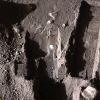
PHOE-SOL145-PIA11383.jpgThe "Trenches" - Sol 145 (False Colors; credits: NASA)65 visite...Tanto per far vedere la "differenza" fra il processing NASA e quello Lunexit...
Caption NASA:"The Surface Stereo Imager on NASA's Phoenix Mars Lander took this false color image on Oct. 21, 2008, during the 145th Martian Day, or Sol, since landing. The bluish-white areas seen in these trenches are part of an ice layer beneath the soil.
The trench on the upper left, called "Dodo-Goldilocks", is about 38 cm (15") long and 4 cm (1,5") deep.
The trench on the right, called "Upper Cupboard", is about 60 cm (24") long and 3 cm (1") deep. The trench in the lower middle is called "Stone Soup".MareKromium
|
|

PHOE-SOL142-PhoenixHolyCowMosaicAPOD.jpgHoly Cow! - Sol 142 (possible True Colors; credits: Marco Di Lorenzo and Kenneth Kremer)65 visiteDa "NASA - Picture of the Day", del giorno 12 Novembre 2008:"The Northern Martian Summer is waning. As predicted, a decline in daylight hours, deteriorating weather, and dust storms are preventing solar arrays on the Phoenix Mars Lander from providing power. Phoenix's last signal was received on November 2, its successful mission ending after more than 5 months in the Arctic Region of the Red Planet, a run that exceeded its planned operational lifetime. Attempting to discover if Mars' Surface has ever been able to support microbial life, Phoenix performed an extensive analysis of the soil and returned a wealth of image data. Of course, one of the lander's most exciting results was the detection of water-ice near the Martian Surface.
Recorded in October, this picture from the Lander's Robotic Arm Camera shows the region under the Phoenix with flat, exposed icy patches. That area caused researchers to exclaim "Holy Cow!" (in Italiano: "Caspita!") when it was first imaged a few days after the May 25 touchdown of the Phoenix Mars Lander".MareKromium
|
|
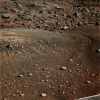
PHOE-SOL059-lg15866-15867-15868-2_copia.jpgMineral Diversity in vastitas Borealis - Sol 59 (possible True Colors; credits: Dr G. Barca)65 visiteUna "risposta Lunexit" ai panorami monocromatici di Vastitas, "made by NASA"...MareKromium
|
|
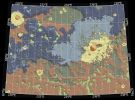
B-PIA09946-2.jpgPossible Landing Ellipses for Phoenix (2)64 visitenessun commentoMareKromium
|
|
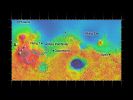
C-Phonix_Others.jpgPhoenix will not be alone on Mars...64 visitenessun commentoMareKromium
|
|

B-PIA09947.jpgContext Image of Planned Landing Site64 visiteCaption NASA:"This view covers an area about 27 Km (about 17 miles) wide within the planned landing area for NASA's Phoenix Mars Lander. It was taken by the Context Camera on NASA's Mars Reconnaissance Orbiter and catalogued as image P02_001893_2485_XI_68N126W_061221 from that instrument.
Note the crater near the top (north) of the image. The red box indicates the position of a higher-resolution image PIA09948 of ground texture in this area".MareKromium
|
|
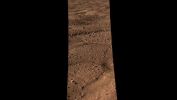
PHOE-SOL001-PIA10693.jpgMartian Surface (Approximate Colors; credits: NASA/JPL-Caltech/University of Arizona/Texas A&M )64 visitenessun commentoMareKromium
|
|

PHOE-SOL003-lg_570.jpgThe soil of Vastitas Borealis - Sol 3 (Natural Colors + MULTISPECTRUM; credits: Lunexit)64 visitenessun commentoMareKromium
|
|
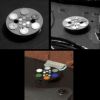
PHOE-SOL003-PIA10720.jpgPhoenix Color Targets64 visiteCaption NASA:"These images of 3 Phoenix Color Targets were taken on Soles 1 and 2 by the Surface Stereo Imager (SSI) on board the Phoenix Lander. The bottom target was imaged in approximate color (SSI's red, green, and blue filters: 600, 530, and 480 nanometers), while the others were imaged with an infrared filter (750 nanometers).
All of them will be imaged many times over the mission to monitor the color calibration of the camera. The two at the top show grains 2 to 3 millimeters in size that were likely lifted to the Phoenix deck during landing. Each of the large color chips on each target contains a strong magnet to protect the interior material from Mars' Magnetic Dust".MareKromium
|
|
| 399 immagini su 34 pagina(e) |
 |
|
|
|
|
25 | |
|
|
|
|








