| |

| Piú viste - Mars in JPEG2000 |

ESP_019589_2340-03.jpgSmall and Shallow (Secondary?) Craters in the Northern Plains (credits for the additional process.: Dr Gianluigi Barca - Lunexit Team)133 visitenessun commentoMareKromium
|
|

PSP_002047_1890-09d.jpgAnubi130 visiteUna supermagnificazione, realizzata dal Grande Dr Faccin, che vogliamo dedicare al nostro vecchio Amico e Partner, Lorenzo Leone.
All'ingresso della "galleria" che - probabilmente - conduce nelle viscere della collina erosa e stratificata che tanto ha attratto la nostra attenzione (e che, vista dall'alto, effettivamente ci può ricordare "L'Occhio di Ra"), c'è qualcosa. Qualcosa di indefinibile, certo (forse dei macigni, forse un'escrescenza rocciosa o chissà che cosa), ma che nella supermagnificazione che Vi proponiamo, può curiosamente assomigliare al volto di Anubi, il Signore delle Tombe.
Fantasia? Certo!
Ma una Fantasia innocua ed immaginifica, ispirata alle bellissime riflessioni che Lorenzo - di quando in quando - riporta sulle nostre pagine e dedicata a lui, in particolare, ma anche e a tutti quelli che non si limitano a "guardare", ma che cercano, a volte anche disperatamente, di "riuscire a vedere e capire"!MareKromium
|
|

PSP_009342_1725_RED_abrowse-1.jpgAnother "Martian Monolith"? (bird's eye view - credits: Dr M. Faccin)130 visiteSu suggerimento della nostra Amica Lettrice Elisabetta Bonora, abbiamo recuperato le immagini di un nuovo - possibile - "Enigma Marziano" (o, se vogliamo essere più tecnici, di una evidente Singolarità - possibile Anomalìa - di Superficie) e quindi, dopo aver ottenuto le migliori e le più dettagliate magnificazioni possibili (migliori, come ovvio, in rapporto ai nostri mezzi ed alle nostre capacità) del dettaglio, riteniamo che sia possibile ESCLUDERE la matrice "artificiale" del rilievo controverso.
Una premessa.
L'istinto dell'Osservatore (di QUALSIASI Osservatore!), come tutti ormai sanno perfettamente, costituisce una "guida", più o meno (in)conscia, verso quella interpretazione della realtà che più "soddisfa" e meglio "risponde", in fondo, alla Cultura, alla Sensibilità e, ovviamente, anche all'Immaginazione dell'Interprete.
Non è un caso, infatti ed a nostro modo di vedere, che una ricorrente (e possibile) Anomalìa Spaziale, alla fine, vada ad identificarsi in rilievi colonnari, pseudo colonnari e/o comunque simili ai terrestri Menhir, o Dolmen, o Monoliti, appunto.
Abbiamo Monoliti su Marte, sulla Luna (le "Cuspidi di Blair"), su Phobos, su Giapeto, forse anche su Encelado e chissà dove ancora ne troveremo.
Ma perchè sempre dei Monoliti? Forse perchè sono strutture rappresentative di un "qualcosa" di importante nell'Immaginario Collettivo Terrestre? O forse perchè siamo rimasti tutti un pò colpiti dall'immortale Monolito del film "2001 - A Space Odyssey"?
O forse perchè il Monolito, con la sua geometria essenziale ma imponente, costituisce - ad occhi e per occhi umani - un'adeguata rappresentazione di qualcosa di trascendente, di concettualmente elevato, forse addirittura di mistico, sino al punto di apparire come un Elemento Prossimo e/o Tendente a Dio e quindi - ed ovviamente a questo punto - un qualcosa di "artificiale"?
Andiamo a vedere bene l'immagine e, soprattutto, caliamo la possibile Anomalìa nel suo contesto.
Questo Metodo/Processo (la Contestualizzazione, appunto), sebbene possa apparire "dissacrante" - e forse può anche esserlo, in un certo senso - dobbiamo SEMPRE adottarlo poichè esso - a nostro parere - è l'UNICO METODO per non lasciarsi ingannare da fattezze le quali, in fondo, proprio perchè "lontane e suggestive", rischiano di confondere gli occhi e la mente di chi le osserva e le studia.
Andiamo quindi a guardare (ed a "vedere") meglio il tutto, calando il panorama nelle sue fattezze reali ed il nostro "Monolito" nel suo ambiente naturale...MareKromium
|
|

PSP_004026_1765-5-GB-PCF-LXTT.jpgVery strange "Dark Spot" in Aureum Chaos (RAW Natural Colors; credits for the addituional process. and color.: Drr Gianluigi Barca and Paolo C. Fienga - Lunexit Team)129 visitenessun commentoMareKromium
|
|

PSP_004026_1765-2-GB-PCF-LXTT.jpgVery strange "Dark Spot" in Aureum Chaos (Original JP2 b/w; credits for the addituional process.: Dr Gianluigi Barca - Lunexit Team)129 visitenessun commentoMareKromium
|
|

ESP_023024_1010-GB-PCF-LXTT-IPF-Possible_Paleo-Lake-02.jpgPossible Paleo-Lake near the South Pole of Mars (an Image-Mosaic in Absolute Natural Colors; credits for the Research, additional process. and color.: Drr Gianluigi Barca and Paolo C. Fienga/Lunar Explorer Italia/Italian Planetary Foundation)129 visiteIn this image-mosaic showing the "Smooth South Polar Region", as NASA defined this Surface Feature, we wish to draw to your attention the extremely linear and, in a way, unusually-looking Chain of "oblong-shaped" Impact Craters that can easily be seen on the East Side (better yet: East Wall) of the Feature, from its upper right (Dx) corner and then down, for about 1/4 (one fourth) of its full length. This Chain of Craters litterally "follows" the Eastern Margin of the Lake-like Feature, then it suddenly stops (or, perhaps, quite a few of the Craters forming the Chain were simply "erased" by the occurrence of some Geological and/or Atmospherical - or both, probably - Events, still unknown at this point), and then it starts again, still remaining sharp and linear, but with a lesser Craters' Density.
Furthermore, on the left (Sx) side of the Craters forming the Chain, the Surface appears to be characterized by the presence of Gullies (---> remember that a so-called "Gully" is a landform created by running water, eroding sharply into the Soil. Gullies may resemble to large ditches or small valleys, but they can be a few meters, to tens of meters, deep and wide. When the Gully Formation is in process, the Water Flow Rate can be substantial, and this fact causes a significant deep cutting action into the Soil). So, one - perhaps remote, but, in any case, extremely intriguing - possibility, is that the Chain of Craters (or whatever those "oblong-shaped holes in the ground" may be) was the actual "passageway" through which a more than significant amount of running water once flew and, in the end (an end that occurred, very likely, in a distant past), filled up the whole Surface Depression and formed a true South Polar Lake. Then the water froze, and the Surface of this Martian Lake got slowly covered by Dust and Ashes but, in any case, it remained very smooth, like the still waters that once must have been there and that, in our opinion, froze very quickly.
All that said, we humbly believe, as IPF, that this whole Surface Feature has too quickly (and superficially) been called "Smooth South Polar Region", and then (at least as far as we know) forgotten by the many Spacecrafts that we still have orbiting around the Red Planet. In other words, if we had the chance, we would strongly suggest NASA (and ESA) to send the Mars Reconnaissance Orbiter and the Mars Express Spacecraft over this Region, and then take a new and better look at was lies down below, on the Surface. And this because, as they should know very well, "Science is always full of surprises"!...
Your opinions and insights about this topic are and shall always be appreciated.
Mars Local Time: 14:56 (Early Afternoon)
Coord. (centered): 78,638° South Lat. and 68,111° East Long.
Spacecraft altitude: 248,0 Km (such as about 154,008 miles)
Original image scale range: 49,6 cm/pixel (with 2 x 2 binning) so objects ~ 1 mt and 49 cm across are resolved
Map projected scale: 50 cm/pixel
Map projection: POLAR STEREOGRAPHIC
Emission Angle: 4,5°
Sun-Martian Surface-MRO Spacecraft (or Phase) Angle: 67,9°
Solar Incidence Angle: 65° (meaning that the Sun was about 25° above the Local Horizon at the time the picture was taken)
Solar Longitude: 317,2° (Northern Winter - Southern Summer)
Credits: NASA/JPL/University of Arizona
Additional process. and coloring: Lunar Explorer Italia
This picture (which is a cropped and NON-Map Projected NASA - Original Mars Reconnaissance Orbiter CTX b/w frame, identified by the serial n. ESP_023024_1010) has been additionally processed and then colorized in Absolute Natural Colors (such as the colors that a human eye would actually perceive if someone were onboard the NASA - Mars Reconnaissance Orbiter and then looked down, towards the Surface of Mars), by using an original technique created - and, in time, dramatically improved - by the Lunar Explorer Italia Team.MareKromium
|
|

PSP_009342_1725_RED_abrowse-2.jpgAnother "Martian Monolith"? (perspective view - credits: Dr M. Faccin)128 visiteIl "Monolito" ha una sua - peculiare - texture ed albedo. Una texture ed un'albedo che, sebbene diverse da quelle proprie dei dintorni ai quali esso accede, trova ampi riscontri in ALTRI RILIEVI AD ESSO PROSSIMI.
Rilievi che, a ben guardare, sembrano costellare un pò tutta la zona ripresa.
Le loro forme sono varie (squadrati, rotondeggianti, di varie dimensioni e diversamente posizionati al suolo), ma le loro caratteristiche superficiali sono sempre coerenti: si tratta di rilievi piuttosto lisci (almeno in apparenza), abbastanza luminosi e disposti secondo un "fronte" che sembra suggerire la loro provenienza come unitaria.
Di che cosa si potrà mai trattare? Probabilmente di Ejecta Boulders.
Ed ora guardate la "postura" del "Monolito" e la posizione in cui si trova: esso è inclinato di circa 47° rispetto al piano del suo Orizzonte Locale ed esso, inoltre, si colloca proprio sulla "linea di corsa" di una Rolling Rock, ossìa una di quelle rocce (più o meno grandi) che, a seguito di un evento ignoto - ma ipotizzabile, comunque - si sono messe a rotolare lungo il pendìo sul quale sorge il nostro rilievo controverso e che quindi hanno ternminato la loro corsa a fondo valle.
Osservate bene: di tracce di Rolling Rocks se ne vedono davvero tante ed UNA di esse PASSA ESATTAMENTE SULLA POSIZIONE in cui sorge il nostro rilievo!
Conclusioni: operata un'adeguata Contestualizzazione, e quindi valutata la zona, la (possibile) Anomalìa ed i suoi dintorni, riteniamo che il "Monolito" sia solo una dei tanti Ejecta Boulders (ossìa dei macigni - porzioni della Superficie Marziana - scagliati via dalla loro posizione originale a seguito di un impatto meteorico) che caratterizzano questa specifica area del Pianeta Rosso.
La sua inclinazione, effettivamente non molto "naturale", è poi - comunque - spiegabile come il risultato finale di un'azione meccanica occorsa in loco (come detto, probabilmente un pietrone che rotolava verso il fondo valle ha impattato il nostro boulder, inclinandolo - e forse ci è addirittura passato sopra! Se avessimo immagini migliori potremmo verificare anche questa specifica circostanza!).
L'albedo del "Monolito" è congrua con l'albedo degli altri Ejecta Boulders presenti in loco, e questo particolare ne conferma una più che probabile matrice comune.
Grazie ancora all'Amica (e, auspichiamo, futura Partner di Lunexit) "2di7" (Elisabetta Bonora), per aver sollevato la discussione!MareKromium
|
|

ESP_019997_1975_RED_abrowse-01.jpgCollapse Pit (Natural Colors; credits for the additional process. and color.: Dr Paolo C. Fienga - Lunexit Team)128 visitenessun commentoMareKromium
|
|

PSP_004006_1900-Cerberus_Fossae-MF-LXTT.jpgTrough in Cerberus Fossae (RAW Natural Colors; credits for the additional process. and color.: Dr Marco Faccin - Lunexit Team)127 visiteAcquisition date: June, 4th, 2007
Mars Local Mars (M.L.T.): 15:05 (early afternoon)
Latitude (centered): 10,1° North
Longitude (East): 157,6°
Range to target site: 280,4 Km (such as 175,3 miles)
Original image scale range: 28,1 cm/pixel (with 1 x 1 binning) so objects ~84 cm across are resolved
Map projected scale: 25 cm/pixel and North is up
Map projection: EQUIRECTANGULAR
Emission Angle: 9,2°
Sun-Mars-Spacecraft (i.e.: Phase) Angle: 64,7°
Solar Incidence Angle (S.I.A.): 57 °, with the Sun about 33° above the Local Horizon
Solar Longitude: 251,1° (Northern Autumn)MareKromium
|
|
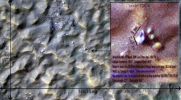
PSP_007820_1505_RED_abrowse-44.JPGThe "Sun-Door" (the measures - credits: Dr M. Faccin)125 visitenessun commentoMareKromium
|
|

ESP_019011_2245-EB-LXTT.jpgEvolution... (an Image-Mosaic by Elisabetta Bonora - Lunexit Team)124 visiteAcquisition date: 16 August 2010
Mars Local Time (MLT): 15:16 (Early Afternoon)
Coord.: Latitude (centered): 44,2° North and Longitude (East): 164,2°
Spacecraft Altitude: approx. 305 km (about 190,6 miles)
Original image scale range: 30,5 cm/pixel (with 1 x 1 binning) so objects ~92 cm across are resolved
Map projected scale: 25 cm/pixel and North is up
Map projection: EQUIRECTANGULAR
Emission Angle: 6,3°
Sun-Mars-Spacecraft Angle (Phase Angle): 54,9°
Solar Incidence Angle: 49° (with the Sun about 41° above the Local Horizon)
Solar Longitude: 134,0° (Northern Summer)MareKromium
|
|

PSP_005370_1845_RED_abrowse-05.jpgExtremely unusually-looking Surface Feature in Sinus Meridiani (EDM n. 4 - Absolute Natural Colors; credits for the additional process. and color.: Drr Gianluigi Barca and Paolo C. Fienga - Lunexit Team)124 visitenessun commentoMareKromium
|
|
| 199 immagini su 17 pagina(e) |
|
|
|
5 | |
|
|
|
|
|
|
|
|








