| Piú viste - Mars in JPEG2000 |

Dunes-PIA14877-PCF-LXTT.jpgRippled Dune-Front in Hershel Crater (Enhanced Absolute Natural Colors; credits for the additional process. and color.: Dr Paolo C. Fienga - Lunexit Team)218 visiteThe Eastern Margin of a Rippled Dune located inside Herschel Crater moved an average distance of 3 meters (such as about 3 yards) between March 3rd, 2007 and December 1st, 2010MareKromium
|
|

ESP_016173_2005_RED_abrowse-PCF-LXTT.jpgSmall Shield-Volcano (Absolute Natural Colors; credits for the additonal process. and color.: Dr Paolo C. Fienga - Lunar Explorer Italia)215 visiteMars Local Time: 14:44 (Early Afternoon)
Coord. (centered): 20,1° North Lat. and 250,3° East Long.
Spacecraft altitude: 274,9 Km (such as about 171,8 miles)
Original image scale range: 55,0 cm/pixel (with 2 x 2 binning) so objects ~ 1 mt and 65 cm across are resolved
Map projected scale: 50 cm/pixel
Map projection: EQUIRECTANGULAR
Emission Angle: 0,6°
Sun-Mars-Spacecraft (or "Phase") Angle: 39,1°
Solar Incidence Angle: 40° (meaning that the Sun is about 50° above the Local Horizon)
Solar Longitude: 34,7° (Northern Spring)
Credits: NASA/JPL/University of Arizona
Additional process. and coloring: Drr Gianluigi Barca and Paolo C. Fienga - Lunar Explorer ItaliaMareKromium
|
|

Dunes-PIA14876.gifMoving Rippled Patch of Sand in Becquerel Crater (a GIF-Movie by NASA/JPL-Caltech/Univ. of Ariz./JHUAPL)214 visitenessun commentoMareKromium
|
|

Volcanic_Features-Fissure-Cerberus_Fossae-TRA_000827_1875-PCF-LXTT.jpgDeep inside Cerberus Fossae (Absolute Natural Colors; credits for the additional process. and color.: Dr Paolo C. Fienga - Lunar Explorer Italia)213 visitenessun commentoMareKromium
|
|

Dunes-PIA14880.gifDegrading North Polar Barchan-type Dune (a GIF-Movie by NASA/JPL-Caltech/Univ. of Ariz./JHUAPL)213 visitenessun commentoMareKromium
|
|

Claritas_Fossae-PIA14461-PCF-LXTT.jpgFeatures of Claritas Fossae (Absolute Natural Colors; credits for the additional process. and color: Dr Paolo C. Fienga - Lunexit Team)208 visiteThe Claritas Fossae Region is characterised by systems of "Graben" running mainly North-West to South-East. A Graben forms when a block of the Planet's Crust drops down between two Faults, due to extension, or pulling, of the Crust itself.
MareKromium
|
|

ESP_022657_1260_RED_abrowse-PCF-LXTT-05.jpgDust Devils' Tracks in Noachis Terra (Natural Colors; credits for the additional process. and color.: Drr Gianluigi Barca and Paolo C. Fienga - Lunexit Team)208 visiteMars Local Time: 14:28 (Early Afternoon)
Coord. (centered): 53,8° South Lat. and 357,1° East Long.
Spacecraft altitude: 253,0 Km (such as about 158,2 miles)
Original image scale range: 25,3 cm/pixel (with 1 x 1 binning) so objects ~ 76 cm across are resolved
Map projected scale: 25 cm/pixel
Map projection: EQUIRECTANGULAR
Emission Angle: 5,4°
Sun-Mars-Spacecraft (or "Phase") Angle: 47,2°
Solar Incidence Angle: 43° (meaning that the Sun is about 47° above the Local Horizon)
Solar Longitude: 300,5° (Northern Winter)
Credits: NASA/JPL/University of Arizona
Additional process. and coloring: Drr Gianluigi Barca and Paolo C. Fienga - Lunar Explorer ItaliaMareKromium
|
|

Dunes-PIA14879-PCF-LXTT.jpgMoving Rippled Dune-Front in Hershel Crater (Enhanced Absolute Natural Colors; credits for the additional process. and color.: Dr Paolo C. Fienga - Lunexit Team)208 visiteA Rippled Dune-Front in Herschel Crater on Mars moved an average of about 1 meter (such as about o1 yard) between March 3rd, 2007 and December 1st, 2010. Herschel Crater is located just South of the Equator, in the Cratered Highlands.
This is one of several sites where the MRO has observed shifting Sand Dunes and Ripples. Previously, scientists thought sand on Mars was mostly immobile. It took the mission's High Resolution Imaging Science Experiment (HiRISE) to take sharp enough images to finally see the movement. While Dust is easily blown around the Red Planet, its thin Atmosphere means that strong Winds are required to move Grains of Sand.MareKromium
|
|

Dunes-PIA14878-PCF-LXTT.jpgMoving Rippled Dune-Front in Hershel Crater (Enhanced Absolute Natural Colors; credits for the additional process. and color.: Dr Paolo C. Fienga - Lunexit Team)206 visiteA Rippled Dune-Front in Herschel Crater on Mars moved about 2 meters (such as about 2 yards) between March 3rd, 2007 and December 1st, 2010. Herschel Crater is located just South of the Equator in the Cratered Highlands.
This is one of several sites where the orbiter has observed shifting Sand Dunes and Ripples. Previously, scientists thought sand on Mars was mostly immobile. It took the mission's High Resolution Imaging Science Experiment (HiRISE) to take sharp enough images to finally see the movement. While Dust is easily blown around the Red Planet, its thin Atmosphere means that strong Winds are required to move Grains of Sand.MareKromium
|
|

Dunes-PIA14879.gifMoving Rippled Dune-Front in Hershel Crater (a GIF-Movie by NASA/JPL-Caltech/Univ. of Ariz./JHUAPL)203 visitenessun commentoMareKromium
|
|

Dunes-PIA14876-PCF-LXTT.jpgRippled Patch of Sand in Becquerel Crater (Enhanced Absolute Natural Colors; credits for the additional process. and color.: Dr Paolo C. Fienga - Lunexit Team)201 visiteA Rippled Patch of Sand in Becquerel Crater on Mars moved about 2 meters (such as about 2 yards) between November 24th, 2006 and September 5th, 2010. Becquerel Crater is located just north of the equator in the Arabia Terra region.
MareKromium
|
|
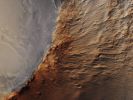
Chrise_Planitia-PIA14462-PCF-LXTT.jpgFeatures of Chrise Planitia (Absolute Natural Colors; credits for the additional process. and color: Dr Paolo C. Fienga - Lunexit Team)196 visiteThe suggested area in this observation is characterized by a group of Cones, such as "shield-like" features, and round Mounds. They are a few hundred meters to kilometers in diameter, but their heights are still unknown.MareKromium
|
|
| 199 immagini su 17 pagina(e) |
2 |  |
|
|
|
|
|
|
|
|
|








