| Piú viste - Mars through Mars Express (ESA - Original Raw Frames & Orbital Panoramas) |
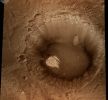
Craters-Pollack_Crater-H1201_0001_ND3_crop_wide-3.jpgPollack Crater and "White Rock" (Natural Colors - Tri-Chromatic Version; credits for the additional process. and color.: Dr Paolo C. Fienga - Lunexit Team)70 visitenessun commentoMareKromium
|
|
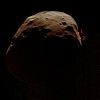
Phobos-403-20080729-5850-6-SRC-01_H1.jpgPhobos and two possible Landing Sites for "GRUNT" (natural colors; credits: Lunexit)70 visiteCaption ESA:"HRSC Super-resolution channel (SRC) image taken on July, 22, 2008 from a distance of approix. 4500 Km, showing the illuminated edge of the potential Landing Site of the Russian "Phobos-Grunt" Mission.
MareKromium
|
|
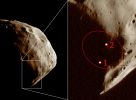
Phobos-402-20080729-5851-6-GRUNT-01-Phobos-Flyby_H1.jpgPhobos and two possible Landing Sites for "GRUNT" (natural colors; credits: Lunexit)70 visiteCaption ESA:"HRSC Stereo Channel 1 image of Phobos with a resolution of 3,7 mt/pixel at its best. The inset to the right shows the potential Landing Region and Sites for the Russia’s Phobos-Grunt sample return mission, due for launch in 2009". MareKromium
|
|
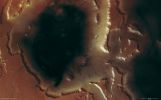
Deuteronilus_Mensae_Region-PCF-LXTT.jpgDeuteronilus Mensae (Enhanced Natural Colors; credits for the additional process. and color.: Dr Paolo C. Fienga - Lunar Explorer Italia70 visiteThis image shows the Deuteronilus Mensae Region on Mars, an area primarily characterized by (peri)glacial features.
It was taken on 14 March 2005 (orbit number 1483) by the High Resolution Stereo Camera (HRSC) onboard ESA's Mars Express with a ground resolution of approx. 29 mt per pixel.
The area is located on the Northern edge of Arabia Terra and borders the Southern High- and Northern Lowlands, at approx. 39° North Lat. and 23° East Long. MareKromium
|
|

Phobos-400-455-20091201.jpgBig Brother and Little Brother70 visitePhobos and Deimos RAW (left panel) and processed images (right panel).
In a first, ESA’s Mars Express Orbiter imaged the Martian Moons Phobos and Deimos together on November, 5th, 2009.
Apart from their ‘wow’ factor, these unique images will help the HRSC team validate and refine existing orbit models of the two moons.
The images were acquired with the Super Resolution Channel (SRC) of the High Resolution Stereo Camera (HRSC). The camera took 130 images of the moons on November 5th at 09:14 CET in a span of 1,5 minutes at intervals of 1", speeding up to 0,5" intervals toward the end. The image resolution is 110 m/pixel for Phobos and 240 m/pixel for Deimos — Deimos was more than twice as far from the camera.
The Super Resolution Channel of the HRSC uses an additional lens, which has a very narrow field of view of just 0,5°, providing four times the magnification than otherwise providing four times the resolution of the HRSC colour stereo channel.
Phobos, the larger of the two moons, orbits closer to the Red Planet, circling it every 7 hours and 39 minutes. It travels faster relative to Mars than the Moon relative to Earth.
Phobos was about 11.800 Km from Mars Express when the images were taken. Deimos, instead, was about 26.200 Km away.MareKromium
|
|

Craters-Lauth_Crater_in_Vastitas_Borealis_Region-Frozen_Lake-W-212-010705-1343-6-3d-01-01.jpgThe misterious "Frozen Lake" of Vastitas Borealis (2 - False Colors; credits for the additional process. and color.: Lunar Explorer Italia)69 visiteNoi non sappiamo se i riflessi color verde ed azzurro che cogliamo nelle immagini telescopiche di Marte (sia ottenute da Terra, sia dallo Spazio - via HST ad esempio) sìano il prodotto di mere aberrazioni cromatiche o se essi possano effettivamente costituire l'evidenza tangibile, rispettivamente, di forme di vegetazione indigena e/o di acque correnti superficiali.
Quello che sappiamo è che non possiamo - semplicemente - ignorare questi dati in sede di interpretazione "cromatica" delle immagini possedute, qualunque ne sia la fonte.
Questa "visione" (di fantasia, ma sino ad un certo punto...) del Lago Ghiacciato di Vastitas si riferisce alla tarda Primavera Polare Marziana.MareKromium
|
|

South_Polar_Regions-h0231_0000_nd3-01.jpgFrame Mars Express n. h0231_0000_nd3 (natural colors - elab. Lunexit)69 visite
|
|
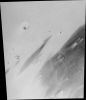
NP-S-h0241_0009_nd3-00.jpgFrame Mars Express RAW n. h0241_0009_nd368 visiteMareKromium
|
|
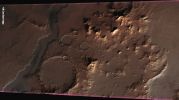
Hellespontus_Region_and_Reull_Vallis.jpgHellespontus and Reull Region (MULTISPECTRUM processing, from an idea of Keith Laney)68 visitenessun commentoMareKromium
|
|

B-h0032_0000_bl3-00.jpgFrame Mars Express RAW n. h0032_0000_bl367 visite
|
|
|
|
| 106 immagini su 9 pagina(e) |
 |
|
|
|
|
|
9 |
|








