| Piú viste - Mars through Mars Express (ESA - Original Raw Frames & Orbital Panoramas) |
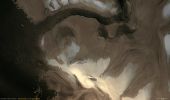
RupesTenuis-428-20081205-5872-6-co-01-RupesTenuis_H1.jpgNorth Polar Features: Rupes Tenuis (Natural Colors; credits: Lunar Explorer Italia)73 visiteCaption ESA:"ESA’s Mars Express Orbiter imaged the snow-laden region of Rupes Tenuis on the Martian North Pole on July, 29th, 2008.
Rupes Tenuis is located at the southern edge of the Martian North Polar Cap, approx. 5500 Km North-East of the Tharsis Province.
The image shows an area located at about 81° North Lat. and 297° East Long. and has a ground resolution of approx. 41 mt/pixel. It covers an area of about 44.000 Km2 (such as almost as large as the Netherlands)".
Nota Lunexit: secondo noi, questa "immagine" (che in realtà dovrebbe essere un fotomosaico) NON E' reale. L'immagine...NON E' un'immagine reale di Marte (è solo una ricostruzione virtuale, nello stile tipico della - sempre più ambigua e sopravvalutata - ESA). MareKromium
|
|
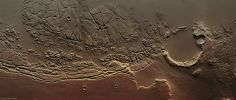
Kasei_Valles_and_Sacra_Fossae-448-20091007-6241-6-co-01_H1.jpgKasei Valles and Sacrae Fossae (Absolute Natural Colors; credits for the additional process. and color.: Dr Paolo C. Fienga - Lunexit Team)73 visiteCaption ESA:"Mars Express flew over the boundary between Kasei Valles and Sacra Fossae and imaged the Region, acquiring spectacular views of the Chaotic Terrain in the area.
The image is centred at about 12° North Latitude and 285° East Longitude and have a ground resolution of approx. 21 mt/pixel.
They cover about 225 x 95 Km (or 21.375 sq Km); an area roughly half the size of the Netherlands".MareKromium
|
|

A-h0751_0000_gr2.jpgFrame Mars Express RAW n. h0751_0000gr272 visite
|
|
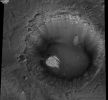
Craters-Pollack_Crater-H1201_0001_ND3_crop_wide-0.jpgPollack Crater and "White Rock" (RAW Frame; credits: ESA - Mars Express)72 visitenessun commentoMareKromium
|
|
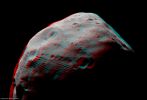
Phobos-404-20080729-5181-6-an-01-Phobos-Flyby_2_H1.jpgPhobos in 3D (red-cyan anaglyph)72 visiteCaption ESA:"On July 23, 2008, the High Resolution Stereo Camera on board ESA’s Mars Express took the highest-resolution full-disc image yet of the surface of the moon Phobos.
This image data was acquired from a distance of about 97 Km with a spatial resolution of about 3,7 m/pixel".MareKromium
|
|
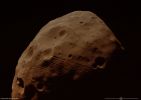
Phobos-401-20080729-5851-6-na-1a-Phobos-Flyby_H1.jpgPhobos in HR (Enhanced Natural Colors; credits for the additional process. and color.: Dr Paolo C. Fienga - Lunexit Team)72 visiteCaption ESA:"On July 23, 2008, the High Resolution Stereo Camera on board the ESA’s Mars Express took the highest-resolution full-disc image yet of the surface of the moon Phobos.
The image data were acquired from a distance of about 97 Km from Phobos' Surface, with a spatial resolution of about 3,7 mt/pixel, during orbit 5851.
These images have surpassed all previous images from other missions in continuous coverage of the illuminated surface at the highest spatial resolution of 3,7 mt/pixel".
This image has been geometrically corrected and exhibits the original illumination and photometric conditions". MareKromium
|
|
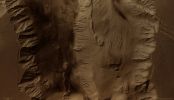
Chasmas-Candor_Chasma.jpgCandor Chasma (Natural Colors; credits: Lunexit)72 visitenessun commentoMareKromium
|
|

A-h0751_0000_bl2.jpgFrame Mars Express RAW n. h0751_0000_bl271 visite
|
|

Hebes_Chasma.jpgHebes Chasma (Natural Colors + MULTISPECTRUM; credits: ESA and Lunexit)71 visiteThe Region is an "Enclosed Trough" situated in Valles Marineris, the Grand Canyon of Mars, where water is believed to have flowed.
The High Resolution Stereo Camera (HRSC) on ESA's Mars Express studied the area providing new pictorial clues to its history.
Hebes Chasma is located at approx. 1° South Lat. and 282° East Long. Image data was obtained on 16 September 2005 with a ground resolution of approx. 15 mt/pixel.
The Region is an enclosed, almost 8 Km-deep trough in the most northern part of Valles Marineris, the 3000-Km long Grand Canyon of Mars.
The steep flanks of the trough show branched incisions and small veins of rock. Below the flanks, run-off and material from larger landslides is also visible.
A flat-topped mountain is located in the centre of Hebes Chasma.
It reaches 8000 mt above the graben floor and rises to almost the same height as the plains surrounding the trough. MareKromium
|
|
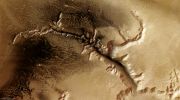
Echus_Chasma-398-260508-2204-6-co-01-H1.jpgEchus Chasma (False Colors)71 visiteThe High-Resolution Stereo Camera (HRSC) on board ESA's Mars Express has returned images of Echus Chasma, one of the largest Water Source Regions on the Red Planet.
The data were acquired on September, 25, 2005.
The pictures are centred at about 1° North and 278° East and have a ground resolution of approx. 17 mt/pixel.
Echus Chasma is an approx. 100 Km long and 10 Km wide incision in the Lunae Planum High Plateau North of Valles Marineris, the "Grand Canyon" of Mars. Echus Chasma is the Water Source Region of Kasei Valles, which extends thousands of Km to the North, and its southern-most part. The images of the Echus Chasma plateau show valleys that are about 10 km long and 1000 m deep. The main valley, Kasei Valles, is about 4 km in depth. The smaller valleys, also called sapping canyons, originate from the discharge of groundwater.
Echus Chasma is bounded to the West by the Echus Chasma Plateau, which lies about 4 Km above Echus' floor. MareKromium
|
|
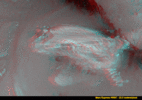
Juventae_Chasma_3D-2.gifJuventae Chasma (High-Def-3D - EDM n.1; credits: ESA)70 visitenessun commento
|
|

PrometheiPlanum.jpgPromethei Terra (Natural Colors + MULTISPECTRUM; credits: ESA & Lunexit)70 visitePromethei Planum, an area seasonally covered with layer of ice more than 3500 mt thick layer of ice in the Martian South Polar Region, was the subject of the High Resolution Stereo Camera’s focus on 22 September 2005 as Mars Express was in orbit above the Red Planet.
Promethei Planum lies at approx. 76° South Lat. and 105° East Long.
An approx. 100 Km-large and 800 mt-deep impact crater is visible in the Northern part of the image. The crater’s interior is partly covered in ice.
In the centre of the image are structures that may have been created by basaltic lava flow from a volcano. This area is covered in ice. The dark dunes towards the bottom of the image are most likely made up of dust originating from this lava flow or volcanic ash.
A broad sheet of ice, which is an extension of the South Polar Ice Cap is located South of the lava flow. The steep flanks clearly show white, clean ice. The thickness of the ice is between 900 and 1100 mt.MareKromium
|
|
| 106 immagini su 9 pagina(e) |
 |
|
|
|
|
|
8 |
|








