| Piú viste - Mars through Mars Express (ESA - Original Raw Frames & Orbital Panoramas) |
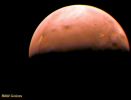
Volcanoes-Arsia_Mons-Eruption-05.jpgArsia Mons is erupting? (RAW Natural Colors; credits for the additional process. and color.: Dr Marco Faccin - Lunexit Team)79 visitenessun commentoMareKromium
|
|
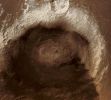
Craters-Crommelin_Crater-PCF-LXTT.jpgCrommelin Crater (Natural Colors; credits for the additional process. and color.: Dr Paolo C. Fienga - Lunar Explorer Italia)78 visiteCoord.: 5,1° North Lat. and 349,8° East Long.MareKromium
|
|
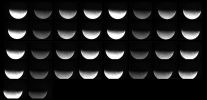
Volcanoes-Arsia_Mons-Eruption-02.jpgArsia Mons is erupting? (ALL available frames - a Photo-Mosaic by Dr Marco Faccin - Lunexit Team)78 visitePer il momento, l'unica ipotesi che noi, come Gruppo Lunar Explorer Italia (LunExIt), possiamo avanzare è orientata verso la verificazione di un fenomeno esplosivo (quello che ha generato la nuvola e poi il pennacchio) di considerevole portata. Se ad esso abbia fatto (e/o stia facendo) seguito una vera e propria eruzione, non lo possiamo sapere.
L'unica certezza è che "qualcosa" è successo.
Marte, se volete, ci ha dato un FORTE segnale di risveglio (ricordate che il vulcanismo è un segno tipico e caratterizzante degli ambienti geologicamente attivi).
Ora noi aspettiamo.
E continuiamo ad osservare...MareKromium
|
|

Coprates_Catena-h0438_0000_nd3-00-PCF-LXTT.jpgFrame Mars Express n. h0438_0000_nd3 (natural colors - elab. Lunexit) 77 visitenessun commentoMareKromium
|
|

Claritas_Fossae-4-096-140904-0508-6-co-01-ClaritasFossae_hires.jpgClaritas Fossae (4 - ESA/ DLR/ FU Berlin - G. Neukum)76 visiteCaption ESA originale:"The lava blankets of the Solis Planum area cover the eastern parts of the older Claritas Fossae ridge and surround some of the higher ground. The geological history of this region can be reconstructed by analysing the layers of tectonic grabens, impact craters, volcanic features and even small valley networks. The complexity of Claritas Fossae Region suggests that some of the events took place at the same time. Furthermore, the detailed view of the large southern impact crater shows patches of dark material which are located near the central and marginal parts of the impact crater floor. This material may be of volcanic origin".
|
|

Echus_Chasma-398-260508-2204-6-co-01-H2.jpgHigh Cliffs Surrounding Echus Chasma on Mars76 visiteWhat created this great cliff on Mars? Did giant waterfalls once plummet through its grooves? With a four-kilometer drop, this high cliff surrounding Echus Chasma, near an impressive impact crater, was carved by either water or lava. A leading hypothesis is that Echus Chasma, at 100-Km long and 10-Km wide, was once one of the largest water sources on Mars. If true, water once held in Echus Chasma likely ran over the Martian Surface to carve the impressive Kasei Valles, which extends over 3000 Km to the North. Even if initially carved by water, lava appears to have later flowed in the valley, leaving an extraordinarily smooth floor. Echus Chasma lies north of tremendous Valles Marineris, the largest canyon in the Solar System. The above image was taken by the robotic Mars Express spacecraft currently orbiting Mars.
Nota Lunexit: checchè ne dica la NASA, questo frame NON E' una fotografia.MareKromium
|
|
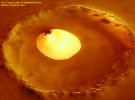
Craters-Lauth_Crater_in_Vastitas_Borealis_Region-Frozen_Lake-W-212-010705-1343-6-3d-01-03.jpgThe misterious "Frozen Lake" of Vastitas Borealis (4 - Extremely Enhanced Natural Colors; credits for the additional process. and color.: Lunar Explorer Italia)74 visitePiena Estate Polare Marziana: polveri rosse ricoprono il cratere senza nome di Vastitas Borealis e colorano, in parte, il suo "laghetto" centrale.
Da notare che, in accordo alle nostre assunzioni di partenza (ed in accordo a regole elementari di logica e di buon senso), un cielo ricco di polveri color arancio, gialle e rossastre (e dunque, di conseguenza, un cielo color rosso/arancio e giallo - di base) si dovrebbe adeguatamente riflettere con questi medesimi colori nelle acque - a questo punto ghiacciate o meno diventa indifferente - del lago di Vastitas.
Ebbene, la regola elementare per cui le acque e/o i ghiacci superficiali, "usualmente", riflettono il colore del cielo, nel frame ESA Originale (fateci caso!) diremmo che NON trova applicazione.
Come mai? Forse abbiamo sbagliato noi...O forse l'immagine ESA è un'mmagine bella ma fasulla? O forse i suoi colori sono stati taroccati (male)?
O magari essa è frutto di incompetenza?
Oppure - chissà... - l'immagine ESA di partenza è un mix di tutte e tre le possibili (e summenzionate) variabili... Decidetelo Voi.MareKromium
|
|

B-h0032_0000_ir3-00.jpgFrame Mars Express RAW n. h0032_0000_ir374 visite
|
|
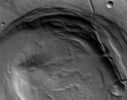
Volcanic_Features-Biblis_Patera-213-190705-1034-6-nd-01-BiblisP_H.jpgBiblis Patera (EDM - credits: ESA/DLR/FU Berlin (G. Neukum))73 visiteOriginal ESA caption:"This image taken by the High Resolution Stereo Camera (HRSC) on board ESA’s Mars Express spacecraft, shows the Biblis Patera Volcano, located in the Western part of the Tharsis rise on Mars.
The HRSC obtained this image on 8 November 2004 during orbit 1034 with a ground resolution of approx. 10,8 mt per pixel. Its shows the region of Biblis Patera at approx. 2,0° North and 236,0° East.
North is to the right".
|
|
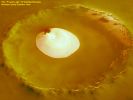
Craters-Lauth_Crater_in_Vastitas_Borealis_Region-Frozen_Lake-W-212-010705-1343-6-3d-01-02.jpgThe misterious "Frozen Lake" of Vastitas Borealis (3 - False Colors; credits for the additional process. and color.: Lunar Explorer Italia)73 visiteQuesta "visione" (sempre di fantasia e sempre solo sino ad un certo punto...) del Lago Ghiacciato di Vastitas si riferisce, invece, all'inizio dell'Estate Polare Marziana.MareKromium
|
|

A-h0751_0000_re2.jpgFrame Mars Express RAW n. h0751_0000_re273 visite
|
|
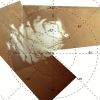
SouthPole-MG_SP_Fig02a_H.jpgThe South Pole of Mars (natural colors; credits: Lunexit)73 visiteCaption ESA:"This is a mosaic of images taken by the Mars Express’s Visible and Infrared Mineralogical Mapping Spectrometer, OMEGA.
It shows the Residual South Polar Cap at the end of Northern Winter on the Red Planet. The cap appears clearly asymmetric, its centre being displaced by 3° from the Geographic Pole".MareKromium
|
|
| 106 immagini su 9 pagina(e) |
 |
|
|
|
|
7 | |
|








