| Piú viste - Mars through Mars Express (ESA - Original Raw Frames & Orbital Panoramas) |
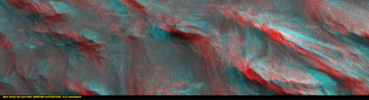
Juventae_Chasma_3D-3.gifJuventae Chasma (High-Def-3D - EDM n.2; credits: ESA)85 visitenessun commento
|
|
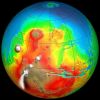
Volcanoes-Arsia_Mons-Eruption-01.jpgArsia Mons is erupting?85 visiteIn questa inequivocabile e spettacolarmente "visiva" ricostruzione del "pennacchio" scaturito dal Vulcano Arsia Mons (un grande complimento al nostro Marco Faccin per l'idea e per l'esecuzione!), ecco che la magnitudine del fenomeno segnalatoVi nella giornata di ieri (16 Luglio 2009) si evidenzia in tutta la sua straordinaria maestosità.
Ma che cosa è successo, esattamente?
Al momento, le Fonti Ufficiali (ESA e soprattutto NASA) non dicono nulla. L'ESA, onore al merito (quando c'é!), ha divulgato l'informazione e le prime immagini; la NASA...nulla. Silenzio assoluto.
Peccato.
Peccato perché, ora come non mai, puntare le ottiche delle Sonde Odyssey e Reconnaissance verso la caldera di Arsia Mons sarebbe una garanzia di immagini straordinarie e, certamente, di assoluto valore storico e scientifico.
Staremo a vedere...MareKromium
|
|
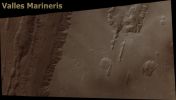
Valles_Marineris-h0471_0001_nd3.jpgPortion of the Valles Marineris Canyon System (Natural Colors; credits for the additional process. and color.: Dr Paolo C. Fienga)85 visitenessun commentoMareKromium
|
|
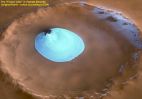
Craters-Lauth_Crater_in_Vastitas_Borealis_Region-Frozen_Lake-W-212-010705-1343-6-3d-01-00.jpgThe misterious "Frozen Lake" of Vastitas Borealis (1 - Natural Colors; credits ESA)84 visiteCaption ESA:"The HRSC on ESA's Mars Express obtained this perspective view on 2 February 2005 during orbit 1343 with a ground resolution of approximately 15 mt per pixel. It shows an unnamed impact crater located on Vastitas Borealis, a broad plain that covers much of Mars's far Northern Latitudes, at approx. 70,5° North Lat. and 103° East Long.
The crater is about 35 Km wide and has a maximum depth of approx. 2 Km beneath the crater rim. The circular patch of bright material located at the centre of the crater is residual water ice.
The colours are very close to natural, but the vertical relief is exaggerated three times. The view is looking East".
Nota: noi crediamo che questo cratere sia molto più enigmatico di quanto non appaia poichè, pur avendo esaminato tutti i frames NASA-MGS relativi alla Regione di Vastitas Borealis (in particolare quelli rapprsentativi dell'area suggerita dalle coordinate ESA), non ci è riuscito di individuare il "laghetto ghiacciato".
Il cratere senza nome che lo dovrebbe contenere, poi, appare solo una volta - e solo in una veduta PARZIALE! - in un frame NASA-Mars Odyssey che Vi proporremo qui di seguito.
Infine, i "colori naturali" di Vastitas Borealis, in accordo ai dati NASA disponibili (i quali sono anche comprensivi di informazioni ottenute sia attraverso vedute telescopiche HST, sia attraverso osservazioni effettuate da Terra), dovrebbero essere molto diversi da quelli suggeriti dall'ESA (noi Vi proporremo tre elaborazioni al riguardo).
|
|

MA_ADIM_VALLIS-440-20090629-6393-6-co-01_H1-1.jpgProximities of Ma'adim Vallis (Natural Colors; credits: ESA)84 visiteCaption ESA:"Mars Express image of a Region close to Ma’adim Vallis, one of the largest - after Vallis Marineris - canyons on Mars.
The imaged Region lies South-East of Ma’adim Vallis; the pictures are centred at about 29° South Lat. and 182° East Long. and have a ground resolution of 15 mt/pixel.
Ma’adim Vallis is located between the Volcanic Province of Tharsis, which harbours 4 volcanoes, including the largest in the Solar System, and the Hellas Planitia Impact Basin.
The canyon, approx. 20 Km wide and 2 Km deep, originates in the Southern Highlands close to the so-called ‘Dichotomy Boundary’ and ends in Gusev Crater.
The Dichotomy Boundary is a narrow Region separating the cratered Highlands, located mostly in the Southern Hemisphere of Mars, from the Northern Hemisphere's Lowland Plains".MareKromium
|
|

NP-h1169_0000_p12-00.jpgFrame Mars Express RAW n. h1169_0000_p1283 visiteMareKromium
|
|
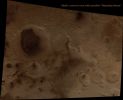
Craters-Crater_Field-h1640_0000_nd3.jpgHeavily Cratered Region and Candidate Migrating Dunefields (Natural Colors; credits for the additional process. and color.: Dr Paolo C. Fienga - Lunexit Team)83 visitenessun commentoMareKromium
|
|

Cydonia_Region-h3253_0000_s12-2.jpgDo you recognize this place? (natural colors; credits: Dr G. Barca & Lunexit)82 visiteUn semplice "Space-quiz": che Regione è quella che vedete in questo frame? Le Vostre risposte - motivate - possono essere inserite nei "Commenti".MareKromium
|
|
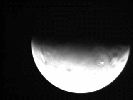
Volcanoes-Arsia_Mons-Eruption-03.gifArsia Mons is erupting? (a GIF-Movie by: Dr Marco Faccin - Lunexit Team)80 visitenessun commentoMareKromium
|
|
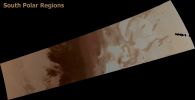
South_Polar_Regions-h1245_0000_nd3~0.jpgThe beautiful Southern Regions of Mars (Natural Colors; credits for the additional process. and color.: Dr Paolo C. Fienga - Lunexit Team)80 visitenessun commentoMareKromium
|
|

Claritas_Fossae-2-029-290304-0068-6-co-02.jpgClaritas Fossae (2 - ESA/ DLR/ FU Berlin - G. Neukum)79 visitevedi il commento al frame che precede
|
|
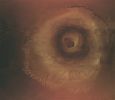
Volcanoes-Olympus_Mons-PCF-LXTT.jpgOlympus Mons and Surroundings (Absolute Natural Colors; credits for the additional process. and color: Dr Paolo C. Fienga - Lunexit Team)79 visiteUna nostra elaborazione Multispettrale del maestoso Vulcano Olympus, ottenuta da un frame HR proveniente dalla Sonda ESA "Mars Express".
Caption ESA:"This is a mosaic of Olympus Mons, the highest volcano on Mars, which towers 26 Km above the surrounding plains. The image covers an area of approx. 600.000 sq/km.
The High Resolution Stereo Camera (HRSC) on board ESA’s Mars Express Orbiter imaged the Region over 18 orbits.
This image is an ortho-image mosaic, where the projecting rays are perpendicular to the plane of projection.
This corrects any deformations introduced by an imaging camera and therefore such an image can be fitted directly on to a map.
From the observations, 16 HRSC orbit strips, with around 35 Gigabytes of data were used to generate a Digital Terrain Model (DTM) mosaic and an ortho-image mosaic. The DTM mosaic has a resolution of 150 mt/pixel. The resolution of individual nadir images (taken by pointing the camera vertically down to the surface) is in the range of 12 to 40 mt/pixel. Individual terrain models with a resolution of up to 50 mt were derived for every HRSC image strip.
The HR DTMs and ortho-images are derived through a complex process. Matching surface features were used to 'stitch' the images strips together, and complex geometrical calculations were used to produce the 3D coordinates of all measured points in the area".MareKromium
|
|
| 106 immagini su 9 pagina(e) |
 |
|
|
|
6 | |
|
|








