| Piú viste - Mars through Mars Express (ESA - Original Raw Frames & Orbital Panoramas) |
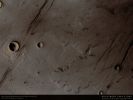
Lava_Flows-Daedalia_Planum-PCF-LXTT.jpgDaedalia Planum (Absolute Natural Colors; credits for the additional process. and color.: Dr Paolo C. Fienga - Lunexit Team)91 visitenessun commentoMareKromium
|
|

Coprates_Catena-h0438_0000_nd3-00.jpgSulphates in Coprates Catena? (CTX Frame - Natural Colors; credits for the Additional Process. and Color.: Dr Paolo C. Fienga - Lunexit Team)91 visitenessun commentoMareKromium
|
|
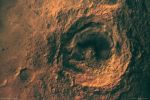
MaunderCrater.jpgMaunder Crater (Natural Colors + MULTISPECTRUM; credits: ESA & Lunexit)89 visiteThe above image shows the striking Maunder crater lying at approx. 50° South Lat. and 2° East Long., in the Noachis Terra Region on Mars.
The High Resolution Stereo Camera (HRSC) on ESA’s Mars Express orbiter took pictures of the Noachis Terra Region during orbits 2412 and 2467 on 29 November and 14 December 2005, respectively, with a ground resolution of approx. 15 mt/pixel.
The Sun illuminates the scene from the North-East (top left in the image).
Maunder crater, named after the British Astronomer Edward W. Maunder, is located halfway between Argyre Planitia and Hellas Planitia on the Southern Highlands of Mars.
With a diameter of 90 Km and a depth of barely 900 mt, the Crater is not one of the largest impact craters on Mars at present, but it used to be much deeper. It has since been filled partially with large amounts of material.MareKromium
|
|
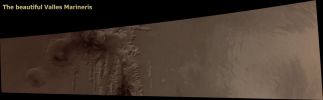
Valles_Marineris-h0442_0008_nd3.jpgPortion of the Valles Marineris Canyon System (Natural Colors; credits for the additional process. and color.: Dr Paolo C. Fienga)89 visitenessun commentoMareKromium
|
|
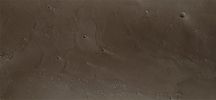
Tiu_Valles-ESA-PCF-LXTT.jpgTiu Valles (Natural Colors; credits: Dr Paolo C. Fienga - Lunexit Team)89 visiteThis image taken by the High Resolution Stereo Camera (HRSC) on board Mars Express shows the mouth of the Tiu Valles Channel System on the Red Planet. The picture was taken in orbit 3103 on 10 June 2006 with a ground resolution of approx. 16 mt/pixel. Visible in the lower part of the image are remnants of a once 'Streamlined' Island. The upper part of the scene covers the mouth of the Tiu Valles nearly in its entire width, approx. 55 Km.
Its winding, meandering Ridges, bound by depressions are eye-catching. The processes that formed these odd structures are still unknown. Possibly, during flooding events, water or water-rich surface layers came in contact with lava from the surrounding areas, which then might have led to the formation of these mysterious ridges.
The Region is located at approx. 27° North Lat. and 330° East Long. The Sun illuminates the scene from the North West, the lower left-hand side in the image. MareKromium
|
|

South_Polar_Regions-Rupes_Tenuis-ESA-PF.jpgRupes Tenuis (possible Natural Colors; credits ESA - additional color. and process. Dr Paolo C. Fienga)88 visiteESA’s Mars Express orbiter imaged the snow-laden Region of Rupes Tenuis on the Martian North Pole on 29 July 2008.
Rupes Tenuis is located at the Southern Edge of the Martian North Polar Cap, approx. 5500 Km northeast of the Tharsis Volcanic Region.
The images are at about 81° north and 297° east and have a ground resolution of approx. 41 mt/pixel. They cover an area of about 44.000 square/Km, almost as large as the Netherlands.
Nota Lunexit: a nostro avviso questa "immagine" NON E' VERA! E' un disegno. Al limite, è la trasposizione digitale di un frame RAW originale unprocessed (ma ne dubitiamo).MareKromium
|
|

Aeolian_Features-Windstreaks-h0165_0068_nd3-PCF-LXTT.jpgWindstreaks (Natural Colors; credits for the additional process. and color.: Dr Paolo C. Fienga - Lunar Explorer Italia)88 visitenessun commentoMareKromium
|
|

Craters-Unnamed_Double_Crater_in_Terra_Tyrrhena.jpgDouble Impact Crater in Terra Tyrrhena (Natural Colors + MULTISPECTRUM; credits: ESA & Lunexit)87 visiteThe High Resolution Stereo Camera (HRSC), ESA's Mars Express obtained images of the Tyrrhena Terra Impact Region on Mars.
On 10 May 2007, the spacecraft was in orbit number 4294 when it snapped pictures of the Region located at 18° South Lat. and 99° East Long. with a ground resolution of approximately 15 meters per pixel.
The Western part of the scene is dominated by a 35 Km-wide and approx. 1000 mt-deep impact crater with an extremely cliffy and chiseled edge. Another, 18 Km-long and approx. 750 mt-deep impact crater, in all likelihood a double impact crater, is located South of the large crater.
These 'double impact craters' develop when two objects, part of a binary, hit the surface almost simultaneously.MareKromium
|
|

Aeolian_Features-Yardangs-h0522_0000_re3.jpgAeolian Surface Features (Natural Colors; credits for the additional process. and color.: Dr Paolo C. Fienga - Lunexit Team)87 visitenessun commentoMareKromium
|
|

Claritas_Fossae-3-096-140904-0508-6-co-01-ClaritasFossae_hires.jpgClaritas Fossae (3 - ESA/ DLR/ FU Berlin - G. Neukum)86 visiteCaption ESA originale:"The displayed region is the eastern part of Claritas Fossae and the western part of Solis Planum at longitude 260° East and latitude of about 28° South.
The diffuse blue-white streaks in the northern parts of the scene (Sx di chi guarda) are clouds or aerosols. The Claritas Fossae (‘fossa’ is Latin for trough----->canale) region is characterised by systems of ‘grabens’ running mainly north-west to south-east. These can be traced several hundred kilometres up to the northern Tharsis shield volcanoes.
A "graben" forms when a block of the planet’s crust drops down between 2 faults, due to extension, or pulling, of the crust. A ‘horst and graben’ system can occur where there are several parallel faults.
Geographically, the grabens separate the eastern volcanic plains of the Solis Planum region from the western Daedalia Planum lava plains.
|
|
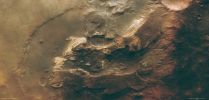
Craters-Terby_Crater.jpgTerby Crater (Natural Colors + MULTISPECTRUM; credits: ESA & Lunexit)86 visiteThe High Resolution Stereo Camera (HRSC) on board ESA’s Mars Express Orbiter imaged the Terby Crater on Mars on 13 April 2007 during orbit 4199.
The Region is of great scientific interest as sediments there hold information on the role of water in the history of the Planet. Eye-catching finger-shaped plateaux extend in the North-South direction. They rise up to 2000 mt above the surrounding terrain. The relatively old crater was filled with sediments in the past, which formed plateaux on erosion.
The flanks of the plateaux clearly exhibit layering of different-coloured material. Differences in colour usually indicate changes in the composition of the material and such layering is called ‘bedding’. Bedding structures are typical of sedimentary rock, which has been deposited either by wind or water. Different rock layers erode differently, forming terraces.
The valleys exhibit gullies, or channels cut in the ground by running liquid, mainly in the Northern part of the image.
These gullies and the rock-bedding structure indicate that the region has been affected by water.
MareKromium
|
|

Aeolian_Features-Windstreak-h0232_0000_nd3-01-PCF-LXTT.jpgWindstreaks (Natural Colors; credits for the additional process. and color.: Dr Paolo C. Fienga - Lunar Explorer Italia)86 visitenessun commentoMareKromium
|
|
| 106 immagini su 9 pagina(e) |
 |
|
|
5 | |
|
|
|








