| Piú viste - Mars through Mars Express (ESA - Original Raw Frames & Orbital Panoramas) |
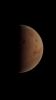
Volcanoes-Arsia_Mons_and_the_Tharsis_Montes-December_2012-PCF-LXTT-IPF-1.jpgNew "Smoke Emission" from Arsia Mons (Absolute Natural Colors; credits for the additional process. and color.: Dr Paolo C. Fienga/Lunar Explorer Italia/Italian Planetary Foundation)140 visiteIn questo interessantissimo (ed ovviamente sconosciuto ai più) frame ESA - Mars Express, ottenuto nel Dicembre 2012, una nuova (e possente, direi) Emissione di Fumi appare essersi formata nella (e caratterizzare la) Regione dove sorge il più "irrequieto" dei tre Tharsis' Montes: Arsia Mons.
Si tratta, ancora una volta, di complessi nuvolosi stratiformi che, "casualmente", si sono formati (o transitavano) nei pressi della Caldera di Arsia - come sostengono ESA e NASA -, oppure siamo realmente davanti ad una (forse l'ennesima) prova che Marte è ancora geologicamemte attivo?
Io la risposta non posso darvela, ma le immagini ci sono ed a me sembrano eloquenti. Poi, come sempre, la "Parola" passa a Voi Lettori...
Dr Paolo C. Fienga (PhD)MareKromium
|
|
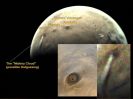
Volcanoes-Arsia_Mons-Eruption-00.jpgArsia Mons is erupting?136 visiteIn data 2 Luglio 2009, sono state ottenute (dalla Sonda ESA "Mars Express") una serie di immagini che SEMBRANO essere la prova visibile della verificazione di un fenomeno vulcanico tutt'altro che residuale nella Provincia Marziana di Tharsis: una nube piuttosto chiara, ma molto densa e compatta (oltre che di dimensioni davvero imponenti - ne stimiamo la lunghezza intorno ai 400/450 Km), pare infatti provenire dal Vulcano Arsia Mons.
La qualità delle immagini ESA (scattate lungo l'arco di circa 30 minuti) è - come sempre... - scarsa e quindi, se non altro per il momento, ci limitiamo a pubblicare l'immagine più significativa (ed in Natural Colors), nel contesto di un piccolo collage il quale Vi sarà di aiuto per capire non solo la possibile origine dello sfogo, ma anche le sue attuali dimensioni (calcolabili agevolmente, una volta tenutosi conto che la caldera di Arsia Mons ha un diametro di circa 110 Km).
Attendiamo le Vostre opinioni ed i Vostri commenti (speculazioni incluse)!MareKromium
|
|
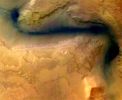
Reull_Vallis-ESA-1-PCF-LXTT.jpgPseudo-Lake in Reull Vallis (Absurde Colors; credits: ESA/DLR/FU Berlin, Dr G. Neukum)129 visite...senza parole...MareKromium
|
|
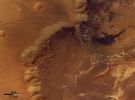
Melas_Chasma.jpgMars from orbit: Melas Chasma Region (Enhanced Natural Colors; credits: ESA - G. Neukum (FU Berlin) and oth.s - Mars Express - DLR)124 visiteA parte ogni considerazione estetica (si tratta di un'immagine davvero bellissima, per qualità e nitidezza), ci stiamo domandando se il colore di Marte non possa variare drammaticamente a seconda del tipo di ripresa che viene effettuata. Nelle immagini riprese da Sonde in orbita, infatti, il colore della superficie appare sempre (o quasi) di un acceso color arancio mentre, al suolo, tutto sembra sbiadirsi o, addirittura, trasformarsi (dal giallo al marrone e dal rosso fuoco al verde scuro). Fantasia?!?
|
|

Volcanoes-Arsia_Mons-Eruption-04.jpgArsia Mons is erupting? (Processed Natural Colors; credits for the additional process. and color.: Dr Marco Faccin - Lunexit Team)123 visitenessun commentoMareKromium
|
|
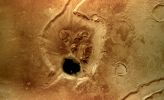
Craters-Unnamed_Crater_at_the_end_of_Mamers_Valles-392-250408-3304-6-co-01.jpgBird's-Eye view of Mamers Valles (MULTISPECTRUM; credits: Lunexit)122 visiteThe High-Resolution Stereo Camera (HRSC) onboard the ESA Spacecraft Mars Express obtained images focusing on a depression that displays a crater at the end of the long, winding Valley System known as Mamers Valles.
The data was obtained on 5 August 2006, with a ground resolution of approx. 14 mt/pixel. The image is centred at approx. 39° North and 17° East on the Planet.
The Mamers Valles System is approx. 1000 Km long, running along the boundary between the Northern Lowlands and Southern Highlands in the Region of Deuteronilus Mensae.
Scientists term a Region such as Mamers Valles ‘fretted terrain’ because it shows numerous deep and wide labyrinth-like valleys and circular depressions which often show structures formed by flowing liquid on their even floors. The structures formed by the flows are thought to be ice-rich debris flows. They show some resemblance to block glaciers seen on Earth.
The patches of rock at the centre of the depression are thought to be remnants of rock detached from the flanks of the depression and transported into its centre MareKromium
|
|
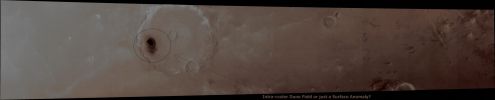
Unusually_looking_Surface_Feature-Pit-h1323_0000_nd3.jpgExtremely unusually-looking Surface Feature (Natural Colors; credits for the additional process. and color.: Dr Paolo C. Fienga - Lunexit Team)120 visitenessun commentoMareKromium
|
|

Aeolian_Features-Yardangs-Eumenides_Dorsum-ESA-ME-424-20081105-5114-6-co-01-H1-PCF-LXTT-IPF.jpgFeatures of Eumenides Dorsum (Absolute Natural Colors; credits for the additional process. and color.: Dr Paolo C. Fienga - Lunexit Team)118 visiteThis frame, which is a mosaic of several orbital images obtained by the High Resolution Stereo Camera onboard the ESA - Mars Express Orbiter, shows us a number of Surface Features; in particular, and in addition to the presence of Plains, Buttes and just a few ancient and semi-buried Impact Craters, we suggest you to pay some special attention to the unbelievable complex of Sinuous Erosional Surface Striations, known as "Yardangs" (which are the most common Aeolian - meaning "sculpted by Wind" - Features that can be found on the Red Planet), that covers a huge portion of the central part of the picture.
All the abovementioned Surface Features are located in the Eumenides Dorsum Region of Mars, which lies to the West of the Tharsis Volcanic Province and forms part of the Region known as Medusae Fossae, at approx. 2° South Latitude and 206° East Longitude. The images here were taken on the date of December, 26, of the AD 2007; they have a ground resolution of about 13 meters per pixel and cover an area (in total) of about 12.000 square Km.
This frame (which is the Original ESA - Mars Express HRST b/w mosaic n. 424-20081105-5114-6-co-01-H1) has been additionally processed and then colorized in Absolute Natural Colors (such as the colors that a human eye would actually perceive if someone were onboard the ESA - Mars Express Orbiter and then looked down, towards the Surface of Mars), by using an original technique created - and, in time, dramatically improved - by the Lunar Explorer Italia Team. Different colors, as well as different shades of the same color, mean, among others, the existence of different Elements present on the Surface of Mars, each having a different Albedo (---> Reflectivity) and Chemical Composition.MareKromium
|
|
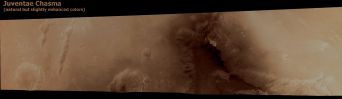
Chasmas-Juventae_Chasma-h0243_0000_nd3.jpgJuventae Chasma (Natural Colors, Tri-Chromatic Version - credits for the additional process. and color.: Dr Paolo C. Fienga - Lunexit Team)115 visitenessun commentoMareKromium
|
|
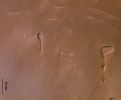
Volcanoes-Ascraeus_Mons-1-027-150304-0068-6-co-01.jpgAscraeus Mons from Mars Express (1 - ESA/ DLR/ FU Berlin - G. Neukum)113 visiteDue immagini in colori naturali del Vulcano Ascraeus Mons e dei suoi rilievi assolutamente affascinanti.
Ed eccoVi la Caption ESA originale:"This colour image shows a larger portion of the southern flank of Ascraeus Mons. The lighter, pink areas on the colour image, are clouds.
The visible lava tubes are caused by the crusting (or cooled lava) which occurs over a lava channel, a covering making the channel into a tunnel.
When lava production ceases, the tunnel empties and the roof of the tunnel falls in, making an elongated depression.
Occasionally, the depression forms a chain of small pits over an emptied lava tunnel. Pit chains and lava tunnels are common on the Martian surface and are also seen on other terrestrial planets and the Moon".
|
|
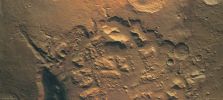
NepenthesMensae-385-090408-5212-6-co1-01.jpgNepenthes Mensae (MULTISPECTRUM; credits: Lunexit)111 visiteThe High Resolution Stereo Camera on board ESA’s Mars Express Orbiter imaged Nepenthes Mensae, a river delta on Mars, on 22 January 2008.
The data was acquired in the Region lying at approx. 3° North and 121° East, with a ground resolution of 15 mt/pixel.
The southern part of the image shows a structure reminiscent of a river delta on Earth, whose material was eroded from a valley, about 30 Km long and upto 1000 mt deep. This formed a fan-shaped deposit at the mouth of the valley. The rim of the deposit stands roughly 300 mt above the floor of the depression.
The resemblance of the structure to river deltas on Earth suggests that it was formed by a similar mechanism. Scientists believe that sediment transported by water was deposited as the flow of the water slowed down where the channel widened and met the mouth of the river.
The pictures show that the Region was affected by two episodes of flooding.
The first left a cone-shaped deposit, reaching far out into the lowland.
The second episode formed the fan with the distinct margin. This margin could indicate the location where sediments flowed into a standing body of water or ice.
Numerous hills and flat-topped mountains visible in the central part of the depression are remnants of the material that was present in the area.
The material was then eroded forming the depression, leaving behind the elevations visible today.MareKromium
|
|
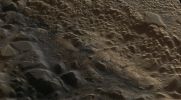
IaniChaos-ESA-PF.jpgIani Chaos (possible Natural Colors; credits ESA - additional color. and process. Dr Paolo C. Fienga)109 visiteIani Chaos on Mars, an area where Light Toned Deposits, or LTD, are known to be present. An analysis of data and images from Mars Express suggests that several LTD, some of the least understood structures on Mars, were formed when large amounts of groundwater burst on to the Surface. Scientists propose that groundwater had a greater role in shaping the Martian Surface than previously believed, and may have sheltered primitive life forms as the Planet started drying up.
This image was obtained with the High Resolution Stereo Camera on board ESA’s Mars Express Spacecraft.
Nota Lunexit: a nostro avviso questa "immagine" NON E' VERA! E' un disegno. Al limite, è la trasposizione digitale di un frame RAW originale unprocessed (ma ne dubitiamo). MareKromium
|
|
| 106 immagini su 9 pagina(e) |
 |
3 | |
|
|
|
|
|








