| Piú viste - Mars through Mars Express (ESA - Original Raw Frames & Orbital Panoramas) |
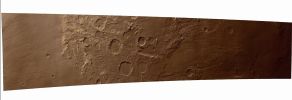
Claritas_Fossae-H0530_0000_ND2-PCF-LXTT.jpgFrame H0530_0000_ND2: Claritas Fossae Region225 visiteCaption ESA:"The HRSC on board ESA's Mars Express Spacecraft obtained this image on June, 20th, 2004, during orbit 530, with a ground resolution of approx. 31,4 mt per pixel.
This scene shows portion of the Claritas Fossae Region, covering an area roughly 200 by 1150 Km and centered at approx. 258° East Long. and 32° South Lat".
MareKromium
|
|
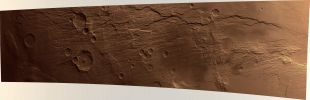
Claritas_Fossae-H0563_0000_ND2_H-PCF-LXTT.jpgFrame H0563_0000_ND2: Claritas Fossae Region223 visiteCaption ESA:"This scene shows the Region of Claritas Fossae, about 150 Km wide in the North and approx. 550 Km wide in the South, about 1200 Km in length, and centered at - approx. - 253° East Long. and 32° South Lat. The Linear Fractures of Claritas Fossae have widths ranging from a few Km up to about 100".MareKromium
|
|

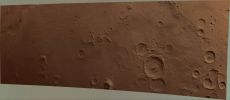
Ismenius_Lacus-H1201_0000_ND2_H-PCF-LXTT.jpgFrame H1201_0000_ND2: Ismenius Lacus Region222 visiteCaption ESA:"The scene shows the Region of Ismenius Lacus, about 77 Km wide in the North and 63 Km wide in the South, about 845 Km in length, and centered at - approx. - 25° East Long and 40° North Lat.
The image represents a Transitional Region on the Surface separating the heavily Cratered Highlands in the South from the smooth Northern Plains.
The Dissected Terrain contains a series of Mesas (i.e.: isolated "High Plateaux") and Buttes (i.e.: small and flat-topped Hills).MareKromium
|
|
Hellas_Planitia-H0572_0000_ND2_H-PCF-LXTT.jpgFrame H0572_0000_ND2: Hellas Planitia Region220 visiteCaption ESA:"The HRSC on board ESA's Mars Express Spacecraft obtained this image on July, 1st, 2004 during orbit 572 with a ground resolution of approx. 45,1 mt per pixel.
The scene shows a portion of Hellas Planitia, a Region which is about 234 Km wide in the North, 345 Km in the South, about 898 Km in length, and centred at approx. 89° East Long. and 29° South Lat.
This image represents an area on the Northern Eastern Rim of Hellas Planitia, also known as the Hellas Impact Basin in Mars's Southern Hemispere. The Basin is thought to have formed around 3900 Million Years ago in a single massive impact".MareKromium
|
|
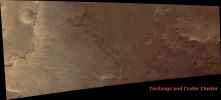
CR-h0500_0000_nd3-00-PCF-LXTT.jpgFrame h0500_0000_nd3-00 - Yardangs and Crater Cluster (Natural Colors; credits for the additional process. and color.: Dr Paolo C. Fienga - Lunexit Team)214 visitenessun commentoMareKromium
|
|
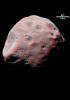
Phobos-406-Mars_Express-stereoME_full.jpgPhobos from Mars Express (HR and Stereo View)198 visitePhobos in versione "stereo", ripreso da una distanza di circa 200 Km dalla Sonda Europea Mars Express. Sulla Sn dell'immagine si può vedere molto bene il famoso "Stickney Crater", di oltre 10 Km di diametro.
Notevole il quantitativo di crateri e crepacci visibili che caratterizza l'intera superficie di questa Luna Marziana e che ci racconta, in play-back, di un passato turbolento.
|
|
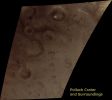
CR-h0330_0000_nd3-PCF-LXTT.jpgFrame h0330_0000_nd3 - Pollack Crater and Surroundings (Natural Colors; credits for the additional process. and color.: Dr Paolo C. Fienga - Lunexit Team)198 visitenessun commentoMareKromium
|
|
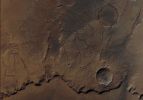
Craters-Huygens_Crater-Rim-ESA-PCF-LXTT.jpgDrainage Channels on the Rim of Huygens Crater (Absolute Natural Colors; credits for the additional process. and color.: Dr Paolo C. Fienga - Lunexit Team)198 visitenessun commentoMareKromium
|
|
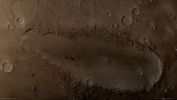
Orcus_Patera-472-20103007-2216-2238-6-co-01-PCF-LXTT2.jpgOrcus Patera (Absolute Natural Colors; credits: Dr Paolo C. Fienga - Lunexit Team)177 visiteCaption ESA:"The High-Resolution Stereo Camera (HRSC), on ESA Mars Express Spacecraft obtained image data in the Orcus Patera Region on 5 and 11 October 2005. The data were acquired during orbits 2216 and 2238 and this image was derived from the HRSC nadir channel, which provides the highest detail of all the channels".MareKromium
|
|

Chasmas-Tithonium_Chasma-2-121-221004-0442-6-co-01.jpgTithonium Chasma - Valles Marineris155 visiteCaption ESA originale:"This image shows the western end of the canyons Tithonium Chasma and Ius Chasma, part of the Valles Marineris canyon system, which are up to 5,5 Km deep.
The image was taken on 26 May 2004 during orbit 442 with a ground resolution of approximately 52 metres per pixel. The displayed region is located at the beginning of the canyon system at about latitude 7° South and longitude 269° East. North is to the left".
|
|
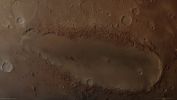
Orcus_Patera-472-20103007-2216-2238-6-co-01-PCF-LXTT1.jpgOrcus Patera (Natural Colors; credits: Dr Paolo C. Fienga - Lunexit Team)147 visiteCaption ESA:"Orcus Patera is an enigmatic elliptical depression located between Elysium and Olympus Mons.
This well-defined depression extends approximately 380 by 140 Km in a N/NE–S/SW direction. It has a Rim that rises up to 1800 mt above the surrounding Plains, while its Floor lies 400–600 mt below the surroundings. The term ‘Patera’ is used for deep, complex or irregularly shaped Volcanic Craters such as the Hadriaca Patera and Tyrrhena Patera at the N/E margin of the Hellas Impact Basin.
However, despite its name and the fact that it is positioned near Volcanoes, the actual origin of Orcus Patera still remains unclear".MareKromium
|
|
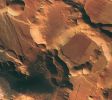
NoctisLabyrinthus.jpgNoctis Labyrinthus (Natural Colors + MULTISPECTRUM; credits: ESA & Lunexit)141 visiteThis image was taken by the High-Resolution Stereo Camera (HRSC), onboard ESA’s Mars Express imaged the Noctis Labyrinthus Region, the ‘Labyrinth of the Night’ on Mars.
The HRSC took these pictures on 25 June 2006 in orbit 3155, with a ground resolution of approx. 16 mt/pixel.MareKromium
|
|
| 106 immagini su 9 pagina(e) |
2 |  |
|
|
|
|
|
|








