| Piú viste - After One-Thousand Soles... |

OPP-SOL2804-1P377116268EFFBR08P2591L5M1-PCF-LXTT.jpgThe "White Wave" - Sol 2804 (Natural Colors; credits for the additional process. and color.: Dr Paolo C. Fienga - Lunexit Team)204 visitenessun commentoMareKromium
|
|
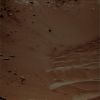
OPP-SOL2540-1P353667729EFFB1I5P2262L2M1-PCF-LXTT.jpgThe Sands of Santa Maria - Sol 2540 (Absolute Natural Colors; credits: Dr Paolo C. Fienga - Lunexit Team)202 visitenessun commentoMareKromium
|
|

OPP-SOL2586-1N357762507EFFB6QZP1978R0M1.jpgFreedom 7 - Sol 2586 (Part I - Natural Colors; credits for the additional process. and color.: Dr Paolo C. Fienga - Lunexit Team) 202 visitenessun commentoMareKromium
|
|
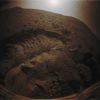
SOL2174-2F319371241EFFB27MP1214R0M1-PCF-LXTT.jpgBye-Bye Spirit! - SOl 2174 (Absolute Natural Colors; credits for the additional process. and color.: Dr Paolo C. Fienga - Lunexit Team)202 visiteMay 25, 2011
NASA Spirit Rover Completes Mission on Mars
NASA has ended operational planning activities for the Mars rover Spirit and transitioned the Mars Exploration Rover Project to a single-rover operation focused on Spirit's still-active twin, Opportunity.
This marks the completion of one of the most successful missions of interplanetary exploration ever launched.
Spirit last communicated on March 22, 2010, as Martian winter approached and the rover's solar-energy supply declined. The rover operated for more than six years after landing in January 2004 for what was planned as a three-month mission. NASA checked frequently in recent months for possible reawakening of Spirit as solar energy available to the rover increased during Martian spring. A series of additional re-contact attempts ended today, designed for various possible combinations of recoverable conditions.
"Our job was to wear these rovers out exploring, to leave no unutilized capability on the surface of Mars, and for Spirit, we have done that" said Mars Exploration Rover Project Manager John Callas of NASA's Jet Propulsion Laboratory, Pasadena, Calif.
Spirit drove 4,8 miles (7,73 Km), more than 12 times the goal set for the mission. The drives crossed a plain to reach a distant range of hills that appeared as mere bumps on the horizon from the Landing Site; climbed slopes up to 30° as Spirit became the first robot to summit a hill on another planet; and covered more than half a mile (nearly a kilometer) after Spirit's right-front wheel became immobile in 2006. The rover returned more than 124.000 images. It ground the surfaces off 15 rock targets and scoured 92 targets with a brush to prepare the targets for inspection with Spectrometers and a Microscopic Imager.
"What's really important is not only how long Spirit worked or how far Spirit drove, but also how much exploration and scientific discovery Spirit accomplished" Callas said.
One major finding came, ironically, from dragging the inoperable right-front wheel as the rover was driving backwards in 2007. That wheel plowed up bright white soil. Spirit's Alpha Particle X-ray Spectrometer and Miniature Thermal Emission Spectrometer revealed that the bright material was nearly pure silica.
"Spirit's unexpected discovery of concentrated silica deposits was one of the most important findings by either rover" said Steve Squyres of Cornell University, Ithaca, N.Y., principal investigator for Spirit and Opportunity. "It showed that there were once hot springs or steam vents at the Spirit site, which could have provided favorable conditions for microbial life".
The silica-rich soil neighbors a low plateau called Home Plate, which was Spirit's main destination after the historic climb up Husband Hill. "What Spirit showed us at Home Plate was that early Mars could be a violent place, with water and hot rock interacting to make what must have been spectacular volcanic explosions. It was a dramatically different world than the cold, dry Mars of today" said Squyres.
The trove of data from Spirit could still yield future science revelations. Years of analysis of some 2005 observations by the rover's Alpha Particle X-ray Spectrometer, Miniature Thermal Emission Spectrometer and Moessbauer Spectrometer produced a report last year that an outcrop on Husband Hill bears a high concentration of carbonate. This is evidence of a wet, non-acidic ancient environment that may have been favorable for microbial life.
"What's most remarkable to me about Spirit's mission is just how extensive her accomplishments became," said Squyres. "What we initially conceived as a fairly simple geologic experiment on Mars ultimately turned into Humanity's first real overland expedition across another planet. Spirit explored just as we would have, seeing a distant hill, climbing it, and showing us the vista from the summit. And she did it in a way that allowed everyone on Earth to be part of the adventure".MareKromium
|
|
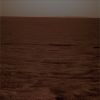
OPP-SOL2572-1P356518029EFFB4X2P2401L2M1-PCF-LXTT.jpgEndeavour's Rim - Sol 2572 (Natural Colors; credits for the additional process. and color.: Dr Paolo C. Fienga - Lunexit Team)201 visitenessun commentoMareKromium
|
|
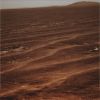
OPP-SOL2594-1P358473801EFFB8FTP2417L2M1-PCF-LXTT.jpgBeyond the Dunes... - Sol 2594 (Absolute Natural Colors; credits for the additional process. and color.: Dr Paolo C. Fienga - Lunexit Team)201 visitenessun commentoMareKromium
|
|
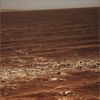
OPP-SOL2594-1P358473693EFFB8FTP2417R2M1-PCF-LXTT.jpgLight Outcrop - Sol 2594 (Natural Colors; credits for the additional process. and color.: Dr Paolo C. Fienga - Lunexit Team)201 visitenessun commentoMareKromium
|
|
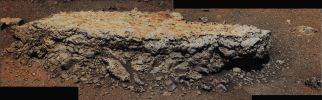
OPP-SOL2690-GB-LXTT-1.jpgRocky Outcrop ("Tisdale-2") near the Edge of Endeavour Crater - Sol 2690 (Absolute Natural Colors; credits for the additional process. and color: Dr Gianluigi Barca - Lunexit Team)201 visitenessun commentoMareKromium
|
|
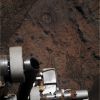
OPP-SOL2735-GB-LXTT-4.jpgLooking at the "RAT Mark" - Sol 2735 (Absolute Natural Colors; credits for the additional process. and color.: Dr Gianluigi Barca - Lunexit Team)201 visitenessun commentoMareKromium
|
|
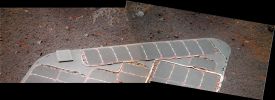
OPP-SOL2793-GB-LXTT-03.jpgSolar Panels - Sol 2793 (an Image-Mosaic in Natural Colors by Dr Gianluigi Barca - Lunexit Team)201 visitenessun commentoMareKromium
|
|
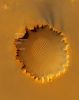
00-VictoriafromMRO.jpgVictoria Crater, from MRO (natural colors)200 visiteQuesto (spettacolare) frame lo potete trovare, in "Approximate True Colors", anche sui Siti NASA dedicati alle Missioni Mars Reconnaissance Orbiter, Opportunity e sul NASA Planetary Photojournal.
Noi, dopo aver valutato le immagini a colori della Regione di Meridiani (sia ottenute dal suolo, sia orbitali), abbiamo concluso che questo frame è stato elaborato non solo in falsi colori, ma "a tavolino", usando un Programma tipo "Paint" o "Photoshop".
Ciò premesso, abbiamo prima decolorizzato il frame NASA Originale e quindi lo abbiamo raffinato e ricolorizzato usando un nostro modestissimo software.
Risultato (che potrete verificare Voi stessi avendo solo un pizzico di pazienza e quindi ponendo a confronto il frame "NASA Originale" con questo): la densità cromatica del frame elaborato da noi è finalmente omogenea (con colori credibili e congrui rispetto ai colori visibili "dal suolo") ed il frame, qualora sottoposto a stretching, non si sgrana (come invece accade al frame NASA Originale).
Attenzione: noi non stiamo dicendo che "siamo più bravi" della NASA! Stiamo solo dicendo che la NASA, per motivi che preferiamo non commentare, "pasticcia" il suo stesso lavoro.
Pensateci sopra...MareKromium
|
|

OPP-SOL5079-1M579076050EFFD2EXP2935M2M1-2.jpgLook who's back!!!... (Part II) - Sol 5079200 visiteClassico esempio di "Illusione Ottica". Difficile analizzare le immagini senza anaglifi, ahimé... Qui ho commesso un grave errore di visione e valutazione, per il quale mi scuso con i Lettori.MareKromium
|
|
| 2388 immagini su 199 pagina(e) |
 |
|
|
|
|
16 | |
|
|
|
|





