| Piú viste - After One-Thousand Soles... |

OPP-SOL1102-1M226014832EFF798DP2956M1M1.jpgLook at the "Martian Light-Horse"! (3) - Sol 110256 visite...Perfetto: un "cavallo di luce" assolutamente perfetto...Non Credete?!?MareKromium
|
|
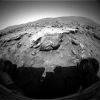
SOL1141-2F227656063EFFAS3KP1201R0M1.jpgErratic Boulder, Ejecta or Old Lava? - Sol 1141 (HR)56 visitenessun commento
|
|
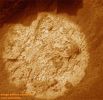
SOL1177-2MMB76ILFATPER48P2936M222M2.jpgThe texture of the "Brown/Orange Soil" of Gusev Crater - Sol 117756 visiteCaption NASA:"On Sol 1177, Spirit used the Rock Abrasion Tool (RAT) to brush away dust covering the surface of a small, nodule-rich outcrop nicknamed "Slide" at the edge of the circular plateau known as "Home Plate". This image mosaic, acquired by the Microscopic Imager (MI), shows the nature of the weathered outcrop surface, just beneath the dust coating. The science team has a special interest in the rocks in this general area, some of which show the highest silica content yet measured on Mars". MareKromium
|
|

SOL1205-2M233343759EFFATEEP2936M2M1.jpgClose views (4) - Sol 120556 visitenessun commentoMareKromium
|
|
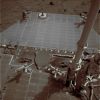
SOL1221-2N234769147EFFATI4P0165R0M1.jpgSpirit's "Solar Panels" - Sol 122156 visitenessun commentoMareKromium
|
|
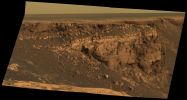
OPP-SOL1167-PIA09694.jpgCape St Vincent (approx. true colors - elab. NASA)56 visiteCaption NASA:"This image captured by NASA's MER Opportunity shows "Cape St. Vincent" one of the many promontories that jut out from the walls of Victoria Crater, Mars. The material at the top of the promontory consists of loose, jumbled rock, then a bit further down into the crater, abruptly transitions to solid bedrock.
This transition point is marked by a bright band of rock, visible around the entire crater.
Scientists say this bright band represents what used to be the surface of Mars before it was impacted to form Victoria Crater. As Opportunity begins to descend into the crater in early July 2007, it will examine the band carefully at an accessible location with a gentle slope.
These investigations might help determine if the band's brighter appearance is the result of ancient interactions with the Martian atmosphere.
This image was taken by Opportunity's PanCam on Sol 1167 (May 6, 2007).
It is presented in approximately true color".MareKromium
|
|
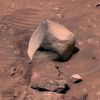
SOL1239-01.jpgUnusual stone near Spirit (2) - Sol 123956 visiteOra, Vi domanderete, perchè spendere tutte queste (in fondo inutili) parole per svolgere delle riflessioni che qualsiasi Lettore potrebbe fare allorchè osservasse con attenzione e per 5 minuti di fila questo frame? Semplice: perchè, sulla base della nostra esperienza, quasi nessuno osserva per 5 minuti di fila un frame come questo e, quindi (ed alla fine), nessun Lettore poi svolge, nel suo foro interno, delle riflessioni simili o analoghe a quelle che noi abbiamo esplicitato. La maggior parte dei Lettori, recentemente, sembra essere molto più coinvolta da altre "problematiche"; su tutte, quella (ormai annosa e noiosa) dei "Colori di Marte".
Ci stiamo sbagliando? Secondo noi no.
In effetti (ed ormai sempre più spesso, come in questo caso), anche i Ricercatori e gli Appassionati, anzichè focalizzare la propria attenzione su dettagli MOLTO interessanti (ivi: una roccia che sta dove non dovrebbe essere), si mettono a discutere su una questione di lana caprina quale è la querelle sui True Colors of Mars al solo ed unico scopo, in fondo (come dice il buon Dr Barca), di poter dire, oggi o domani (o fra 100 anni...):"Vedete? Avevo ragione io! Sono stato io il primo a capire quali fossero i True Colors of Mars!".
Forse lo avevamo già detto ma, a nostro parere, repetita juvant: il vero ed unico Mistero dei "True Colors of Mars" è nella domanda che recita "Come mai i True Colors of Mars sono diventati un Mistero"?
In altre parole: mentre continuiamo a scherzare ed a beccarci sulle "pagliuzze", un sempre più ingente quantitativo di "travi" ci sta passando davanti agli occhi...senza che nessuno apra bocca al riguardo. Questo Erratic Boulder è solo una minuzia, ovviamente, ma serve a rendere l'idea di come sia facile concentrarsi sulle sciocchezze e perdere di vista le cose essenziali. Che ne è stato, ad esempio, della Silver Sphere? E del "tubo argenteo" fotografato da Spirit nei suoi primi Soles? E delle "pseudo-rocce" che cambiavano forma e posizione fra uno scatto e l'altro? E che ci dite del Totem? E delle flares che, di quando in quando, venivano riprese mentre si "accendevano" sulla superficie di Gusev, a non troppa distanza dal Rover?...
Niente. Tutti dettagli dimenticati, passati via.
Tutte questioni (ovviamente) "irrilevanti". Ciò che conta, alla fine, sembra essere solo il "Colore di Marte".
E allora, alla fine della chiacchierata, per capire quanto sia assurda - in fondo - questa pseudo-problematica, provata rispondere ad una domandina semplice-semplice (e tanto ingannevole quanto lo è la domanda sui "Colori del Pianeta Rosso): quali sono i "True Colors" della Terra che Vi circonda?
Sapreste individuarli e descriverli su basi OGGETTIVE?
Provateci, e buon lavoro...MareKromium
|
|
SOL1239-2P236353741ESFAUATP2568R4M1-01.jpgFlat-Rock, after Spirit rolled over it (2)56 visitenessun commentoMareKromium
|
|
OPP-SOL1220-1P236485480EFF85R9P2629L6M1.jpgMorning Mist over Victoria (2) - Sol 122056 visitenessun commentoMareKromium
|
|
SOL1245-2P236905395EFFAUATP2763L4M1.jpgPanorama - Sol 124556 visitenessun commentoMareKromium
|
|

SOL1248-2P237153131EFFAUBKP2629L5M1-PCF-LXTT-00.jpgHeavy Dust and Fog over Gusev Crater - Sol 124856 visitenessun commentoMareKromium
|
|

OPP-SOL1235-PIA09935-DustStorm.gifPlanetary Dust Storm (GIF Movie)56 visiteNASA's Opportunity rover is literally seeing some of its darkest days. Both Mars Exploration Rovers have been riding out a regional dust storm for several weeks. Conditions became particularly dreary in the Meridiani Planum region where Opportunity sits, perched on the edge of "Victoria Crater."
This image is a time-lapse composite where each horizon-survey image has been compressed horizontally (but not vertically) to emphasize the sky. The relative brightness and darkness of the sky from sol to sol (over a 30-sol period beginning June 14, 2007) is depicted accurately in these images, which view roughly the same part of the plains southwest of the rover. The images are approximately true color composites, generated from calibrated radiance data files using the panoramic camera's 601-nanometer, 535-nanometer and 482-nanometer filters.
The rovers' atmospheric science team is concerned that smaller, regional dust storms could expand into a larger, globe-encircling storm. That could extend the time the sun stays obscured, challenging the capability of Opportunity's solar panels to produce enough electricity for the rover to function.
Fortunately, as of July 19, 2007, the Opportunity site is clearing slightly. When the storm ends, atmospheric scientists hope to review data from the rovers that will help them determine what sort of dust was being lifted and distributed.
The numbers across the top of the image report a measurement of atmospheric opacity, called by the Greek letter tau. The lower the number, the clearer the sky. Both Opportunity and Spirit have been recording higher tau measurements in July 2007 than they had seen any time previously in their three and a half years on Mars. The five sol numbers across the bottom correspond (left to right) to June 14, June 30, July 5, July 13 and July 15, 2007.
MareKromium
|
|
| 2388 immagini su 199 pagina(e) |
 |
|
|
|
|
148 | |
|
|
|
|





