| Piú viste - After One-Thousand Soles... |

SOL1198-Sol1198A_P2539_L257F.jpgIn the trench... - Sol 1198 (natural colors; elab. NASA)57 visiteCaption NASA:"A shallow trench made by Spirit's dragging right front wheel uncovered some of the best evidence Spirit has found for ancient water-rich environments in Gusev Crater -- bright patches of almost pure, fine-grained silica (SiO2).
On ancient Earth, warm, evaporating coastal waters deposited fine silica in shallow sediments.
In Yellowstone National Park, hot, mineral-laden waters deposit fine-grained silica around geysers and hot springs. The discovery of silica-rich deposits on Mars adds compelling new evidence of ancient environments that might have been favorable for life".MareKromium
|
|

OPP-SOL1196-PIA09693.jpgDuck Bay - Sol 119657 visiteCaption NASA:"This image shows "Duck Bay", an alcove in the rim of Victoria Crater. NASA's MER Opportunity will roll down the slopes of Duck Bay in early July 2007 and investigate the rocks inside the Crater. One of its first targets will be the bright band of bedrock seen here lining the upper portion of the crater walls.
This band appears to be unlike anything encountered before at Opportunity's Landing Site.
Scientists say it marks the spot where the ground surface used to lie just before an impace formed Victoria Crater.
Future investigations with Opportunity might help determine whether the band's brighter appearance is the result of ancient interactions with the Martian atmosphere".MareKromium
|
|
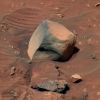
SOL1239-00.jpgUnusual stone near Spirit (1) - Sol 123957 visiteMentre ci congratuliamo con gli Autori di questa splendida interpretazione in "Possibili Colori Naturali" di un frammento di terreno prossimo al MER Spirit (il quale continua a "girellare", come ama dire il nostro Amico e Collega, Dr Alessio Feltri, nei pressi di Home Plate), ci sembra doveroso spendere qualche parola sulla roccia che domina l'inquadratura.
Ebbene, come potete facilmente notare, siamo davanti ad un rilievo che appartiene alla grande Famiglia dei cd. "Macigni Erratici" (Erratic Boulders), ossìa dei macigni i quali, per caratteristiche esteriori (forma, colore, texture etc.) ed interiori (composizione e proprietà chimico/fisiche) non dovrebbero - almeno in teoria - trovarsi dove invece si trovano.
Come avrete notato attraverso l'osservazione dei frames che abbiamo pubblicato negli ultimi mesi, tutta l'area di Home Plate appare ricoperta, oltre che da sabbie e polveri sottili/sottilissime, anche da rocce "porose" e/o "laminari" che noi abbiamo battezzato "Reef-like Rocks" e che la NASA ha più volte ribadito trattarsi di rocce vulcaniche. Le rocce ignee che Spirit ha fotografato in quasi un anno di permanenza in questa zona di Gusev Crater sono tutte caratterizzate, tra l'altro, dal fatto di avere una forma piuttosto irregolare, un colore (tendenzialmente) scuro ed una texture (almeno in apparenza) ruvida, porosa e - spesso - spigolosa (e cioè ricca di angoli vivi, di punte, di lati forse taglienti) o comunque articolata e variegata.
Ora, se quanto sopra detto è vero, il masso che si trova davanti a noi in questo (bellissimo) frame decisamente NON appartiene alla classe delle rocce ignee che abbiamo sommariamente descritto. La sua texture, infatti, è liscia (gli angoli appaiono addirittura smussati); il colore è decisamente chiaro (bianco e grigio/azzurro) e la forma, sostanzialmente regolare.
Anzi: se osservate attentamente il lato Dx del macigno (a Sx dell'Osservatore) non potrete non notare che esso pare come "tagliato di netto": una feature, questa, decisamente rara e curiosa.
Una feature che, ai Ricercatori di Scuola Hoaglandiana - che sono decine di migliaia - farebbe subito scattare l'idea del "possibile artifact" (e, come ormai saprete bene, di pseudo-artifacts, i Colleghi Troy, Bara & C. ne hanno visti in casi MOLTO MENO ECLATANTI di questo).
Ed invece, a quanto pare, niente da dire. Non si discute sul "taglio" che pare aver interessato - in un tempo forse neppure tanto remoto - questo macigno.
Adesso si discute sul "colore" del macigno (e del paesaggio al quale esso accede).
Si discute...Parolona! Diciamo che "si specula", che è più giusto e più corretto.MareKromium
|
|
OPP-SOL1224-1N236844860EFF85R9P1963R0M1.jpgFresh wind-tails - Sol 1224 (natural colors - elab. Lunexit)57 visitenessun commentoMareKromium
|
|

SOL1252-2P237513744ESFAUCMP2576R3M1.jpgBoulders... - Sol 125257 visitenessun commentoMareKromium
|
|
OPP-SOL1232-1N237560312EFF85W0P1993R0M1.jpgClearing Skies over Meridiani... (3) - Sol 123257 visitenessun commentoMareKromium
|
|
SOL1254-2N237599908EFFAUCMP1936R0M1.jpgFoggy days over Gusev Crater... - Sol 125457 visitenessun commentoMareKromium
|
|
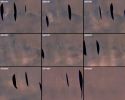
OPP-SOL1235-PIA-00937.jpgSeries of Storms Shrouds Mars in Dust (2) - NASA/JPL/Malin Space Science Systems57 visiteThis sequence of Mars Reconnaissance Orbiter (MRO) Mars Color Imager (MARCI) daily mosaics shows some of the dust storm activity that occurred near the Mars Exploration Rover (MER) Opportunity landing site between 21 June 2007 and 18 July 2007. The Opportunity rover is located near the martian prime meridian and equator. The top and middle rows of images show the first six days of dust storm activity near the rover site as dust advanced from the west to the south and passed south of the rover over the course of a week. By the end of that first week, storm activity strengthened and continued to move east, eventually passing over nearly half of the martian southern hemisphere. Other storms spawned by this atmospheric disturbance affected the MER Spirit rover on the other side of the planet, while new storms developed, approached, and affected Opportunity. The bottom three images show dust activity over the MER Opportunity site on 3, 14, and 18 July. By 19 July, most of the martian surface was obscured by the dust lofted from these storms. As with previous large dust-raising events on Mars, once the active storms die down, many weeks to months will pass before the dust settles out and the atmosphere clears. The white circle indicates the location of the Opportunity landing site, the black gaps are caused by slewing the spacecraft east or west to image specific science targets, and north in each picture is toward the top, west is to the left.
MareKromium
|
|
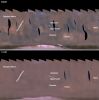
OPP-SOL1235-PIA-00936.jpgSeries of Storms Shrouds Mars in Dust (1) - NASA/JPL/Malin Space Science Systems57 visiteSince late June 2007, Mars has been having a series of regional dust storms. The dust raised by these individual storms has obscured most of the planet over the past few weeks. The two maps shown here are mosaics of images acquired by the Mars Reconnaissance Orbiter (MRO) Mars Color Imager (MARCI) on two days separated by about 3 and a half weeks. The first, on 22 June, shows that there was a dust storm occurring near the east end of the Valles Marineris trough system (left of the label for "Opportunity" in the map). This was the first in the series of storms. The second mosaic shows how Mars appeared on 17 July, after dust was lofted high into the atmosphere by several regional storms and countless smaller, local dust storms.
Each map was constructed from 13 pole-to-pole image swaths at red, green, and blue wavelengths acquired by the MRO MARCI. The maps are simple cylindrical projections, with north at the top and south at the bottom. Each image swath was acquired at about 3 p.m. local time on Mars over the course of 13 orbits. The black gaps occur in the MARCI data at places where the MRO spacecraft was slewed east or west to point its instruments at a specific target of scientific interest. The north polar region is not shown because winter began on 4 July and the north polar region is in wintertime darkness. Key features labeled on the maps include the Tharsis Montes and Olympus Mons volcanoes, the Hellas impact basin, Noachis Terra, Sinus Meridiani, and the two Mars Exploration Rover (MER) landing sites, Opportunity and Spirit. The dust storms, and the planet-encircling dust veil they generated, has greatly reduced the amount of sunlight available to run the two solar-powered rovers.
MareKromium
|
|

OPP-SOL1254-1P239512176EFF85W0P2351L7M1.jpgRover Tracks and bright "berries" all over... - Sol 1254 (False Colors; credits: Lunexit)57 visiteUna splendida immagine dei Berries che circondano Opportunity ci arriva (diremmo finalmente!) da Meridiani Planum, Sol 1254. Forse la tempesta di sabbia che aveva messo in pericolo la sopravvivenza dei MER si sta esaurendo e, forse, è ancora presto per dichiarare il cessato allarme.
Comunque sia, questa immagine (assieme a molte altre appena pervenute e da poco processate e colorizzate) ci dimostra che Opportunity è ancora in eccellente salute e riesce a fare il proprio lavoro egregiamente.
Noi - in tutta sincerità - non ne abbiamo mai dubitato.MareKromium
|
|

OPP-SOL1266-1R240573239EFF85W0P1369L0M1.jpgA still dusty sky and horizon... - Sol 1266 (natural colors; elab. Lunexit)57 visitenessun commentoMareKromium
|
|

OPP-SOL1266-1N240572984EDN85W0P1585L0M1.jpgThe sky over Opportunity - Sol 1266 (natural colors; elab. Lunexit)57 visitenessun commentoMareKromium
|
|
| 2388 immagini su 199 pagina(e) |
 |
|
|
|
|
128 | |
|
|
|
|





