| |

| Ultimi arrivi - SOLAR SYSTEM |

ZZ-Mercury-Craters-Balanchine_Crater-PIA17057-PCF-LXTT-IPF-1.jpgBalanchine Crater (CTX Frame - Absolute Natural Colors; credts for the additional process. and color.: Dr Paolo C. Fienga/Lunar Explorer Italia/Italian Planetary Foundation)71 visiteThe Impact Crater located at the center of this scene (such as the one whose Floor is largely covered by extremely bright - and therefore, here, slightly over-exposed - Hollows) has been named "Balanchine", after the choreographer George Balanchine (Leningrad, 1904/New York City - NY - 1983). Now, if you carefully take a look at the Ejecta Blanket which emanates from Balanchine Crater, you may ask yourself what could have caused such an Asymmetric Pattern. Obviously, an absolutely definitive answer to this kind of question, as you should know, cannot be given by anybody, but one reasonable possibility is that the irregularly shaped Ejecta Pattern of Balanchine Crater formed (maybe just in part) on top of a similarly sized, and, of course, pre-existing, Impact Crater.
In this scenario, the older Impact Crater could have unearthed the Lower Reflectance dark-gray Deposit (as a matter of fact, in Absolute Natural Colors this Material looks almost black - blue in the Original NASA false color image-mosaic) from beneath the Surface, while, some time (perhaps a few millions of years) afterwards, a certain portion of them was (unevenly) redistributed all over the Mercurian Surface by the impact that formed Balanchine.
The Cracks that are well visible in the lower left (Sx) quadrant of the mosaic, on the other hand, are part of the Complex System of Graben that cuts the Floor of the giant Caloris Basin, in which Balanchine Crater is located. North is up.
Date acquired: June 29th, 2011
Images Mission Elapsed Time (MET): 217863931, 217863927, 217863923
Images ID: 441964, 441963, 441962
Instrument: Wide Angle Camera (WAC) of the Mercury Dual Imaging System (MDIS)
Center Latitude: 39,05° North
Center Longitude: 175,80° East
Resolution: 282 meters/pixel
Solar Incidence Angle: 39,6° (meaning that the Sun, at the time that the picture was taken, was about 50,4° above the imaged Local Mercurian Horizon)
Emission Angle: 6,3°
Sun-Mercury-Messenger (or "Phase") Angle: 40,9°
This picture (which is an Original NASA - MESSENGER Spacecraft Map Projected false color image-mosaic published on the NASA - Planetary Photojournal with the ID n. PIA 17057) has been additionally processed, contrast enhanced, magnified and then re-colorized in Absolute Natural Colors (such as the colors that a human eye would actually perceive if someone were onboard the NASA - MESSENGER Spacecraft and then looked down, towards the Surface of Mercury), by using an original technique created - and, in time, dramatically improved - by the Lunar Explorer Italia Team. Different colors, as well as different shades of the same color, mean, among other things, the existence of different Elements (Minerals) present on the Surface of Mercury, each having a different Albedo (---> Reflectivity) and Chemical Composition.MareKromiumMag 26, 2013
|
|

ZZ-Mercury-Full_Disk-PIA16852-PCF-LXTT-IPF.jpgMercury (Possible Absolute Natural Colors; credits for the additional process. and color.: Dr Paolo C. Fienga/Lunar Explorer Italia/Italian Planetary Foundation)99 visiteThis extremely detailed and, in fact, really impressive view of the Planet Mercury was produced by using images from the Color Base Map Imaging Campaign that was carried out during the NASA - MESSENGER Spacecraft's Primary Mission. Young Rays, extending radially from (relatively) fresh Impact Craters, appear of a light gray or whitish color; the dark-gray and almost black-colored Regions and Areas are those Geologic Units of Mercury's Crust which are known as the "Low-Reflectance Material" (such as a Material that, according to the opinion of many Planetary Scientists, is thought to be rich in a dark and opaque Mineral). The brown and orange Regions are Plains that were formed, most likely, by the passage of Highly Fluid Lavas. The Impact Crater visible in the upper right of the image, at about one 'clock, and whose etremely well defined Rays' System stretches across the entire Planet, is Hokusai Crater.
We, as IPF, believe that the different colors of Mercury, as visible in this picture (which is an Ortographic Projection of the Innermost Planet in the Solar System), also can tell us something important about the age of the various Mercurian Regions and Areas. For instance, the almost black (or completely black) Areas and Spots, should be the ones which were more exposed to (and therefore that should have suffered for the longest time) the relentless action of the Charged Particles forming the Solar Wind and the Cosmic Rays. This means, in terms of age of these Areas and Spots, that the Surface Materials forming them should be the oldest ones that can be found on the Planet.
On the other hand, the Regions and Areas whose colors become less and less dark (and therefore we are talking about colors going from brown and dark orange, to yellow and, finally, to light gray or white) should be the ones that were less exposed to the so-called Cosmic Weathering, and this means, still in terms of age, that the Surface Materials that form them, should be the youngest ones present, today, on Mercury.
Instrument: Wide Angle Camera (WAC) of the Mercury Dual Imaging System (MDIS)
Center Latitude: 0°
Center Longitude: 320,00° East
This image (which is an Original NASA - MESSENGER Spacecraft false color image-mosaic published on the NASA - Planetary Photojournal with the ID n. PIA 16852) has been additionally processed and then re-colorized in Absolute Natural Colors (such as the colors that a human eye would actually perceive if someone were onboard the NASA - MESSENGER Spacecraft and then looked outside, towards the Planet Mercury), by using an original technique created - and, in time, dramatically improved - by the Lunar Explorer Italia Team. Different colors, as well as different shades of the same color, mean, among other things, the existence of different Elements (Minerals) present on the Surface of Mercury, each having a different Albedo (---> Reflectivity) and Chemical Composition.MareKromiumMag 14, 2013
|
|

ZZ-Mercury-Full_Disk-PIA16853-PCF-LXTT-IPF.jpgMercury (Possible Absolute Natural Colors; credits for the additional process. and color.: Dr Paolo C. Fienga/Lunar Explorer Italia/Italian Planetary Foundation)101 visiteThis extremely detailed and, in fact, really impressive view of the Planet Mercury was produced by using images from the Color Base Map Imaging Campaign that was carried out during the NASA - MESSENGER Spacecraft's Primary Mission. Young Rays, extending radially from (relatively) fresh Impact Craters, appear of a light gray or whitish color; the dark-gray and almost black-colored Regions and Areas are those Geologic Units of Mercury's Crust which are known as the "Low-Reflectance Material" (such as a Material that, according to the opinion of many Planetary Scientists, is thought to be rich in a dark and opaque Mineral). The brown and orange Regions are Plains that were formed, most likely, by the passage of Highly Fluid Lavas. The giant Caloris Impact Basin is the large, and very well visible, circular yellow-orangish Surface Feature located just near the upper right of center of the image (such as at abour one 'o clock of Mercury's disk).
We, as IPF, believe that the different colors of Mercury, as visible in this picture (which is an Ortographic Projection of the Innermost Planet in the Solar System), also can tell us something important about the age of the various Mercurian Regions and Areas. For instance, the almost black (or completely black) Areas and Spots, should be the ones which were more exposed to (and therefore that should have suffered for the longest time) the relentless action of the Charged Particles forming the Solar Wind and the Cosmic Rays. This means, in terms of age of these Areas and Spots, that the Surface Materials forming them should be the oldest ones that can be found on the Planet.
On the other hand, the Regions and Areas whose colors become less and less dark (and therefore we are talking about colors going from brown and dark orange, to yellow and, finally, to light gray or white) should be the ones that were less exposed to the so-called Cosmic Weathering, and this means, still in terms of age, that the Surface Materials that form them, should be the youngest ones present, today, on Mercury.
Instrument: Wide Angle Camera (WAC) of the Mercury Dual Imaging System (MDIS)
Center Latitude: 0°
Center Longitude: 140,00° East
This image (which is an Original NASA - MESSENGER Spacecraft false color image-mosaic published on the NASA - Planetary Photojournal with the ID n. PIA 16853) has been additionally processed and then re-colorized in Absolute Natural Colors (such as the colors that a human eye would actually perceive if someone were onboard the NASA - MESSENGER Spacecraft and then looked outside, towards the Planet Mercury), by using an original technique created - and, in time, dramatically improved - by the Lunar Explorer Italia Team. Different colors, as well as different shades of the same color, mean, among other things, the existence of different Elements (Minerals) present on the Surface of Mercury, each having a different Albedo (---> Reflectivity) and Chemical Composition.MareKromiumMag 14, 2013
|
|

ZZ-Mercury-Volcanic_Features-Vent-PIA15245-PCF-LXTT-IPF.jpgVolcanic Vent on the Edge of Caloris Basin (Absokute Natural Colors; credits for the additional process. and color.: Dr Paolo C. Fienga/Lunar Explorer Italia/Italian Planetary Foundation)72 visiteThis kidney-shaped Surface Depression (which is approximately 23 Km - such as 14,283 miles - across its longest dimension) lies along the Inner Margin of the giant Caloris Basin and it was first imaged during the NASA - MESSENGER Spacecraft's first Fly-By of the innermost Planet in the Solar System, about 2 years ago. The Rimless, non-circular Surface Depression is, in fact, the Vent of a small, explosive Volcano, and it is similar to many other Volcanic Vents that have been discovered on Mercury. The small number of superposed Impact Craters indicates that this Feature is, just in a manner of speaking, relatively "young" as to the surrounding Terrain. Notice, also, the considerable number of bright Hollows that seem to characterize a large portion of the Inner Rim as well as the East-facing Slopes of the small Impact Crater located right outside the Eastern Margin of the Vent, at about 4 o'clock of the Main Feature.
Note: for another view of this Volcanic Vent and its extremely interesting surroundings (seen on a larger scale), please refer to the APOD of December, 22nd, 2012.
Date acquired: June 7th, 2011
Image Mission Elapsed Time (MET): 215894570
Image ID: 347724
Instrument: Narrow Angle Camera (NAC) of the Mercury Dual Imaging System (MDIS)
Center Latitude: 22,5° North
Center Longitude: 146,1° East
Resolution: 28 meters/pixel
Solar Incidence Angle: 39,6° (meaning that the Sun, at the time that the picture was taken, was about 50,4° above the imaged Local Mercurian Horizon)
Emission Angle: 45,5°
Sun-Mercury-Messenger (or "Phase") Angle: 78,3°
This picture (which has been cropped from an Original NASA - MESSENGER Spacecraft b/w frame published on the NASA - Planetary Photojournal with the ID n. PIA 15245) has been additionally processed and then colorized in Absolute Natural Colors (such as the colors that a human eye would actually perceive if someone were onboard the NASA - MESSENGER Spacecraft and then looked down, towards the Surface of Mercury), by using an original technique created - and, in time, dramatically improved - by the Lunar Explorer Italia Team. Different colors, as well as different shades of the same color, mean, among other things, the existence of different Elements (Minerals) present on the Surface of Mercury, each having a different Albedo (---> Reflectivity) and Chemical Composition.MareKromiumMag 14, 2013
|
|

Dione_and_Mimas-PIA14619-PCF-LXTT-IPF-1.jpgSo close, and yet so far... (Absolute Natural Colors; credits for the additional process. and color.: Dr Paolo C. Fienga/Lunar Explorer Italia/Italian Planetary Foundation)91 visiteThe Saturnian moon Mimas peeps out from behind the larger moon Dione in this suggestive view of a so-called "Mutual Event" as it was seen from and recorded by the NASA - Cassini Spacecraft. Mimas (which is approx. 246 miles - such as a little less than 396 Km - across) is near the bottom center of the image. This view looks toward the anti-Saturn side of Dione (which is about 698 miles - such as approx 1123,3 Km - across). North on Dione is up and rotated 20° to the right.
The image was taken in Visible Light with the NASA - Cassini Spacecraft Narrow-Angle Camera on December 12, 2011, at a distance of approximately 377.000 miles (such as about 606.721 Km) from Mimas and approximately 56.000 miles (such as a little more than 90.000 Km) from Dione, at a Sun-Dione-Cassini Spacecraft , or Phase, Angle of 42°. Image scale is 1773 feet (such as about 540,41 meters) per pixel on Dione.
This frame (which is a crop from an Original NASA - Cassini Spacecraft b/w image published on the NASA - Planetary Photojournal with the ID n. PIA 14619) has been additionally processed and then colorized in Absolute Natural Colors (such as the colors that a human eye would actually perceive if someone were onboard the NASA - Cassini Spacecraft and then looked outside, towards the Saturnian moons Dione and Mimas), by using an original technique created - and, in time, dramatically improved - by the Lunar Explorer Italia Team. Different colors, as well as different shades of the same color, mean, among others, the existence of different Elements present on the Surface of Dione and Mimas, each having a different Albedo (---> Reflectivity) and Chemical Composition.MareKromiumMag 14, 2013
|
|

Venus-Mariner_10.jpgVenus, from Mariner 10 (Natural Colors; credits: NASA/JPL)122 visitenessun commentoMareKromiumApr 28, 2013
|
|

ZZ-Mercury-Volcanic_Features-Vent-GC-PIA16990-PCF-LXTT-IPF-1.jpgVolcanic Vent? (Absokute Natural Colors; credits for the additional process. and color.: Dr Paolo C. Fienga/Lunar Explorer Italia/Italian Planetary Foundation)100 visiteThis picture is a NASA - MESSENGER Spacecraft frame that shows us a potential Volcanic Vent located within the Mercurian Impact Crater Glinka. The resolution of this image (which is approx. 46 Km - such as about 28,566 miles - across) is more than two times better than the one of quite a few previous images of the same area, but there are still many doubts among Planetary Scientists that the Depression of the Surface that we see here is actually a Volcanic Vent (---> as a matter of fact, it could also easily be an unusually-looking Collapse Pit, for instance...). The Impact Crater Glinka was named after the Russian composer Mikhail Glinka (1804 - 1857), who is regarded as one of the Fathers of the Russian Classical Music.
Date acquired: November 26th, 2012
Image Mission Elapsed Time (MET): 262402263
Image ID: 3026496
Instrument: Narrow Angle Camera (NAC) of the Mercury Dual Imaging System (MDIS)
Center Latitude: 14,96° North
Center Longitude: 247,40° East
Resolution: 44 meters/pixel
Solar Incidence Angle: 67,5° (meaning that the Sun, at the time that the picture was taken, was about 22,5° above the imaged Local Mercurian Horizon)
Emission Angle: 3,1°
Sun-Mercury-Messenger (or "Phase") Angle: 64,5°
This image (which has been cropped from an Original NASA - MESSENGER Spacecraft Map Projected b/w frame published on the NASA - Planetary Photojournal with the ID n. PIA 16990) has been additionally processed and then colorized in Absolute Natural Colors (such as the colors that a human eye would actually perceive if someone were onboard the NASA - MESSENGER Spacecraft and then looked down, towards the Surface of Mercury), by using an original technique created - and, in time, dramatically improved - by the Lunar Explorer Italia Team. Different colors, as well as different shades of the same color, mean, among other things, the existence of different Elements (Minerals) present on the Surface of Mercury, each having a different Albedo (---> Reflectivity) and Chemical Composition.MareKromiumApr 28, 2013
|
|

ZZ-Mercury-Craters-Snorri_Crater-PIA16993-PCF-LXTT-IPF.jpgSnorri Crater (Absolute Natural Colors; credits for the additional process. and color.: Dr Paolo C. Fienga/Lunar Explorer Italia/Italian Planetary Foundation)101 visiteThe bright, Rayed Impact Crater visible in this image taken by the NASA - MESSENGER Spacecraft, is one of the most prominent that we can find on the Planet Mercury. Named Snorri, after an Icelandic writer and poet, this Impact Crater is approx. 21 Km (such as a little more than 13 miles) in diameter and it was, in fact, discovered after the examination of the images returned by the NASA - Mariner 10 Spacecraft when it flew by Mercury on September, 21, 1974.
This frame was acquired as part of MDIS's High-Resolution Surface Morphology Base Map. The Surface Morphology Base Map covers more than 99% of Mercury's Surface with an Average Resolution of 200 meters/pixel. Images acquired for the Surface Morphology Base Map typically are obtained at off-vertical Sun Angles (---> high Solar Incidence Angles) and have visible Shadows so to clearly reveal the actual topographic forms/shapes of the imaged Geologic Features.
Date acquired: October, 14th, 2011
Image Mission Elapsed Time (MET): 227045180
Image ID: 882221
Instrument: Narrow Angle Camera (NAC) of the Mercury Dual Imaging System (MDIS)
Center Latitude: 9,42° South
Center Longitude: 277,10° East
Resolution: 195 meters/pixel
Solar Incidence Angle: 22,4° (meaning that the Sun, at the time that the picture was taken, was about 67,6° above the imaged Local Mercurian Horizon)
Emission Angle: 51,0°
Sun-Mercury-Messenger (or "Phase") Angle: 73,4°
This image (which is an Original NASA - MESSENGER Spacecraft Map Projected b/w frame published on the NASA - Planetary Photojournal with the ID n. PIA 16993) has been additionally processed and then colorized in Absolute Natural Colors (such as the colors that a human eye would actually perceive if someone were onboard the NASA - MESSENGER Spacecraft and then looked down, towards the Surface of Mercury), by using an original technique created - and, in time, dramatically improved - by the Lunar Explorer Italia Team. Different colors, as well as different shades of the same color, mean, among other things, the existence of different Elements (Minerals) present on the Surface of Mercury, each having a different Albedo (---> Reflectivity) and Chemical Composition.MareKromiumApr 28, 2013
|
|

ZZ-Mercury-Z2.jpgFading away...120 visiteUn piccolo esempio di come la NASA "giochi" con i colori dei Pianeti: nell'inset, come da didascalia, un'immagine in "True Colors" di Mercurio ottenuta dalla Sonda Mariner 10, durante il terzo Fly-By di Mercurio, occorso nel lontano AD 1975. Mercurio, come in TUTTE le foto dell'epoca (incluse quelle ottenute via-telescopio, da Terra) appare di un color rossiccio/marrone, ed infatti più di un Astronomo, in quegli anni, disse che Mercurio era "molto più rosso/arancio di Marte".
Perchè?
Per effetto dell'azione, incessante e combinata, delle particelle cariche che formano il Vento Solare ed i Raggi Cosmici; particelle che, per almeno 4,5/5 miliardi di anni, hanno "martellato" Mercurio (particelle cariche le quali, unite all'azione di bombardamento meteorico, costituiscono l'essenza del cosiddetto "Space Weathering").
Ora, qual'è l'effetto del bombardamento di particelle cariche sulla roccia che forma i Corpi Celesti "massicci" (la roccia che è "esposta" al duro "Ambiente Cosmico", come si dice tecnicamente - Harsh Space Environment)? Semplice: prima la roccia diventa rosa, poi più scura (diciamo arancio/rossiccia), poi ancora più scura (rosso/marrone) ed infine diviene nera. In altre parole: l'azione congiunta delle particelle che formano il Vento Solare (il quale "batte" Mercurio incessantemente e da - relativamente - vicino) e di quelle che formano i Raggi Cosmici, porta la roccia a diventare, negli eoni, sempre più scura.
Questo concetto che Vi ho appena esposto è accettato dall'INTERA Comunità Scientifica.
Ora, come vedete, la NASA ci fa vedere un qualcosa di assolutamente bizzarro, ossia la Superficie di Mercurio che, negli anni tra il 1975 ed il 2011, anzichè rimanere scura (o scurirsi ancor di più) si è "schiarita". E allora? Come è mai possibile una cosa simile? Semplice: non è possibile.
Questo vuol dire che le foto Mariner 10 del 1975 (dal punto di vista cromatico) erano genuine, al pari delle immagini ottenute da Terra. D'altro canto, le foto MESSENGER che ci arrivano adesso sono, sempre dal punto di vista cromatico, "taroccate": per l'esattezza, sono state TUTTE sovrasaturate - ergo sbiadite nei toni cromatici, così "trasformando" Mercurio da Pianeta Rossiccio/Marrone, in Pianeta Grigio.
Perchè? Beh, questo chiedetelo ai Ragazzi di Pasadena: loro, con i colori, ci giocano da parecchi anni....MareKromiumApr 26, 2013
|
|

ZZ-Mercury-Craters-Donalaitis_Crater-PIA16958-PCF-LXTT-IPF-1.jpgDonelaitis Crater (Absolute Natural Colors; credits for the additional process. and color.: Dr Paolo C. Fienga/Lunar Explorer Italia/IPF)125 visiteThis composite of three frames, taken by the NASA - MESSENGER Spacecraft in August 2011, shows us the recently named Donalaitis Crater (whose diameter is approx. 84,5 Km - such as about 52,47 miles - and it lies well visible at the center of the image). As you can see, this Complex Mercurian Impact Crater exhibits some extremely unusually-looking bright yellow-orangish Deposits on its Floor. These colorful and very bright Deposits, as you may easily notice, contrast starkly with the much darker and gray colors (with pale brown/reddish nuances and some brighter white spots - where the latter could be, perhaps, some Hollows-covered areas) of the surrounding (and highly cratered) Terrain.
Donelaitis Crater was named after Kristijonas Donelaitis (1714 - 1780), a Lithuanian poet. His classic poem, 'The Seasons (Metai)', describes the lives of Lithuanian peasants, who at the time of its writing were being pushed into serfdom as most of their country was annexed by the Russian Empire.
Date acquired: August, 21st, 2011
Images Mission Elapsed Time (MET): 222408661, 222408681, 222408665
Images ID: 658976, 658981, 658977
Instrument: Wide Angle Camera (WAC) of the Mercury Dual Imaging System (MDIS)
Center Latitude: 51,81° South
Center Longitude: 39,11° East
Resolution: 874 meters/pixel
Solar Incidence Angle: 56,2° (meaning that the Sun, at the time that the picture was taken, was about 33,8° above the imaged Local Mercurian Horizon)
Emission Angle: 0,5°
Sun-Mercury-Messenger (or "Phase") Angle: 55,7°
This picture (which has been cropped from an Original NASA - MESSENGER Spacecraft false color image-mosaic published on the NASA - Planetary Photojournal with the ID n. PIA 16958) has been additionally processed and then colorized in Absolute Natural Colors (such as the colors that a human eye would actually perceive if someone were onboard the NASA - MESSENGER Spacecraft and then looked down, towards the Surface of Mercury), by using an original technique created - and, in time, dramatically improved - by the Lunar Explorer Italia Team. Different colors, as well as different shades of the same color, mean, among other things, the existence of different Elements (Minerals) present on the Surface of Mercury, each having a different Albedo (---> Reflectivity) and Chemical Composition.MareKromiumApr 20, 2013
|
|
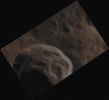
ZZ-Mercury-Craters-Unnamed_Crater-PIA16948-PCF-LXTT-IPF.jpgUnnamed Crater with "Slump" Deposits (Absolute Natural Colors; credits for the additional process. and color.: Dr Paolo C. Fienga/Lunar Explorer Italia/Italian Planetary Foundation)134 visiteThe Unnamed Impact Crater visible in this image taken by the NASA - MESSENGER Spacecraft shows prominent "Slump Deposits" that were created when the Crater Walls collapsed and, perhaps, some portion of the Ejecta, fell back down, inside the Crater itself. These events, according to NASA Scientists, probably occurred immediately (or just a VERY little time) after the Crater formation. If you look closely, you can also see that the Inner Rim appears to host small patches of Hollows. One clue to understand the Hollow formation is that they appear to form, preferentially (but NOT always!), on Sunward-facing Slopes (and since this Impact Crater is located at a high Northern Latitude, its Northern (Inner) Wall gets the most exposure to the Sun). This extra heating may enhance the sudden loss (---> escape) of the Volatiles that are present in and near the subsurface, thus creating those strange, bright Features that are now commonly known as "Hollows" (---> litterally: a "hollow" is a place that once was full of "something" - i.e.: Ice, Gases and/or other Volatiles like Nitrogen, Carbon Dioxide, Ammonia, Hydrogen, Methane and Sulfur Dioxide - and that now has become empty).
Date acquired: October 12th, 2012
Image Mission Elapsed Time (MET): 258544256
Image ID: 2752092
Instrument: Narrow Angle Camera (NAC) of the Mercury Dual Imaging System (MDIS)
Center Latitude: 59,38° North
Center Longitude: 307,20° East
Resolution: 16 meters/pixel
Solar Incidence Angle: 71,8° (meaning that the Sun, at the time that the picture was taken, was about 18,2° above the imaged Local Mercurian Horizon)
Emission Angle: 50,2°
Sun-Mercury-Messenger (or "Phase") Angle: 122,1°
This picture (which is an Original NASA - MESSENGER Spacecraft Map Projected b/w frame published on the NASA - Planetary Photojournal with the ID n. PIA 16948) has been additionally processed and then colorized in Absolute Natural Colors (such as the colors that a human eye would actually perceive if someone were onboard the NASA - MESSENGER Spacecraft and then looked down, towards the Surface of Mercury), by using an original technique created - and, in time, dramatically improved - by the Lunar Explorer Italia Team. Different colors, as well as different shades of the same color, mean, among other things, the existence of different Elements (Minerals) present on the Surface of Mercury, each having a different Albedo (---> Reflectivity) and Chemical Composition.MareKromiumApr 20, 2013
|
|

090-Craters-Cornelia_Crater-PIA16489-PCF-LXTT-IPF.jpgCornelia Crater (Absolute Natural Colors; credits for the additional process. and color.: Dr Paolo C. Fienga/Lunar Explorer Italia/Italian Planetary Foundation)132 visiteThis frame shows us a consistent number of examples of long, narrow and sinuous Gullies that scientists on NASA's Dawn Mission have found on the Giant Asteroid 4-Vesta. The Impact Crater shown here is called Cornelia and the Gullies inside it - called "Type-B" Gullies - are different substantially from the straighter, wider, shorter Gullies that Planetary Scientists have found on different Celestial Bodies (like the ones located on the Rims of many Martian Impact Craters, for instance) and which are designated as "Type-A" Gullies (and the reason of such a distinction is found in the circumstance that these two Gully-types have different formation mechanisms). This picture was obtained by the NASA - Dawn Spacecraft Framing Camera on January 11, 2012; North is up.
This frame (which is an Original NASA - Dawn Spacecraft b/w image published on the NASA - Planetary Photojournal with the ID n. PIA 16489) has been additionally processed and then colorized, according to an informed speculation carried out by Dr Paolo C. Fienga (LXTT-IPF), in Absolute Natural Colors (such as the colors that a human eye would actually perceive if someone were onboard the NASA - Dawn Spacecraft and then looked outside, towards the Surface of the Giant Asteroid 4-Vesta), by using an original technique created - and, in time, dramatically improved - by the Lunar Explorer Italia Team. Different colors, as well as different shades of the same color, mean, among others, the existence of different Elements present on the Surface of 4-Vesta, each having a different Albedo (---> Reflectivity) and Chemical Composition.MareKromiumApr 20, 2013
|
|
| 4548 immagini su 379 pagina(e) |
|
|
|
|
|
21 | |
|
|
|
|
|
|





