| Ultimi arrivi - SOLAR SYSTEM |

ZZ-ZZ-ZZ-ZZ-ZZ-ZZ-ZZ-ZZ-ZZ-Pluto-PIA21863.jpgFlying over Pluto...80 visiteNote: the topographic reliefs visible here have been exaggerated by a factor of 2 to 3 to emphasize topography; the Surface colors have also been enhanced to bring out detail. Digital mapping and rendering were performed by Paul Schenk and John Blackwell of the Lunar and Planetary Institute in Houston".
MareKromiumGen 20, 2020
|
|

ZZZ-Mercury-PIA19424.jpg104 visiteCaption NASA:"The MESSENGER Spacecraft sent this frame back to Earth after the it emerged from Superior Solar Conjunction, when the communication is largely blocked by the Sun. This is one of our last views of Mercury from MESSENGER. Featured here is the Ejecta Blanket of a (relatively) fresh Unnamed Impact Crater located just outside the scene. Ejecta scoured the Surface leaving behind beautiful patterns of Secondary Impact Craters".
Date acquired: April 16, 2015
Image Mission Elapsed Time (MET): 71544702
Image ID: 8343072
Instrument: Narrow Angle Camera (NAC) of the Mercury Dual Imaging System (MDIS)
Center Latitude: 55,67° North
Center Longitude: 97,37° East
Resolution: 19,9 meters/pixel
Scale: This scene is approximately 20 Km acrossMareKromiumGen 20, 2020
|
|

ZZ-Mercury-Terminator-PIA10937-1.jpgNorthern Latitudes and a possible Orbital Anomaly (EDM - Enhanced Natural Colors; credits for the add. process. and color.: Dr Paolo C. Fienga)) 131 visiteRaggio Cosmico, senza dubbi.MareKromiumGen 06, 2020
|
|

Tethys-PIA09915-1.jpgShall Odysseus ever find Ithaca? (Stretched Absolute Natural Colors; credits for the add. process.: Dr Paolo C. Fienga-LXTT-IPF)159 visiteCaption NASA:"From a highly inclined orbit, the Cassini Spacecraft looks toward far Northern Latitudes on Tethys.
Here, the spacecraft was above a position about 45° North of the moon's Equator.
This vantage point afforded a view of the moon's three most recognizable features: the Ithaca Chasma Canyon System (at lower right), Odysseus Crater (at upper left) and the Equatorial Band of Darker Terrain (at lower left).
Lit terrain seen here is on the Leading Hemisphere of Tethys (1062 Km, or approx. 660 miles across). North is up.
The image was taken in Visible Light with the NASA - Cassini Spacecraft narrow-angle camera on April 29, 2008.
The view was obtained at a distance of approx. 991.000 Km (such as about 616.000 miles) from Tethys and at Phase Angle of 73°.
Image scale is roughly 6 Km (about 4 miles) per pixel".MareKromiumGen 03, 2020
|
|

ZZ-ZZ-ZZ-ZZ-ZZ-ZZ-Nix-O.jpgCrescent Nix169 visitenessun commentoMareKromiumNov 25, 2019
|
|
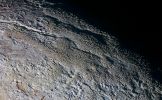
ZZ-ZZ-ZZ-ZZ-ZZ-ZZ-Pluto03-Tartarus_Dorsa.pngTartarus Dorsa170 visiteDa notare la stranissima (apparentemente) Texture e la direzionalità di questa imponente Catena Montuosa Plutoniana. Davvero suggestiva...MareKromiumNov 25, 2019
|
|

Comet_Borisov_-_GIF_3.gifFrom far away: the Comet Borisov through the Solar System (GIF-Movie)299 visiteGuardate bene! EccoVi la differenza (REALE ed IN FATTO) tra un Fly-By and uno Swing-By...E senza dimenticare "Oumuamua"!
As the first known object of its type, Oumuamua presented a unique case for the International Astronomical Union (IAU, for short), which assigns designations for astronomical objects. Originally classified as comet C/2017 U1, it was later reclassified as Asteroid A/2017 U1, due to the absence of a coma (--> "Chioma", in Italian).
Once it was unambiguously identified as coming from outside the Solar System, a new designation was created.
The name comes from the Hawaiian word "oumuamua", meaning 'scout' (from ou, meaning 'reach out for', and mua, reduplicated for emphasis, meaning 'first, in advance of', and reflects the way this object is like a scout or messenger sent from the distant past to reach out to Humanity.
It roughly translates to 'first distant messenger' (or "The First Messenger from the distance").
Before the official name was decided upon, the name "Rama" was suggested by the name given to an Alien Spacecraft discovered under similar circumstances in the 1973 science fiction novel "Rendezvous with Rama", by Sir Arthur C. Clarke.MareKromiumNov 10, 2019
|
|

Comet_Borisov_-_GIF.gifFrom far away: Comet Borisov (GIF-Movie)128 visitenessun commentoMareKromiumNov 10, 2019
|
|

Comet_Borisov_-_Still.pngFrom far away: Comet Borisov154 visiteDa un altro Sistema, dallo Spazio Interstellare, da "altrove".... La "Cometa" Borisov attraverserà il nostro Sistema Solare così come una Rondine attraversa il nostro campo visivo in un luminoso giorno di Primavera.
Da dove viene? Dove va?
... Ma che importa, alla fine?!?.....MareKromiumNov 10, 2019
|
|

ZZ-ZZ-ZZ-ZZ-ZZ-ZZ-Z-Pluto-Map.jpgA few names for the Main Features of Pluto79 visiteEcco i nomi di alcune delle aree e Regioni di maggior interesse di Plutone. Su molte, devo dire che la scelta é stata felice. Su qualcuna.... Beh, decidete Voi.
Alcyonia Lacus, a possible frozen Nitrogen Lake on Pluto's Surface, is named for the bottomless lake in or in the vicinity of Lerna, a region of Greece known for springs and swamps; the Alcyonian lake was one of the entrances to the underworld in Greek mythology.
Elcano Montes is a mountain range honoring Juan Sebastián Elcano (1476–1526), the Spanish explorer who in 1522 completed the first circumnavigation of the Earth (a voyage started in 1519 by Magellan).
Hunahpu Valles is a system of canyons named for one of the Hero Twins in Mayan mythology, who defeated the lords of the underworld in a ball game.
Khare crater honors planetary scientist Bishun Khare (1933–2013), an expert on the chemistry of planetary atmospheres who did laboratory work leading to several seminal papers on tholins – the organic molecules that probably account for the darkest and reddest regions on Pluto.
Kiladze crater honors Rolan Kiladze (1931–2010), the Georgian (Caucasus) astronomer who made pioneering early investigations the dynamics, astrometry and photometry of Pluto.
Lowell Regio is a large region honoring Percival Lowell (1855–1916), the American astronomer who founded Lowell Observatory and organized a systematic search for a planet beyond Neptune.
Mwindo Fossae is a network of long, narrow depressions named for the Nyanga (Eastern Dem. Rep. Congo/Zaire) epic hero who traveled to the Underworld and after returning home became a wise and powerful king.
Piccard Mons is Mountain and suspected Cryo-Volcano that honors Auguste Piccard (1884–1962), a 20th century inventor and physicist best known for his pioneering balloon flights into Earth's Upper Atmosphere.
Pigafetta Montes honors Antonio Pigafetta (c. 1491–c. 1531), the Italian scholar and explorer who chronicled the discoveries made during the first circumnavigation of the Earth, aboard Magellan's ships.
Piri Rupes is a long cliff honoring Ahmed Muhiddin Piri (c. 1470–1553), also known as Piri Reis, an Ottoman navigator and cartographer known for his world map. He also drew some of the earliest existing maps of North and Central America.
Simonelli Crater honors astronomer Damon Simonelli (1959–2004), whose wide-ranging research included the formation history of Pluto.
Wright Mons honors the Wright brothers, Orville (1871–1948) and Wilbur (1867–1912), American aviation pioneers credited with building and flying the world's first successful airplane.
Vega Terra is a large land mass named for the Soviet Vega 1 and 2 missions, the first Spacecraft to fly balloons on another planet (Venus) and to image the Nucleus of a Comet (1P/Halley).
Venera Terra is named for the Venera missions sent to Venus by the Soviet Union from 1961–1984; they included the first human-made device to enter the Atmosphere of another Planet, to make a soft landing over there and to return images from an alien planetary surface.MareKromiumOtt 25, 2019
|
|

ZZ-ZZ-ZZ-ZZ-ZZ-ZZ-Pluto-Surface.jpgUnusually-looking Surface Features along the Plutonian Terminator98 visiteDa "NASA - Picture of the Day" del 16 Luglio 2015.
"An about 50 miles (such as approx. 80 Km) trip across Pluto would cover the distance indicated by the scale bar in this startling image.
The close-up of the icy world's rugged Equatorial Terrain was captured when the New Horizons Spacecraft was about 47.800 miles (approx. 77.000 Km) from the Surface, 1,5 hours (i.e.: 90 minutes) before its closest approach.
Rising to an estimated 11.000 feet (about 3500 meters), the Mountains visible here are likely composed of (mostly - added by Lunexit) Water Ice.
Suggesting surprising geological activity, they are also likely young with an estimated age of about 100 MY (Million Years). This speculation is based on the apparent absence of "fresh" Impact Craters.
The area pictured is near the base of Pluto's broad, bright and heart-shaped Region".MareKromiumOtt 24, 2019
|
|

ZZ-ZZ-ZZ-ZZ-ZZ-ZZ-Z-Pluto-h-Plutonian_Moons-HST-1280.jpgPlutonian Moons: Kerberos and Styx (Cerbero e Stige)86 visiteDa "NASA - Picture of the Day" dell'8 Luglio 2013.
"Pluto's newly discovered moons now have names.
Known previously as P4 and P5, the International Astronomical Union (IAU) has now given the fourth and fifth discovered moons of Pluto the names Kerberos and Styx.
The small moons were discovered in 2011 and 2012 by the Hubble Space Telescope in preparation for the close passing of the New Horizons Spacecraft by Pluto in 2015.
Kerberos is named after the many headed dog in Greek mythology that guards the entrance to the so-called "Underworld" (Hell?!?), while Styx is named after the goddess who overlooks the mythological river that runs between the Earth and the Underworld.
Both monikers are related to the name of Pluto, who rules the mythical Region. Because their reflectivity is unknown, the size of each moon is quite uncertain - but each is crudely estimated to be about 20 Km in diameter.
The robotic New Horizons Spacecraft is on schedule to pass by Pluto in 2015 and it will provide the first clear images of the dwarf planet and its companions". MareKromiumOtt 24, 2019
|
|
| 4548 immagini su 379 pagina(e) |
 |
|
|
|
|
13 | |
|
|
|
|





