| |

| Ultimi arrivi - SOLAR SYSTEM |
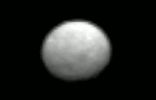
000-1-Ceres.gifCeres on sight (GIF-Movie)137 visiteIt is the largest asteroid in the asteroid belt - what secrets does it hold? To find out, NASA has sent the robotic Dawn Spacecraft to explore and map this cryptic 1,000-Km wide world: Ceres. Orbiting between Mars and Jupiter, 1-Ceres is officially categorized as a dwarf planet but has never been imaged in detail.
Featured here is a 20-frame video that rivals the best images of Ceres ever taken by the Hubble Space Telescope. The video shows enough surface definition to discern its 9-hour rotation period.
On target to reach 1-Ceres in early March, Dawn will match speeds and attempt to orbit this previously unexplored body, taking images and data that may help humanity better understand not only the nature and history of Ceres but also the early history of our entire Solar System.MareKromiumMag 23, 2026
|
|

ZZ-ZZ-ZZ-ZZ-ZZ-ZZ-ZZ-ZZ-Pluto-nh_01_stern_05_pluto_hazenew-PCF-LXTT-IPF-2.jpgA "Blue-rayed" Farewell to Pluto181 visiteNew Horizons is a NASA mission to study the dwarf planet Pluto, its moons, and other objects in the Kuiper Belt, a region of the solar system that extends from about 30 AU, near the orbit of Neptune, to about 50 AU from the Sun.
It was the first mission in NASA’s New Frontiers program, a medium-class, competitively selected, and principal investigator-led series of missions. (The program also includes Juno and OSIRIS-REx.)
New Horizons was the first spacecraft to encounter Pluto, a relic from the formation of the solar system. By the time it reached the Pluto system, the spacecraft had traveled farther away and for a longer time period (more than nine years) than any previous deep space spacecraft ever launched.
The design of the spacecraft was based on a lineage traced back to the CONTOUR and TIMED spacecraft, both also built by the Applied Physics Laboratory at Johns Hopkins University.
Besides its suite of scientific instruments, New Horizons carries a cylindrical radioisotope thermoelectric generator (a spare from the Cassini mission) that provided about 250 watts of power at launch (decaying to 200 watts by the time of the Pluto encounter).
After reaching initial Earth orbit at about 105 × 130 miles (167 × 213 kilometers), the Centaur upper stage fired (for a second time) for nine minutes to boost the payload to an elliptical orbit that stretched to the asteroid belt.
A second firing of the Star 48B solid rocket accelerated the spacecraft to a velocity of about 36,400 miles per hour (58,536 kilometers per hour), the highest launch velocity attained by a human-made object relative to Earth. The spacecraft was now set on a trajectory to the outer reaches of the solar system.
Controllers implemented course corrections on Jan. 28, Jan. 30, and March 9, 2006. A month later, on April 7, 2006, New Horizons passed the orbit of Mars.
A fortuitous chance to test some of the spacecraft’s instruments – especially Ralph (the visible and infrared imager and spectrometer) – occurred June 13, 2006, when New Horizons passed by a tiny asteroid named 132524 APL at a range of about 63,300 miles (101,867 kilometers).
The spacecraft flew by the solar system’s largest planet, Jupiter, for a gravity assist maneuver on Feb. 28, 2007, with the closest approach at 05:43:40 UT. The encounter increased the spacecraft’s velocity by about 9,000 miles per hour (14,000 kilometers per hour), shortening its trip to Pluto by three years.
During the flyby, New Horizons carried out a detailed set of observations over a period of four months in early 2007. These observations were designed to gather new data on Jupiter’s atmosphere, ring system, and moons (building on research from Galileo) and to test out New Horizon’s instruments.
Although observing the moons from distances much farther than Galileo, New Horizons was still able to return impressive pictures of Io (including eruptions on its surface), Europa, and Ganymede.
After the Jupiter encounter, New Horizons sped toward the Kuiper Belt, performing a course correction on Sept. 25, 2007.
The spacecraft was put in hibernation mode starting June 28, 2007, during which time the spacecraft’s onboard computer kept tabs on mission systems, transmitting special codes indicating that operations were either nominal or anomalous. During hibernation, most major systems of New Horizons were deactivated and revived only about two months every year. The second, third, and fourth hibernation cycles were Dec. 16, 2008, Aug. 27, 2009, and Aug. 29, 2014.
New Horizons passed the halfway point to Pluto on Feb. 25, 2010.
The discovery of new Pluto moons Kerberos and Styx during the mission added to concerns that there might be debris or dust around Pluto. Mission planners devised two possible contingency plans in case debris increased as the spacecraft approached Pluto, either using its antenna facing the incoming particles as a shield or flying closer to Pluto where there might be less debris.
On Dec. 6, 2014, ground controllers revived New Horizons from hibernation for the last time to initiate its active encounter with Pluto. At that time, it took four hours and 25 minutes for a signal to reach Earth from the spacecraft.
The spacecraft began its approach phase toward Pluto on Jan. 15, 2015, and its trajectory was adjusted with a 93-second thruster burn on March 10. Two days later, with about four months remaining before its close encounter, New Horizons finally became closer to Pluto than Earth is to the Sun.
Pictures of Pluto began to reveal distinct features by April 29, 2015, with detail increasing week by week into the approach. A final 23-second engine burn on June 29, 2015, accelerated New Horizons toward its target by about 11 inches per second (27 centimeters per second) and fine-tuned its trajectory.
There was concern on July 4, 2015, when New Horizons entered safe mode due to a timing flaw in the spacecraft command sequence. Fortunately, the spacecraft returned to normal science operations by July 7.
Three days later, data from New Horizons was used to conclusively answer one of the most basic mysteries about Pluto: its size. Mission scientists concluded that Pluto is about 1,470 miles (2,370 kilometers) in diameter, slightly larger than prior estimates. Its moon Charon was confirmed to be about 750 miles (1,208 kilometers) in diameter.MareKromiumMag 20, 2026
|
|
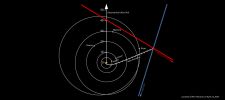
ZZ-ZZ-ZZ-ZZ-ZZ-Z-New_Horizons_Proxima-2025_28129_gifH_Interstellar_v2.jpgInterstellar Navigation116 visiteSince its launch in 2006, New Horizons has been on a trajectory that brought it past Pluto and then Kuiper Belt object Arrokoth and will eventually take it out of the solar system, into interstellar space over the next decade. In 2020, the New Horizons science team, in an effort led by Lauer, obtained images of the star fields around the nearby stars Proxima Centauri and Wolf 359 simultaneously from New Horizons and Earth. This program vividly demonstrated New Horizons’ change in perspective as it ventured from the inner to the outer solar system.
But more recent and sophisticated analyses of the exact positions of the two stars in those 2020 images allowed Lauer, working with retired Lawrence Livermore National Laboratory researcher David Munro, as well as members of the New Horizons team and external collaborators, to deduce New Horizons’ three-dimensional position relative to nearby stars – accomplishing the first use of stars imaged directly from a spacecraft to provide its navigational fix, and the first demonstration of interstellar navigation by any spacecraft on an interstellar trajectory.
A paper describing the results was accepted for publication in The Astronomical Journal. The preprint is available on the server arXiv.
“This pioneering interstellar navigation demonstration and its accompanying publication show that a deep-space mission can use its onboard imaging system to find its way among the stars,” said Alan Stern, principal investigator for New Horizons from the Southwest Research Institute in Boulder, Colorado. “While for New Horizons, this method isn’t as accurate as NASA’s sophisticated tracking from Earth, it could be highly useful for future deep space missions in the far reaches of the solar system and in interstellar space.”MareKromiumMag 20, 2026
|
|
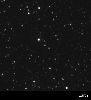
ZZ-ZZ-ZZ-ZZ-ZZ-Z-New_Horizons_Proxima-2025_28129.gif135 visiteWhile spacecraft can use stars to get a sense of direction, figuring out how far and where a spacecraft has traveled from home usually requires accurate radio tracking from Earth. But members of NASA’s New Horizons team – using the mission’s spacecraft, now more than five billion miles from Earth – have demonstrated for the first time that it’s possible to determine direction and distance just by examining images the spacecraft snaps of star fields.
“As a spacecraft travels deeper into space, the positions of the stars seen from its location begin to shift from where they are seen from Earth,” explained Tod Lauer, an astrophysicist and New Horizons science team member from the National Optical-Infrared Astronomy Research Laboratory in Tucson, Arizona. “A spacecraft voyaging out into the Milky Way can measure these shifts, due to an effect called parallax, to locate where it is with respect to nearby stars. New Horizons has traveled far enough away that it can provide the first true demonstration of interstellar navigation.”MareKromiumMag 20, 2026
|
|

3I-ATLAS_noise_or_signal.mp33I/Atlas says "Hi!"167 visiteMaking a comment, I believe it's just useless. Enjoy it, anyway!MareKromiumMag 16, 2026
|
|
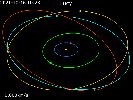
Asteroid_-_Donaldjohanson_P_Lucy_s_trajectory_around_Sun.gifLucy's race (GIF-Movie)143 visiteDonaldjohanson was visited by the Lucy Spacecraft that was launched on 16 October 2021. The Fly-By took place on 20 April 2025, with a closest approach distance of approx. 960 Km (about 600 mi) at a relative velocity of 13.4 Km (8.3 mi) per second.MareKromiumMag 12, 2026
|
|
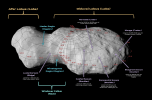
Asteroid_-_Donaldjohanson_Offical_Names.pngAsteroid Donaldjohanson (nomenclature)169 visiteOn 27 August 2025, the International Astronomical Union announced 11 official names for Geological Features on Donaldjohanson, which follow the naming theme of archeological sites and hominin fossils. The smaller lobe of Donaldjohanson is named Afar Lobus, after the Afar Triangle in Ethiopia, and the larger lobe is named Olduvai Lobus, after Olduvai Gorge in Tanzania.
The neck connecting the two lobes is named Windover Collum, after the Windover Archeological Site in Florida, United States. The middle of Windover Collum is encircled by a ridge named Luzia Dorsum (named after the Luzia Woman), which divides the neck into Hadar Regio and Minatogawa Regio (named after Hadar, Ethiopia and the Minatogawa Man, respectively). Several craters and large boulders ("saxa") on Olduvai Lobus have been named as well.MareKromiumMag 12, 2026
|
|
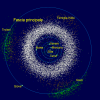
000-Asteroids_-_Main_Belt.pngAsteroid Belt145 visiteThe Asteroid Belt is a torus-shaped region in the Solar System, centered on the Sun and roughly spanning the space between the orbits of the planets Jupiter and Mars. It contains a great many solid, irregularly shaped bodies called asteroids or minor planets. The identified objects are of many sizes, but much smaller than planets, and, on average, are about one million kilometers (or six hundred thousand miles) apart. This asteroid belt is also called the main asteroid belt or main belt to distinguish it from other asteroid populations in the Solar System.
The Asteroid Belt is the innermost and smallest circumstellar disc in the Solar System. Its total mass is estimated to be 3% that of the Moon, with about 60% contained in the four largest asteroids: Ceres, Vesta, Pallas, and Hygiea. Classes of small Solar System bodies in other regions are the near-Earth objects, the Centaurs, the Kuiper Belt Objects, the scattered Disc Objects, the Sednoids, and the Oort Cloud Objects.MareKromiumMag 12, 2026
|
|
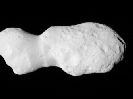
Asteroid_-_Donaldjohanson_-_encounter.gifAsteroid Donaldjohanson (GIF-Movie)143 visiteL'analisi della superficie di Donaldjohanson ha permesso di individuare un dorsum, svariati crateri da impatto (almeno 2 o 3 di maggiore evidenza e discrete dimensioni, due "Regiones" maggiori e svariati "saxa" (macigni di medio/grandi dimensioni).MareKromiumMag 12, 2026
|
|
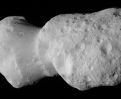
Asteroid_-_Donaldjohanson.jpeg52246 Donaldjohanson141 visite52246 Donaldjohanson (provisional designation 1981 EQ5) is a carbonaceous asteroid from the inner regions of the Asteroids' Belt, approximately 8 Km(about 5 miles) long and 3.5 Km (about 2.2 miles) at its widest point.
It was discovered on 2 March 1981, by American astronomer Schelte Bus at the Siding Spring Observatory in Australia.
The C-type asteroid was the second target of the Lucy Mission, with the spacecraft flying approx. 960 Km (roughly 600 mi) from the surface on 20 April 2025, revealing the asteroid to be a "contact binary". It was named after American paleoanthropologist Donald Johanson, the discoverer of the "Lucy" hominid fossil.MareKromiumMag 12, 2026
|
|
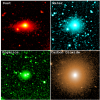
3I-ATLAS_20-PIA26720_SPHEREx_3I_4panel_colorized.pngCompounds of 3I/Atlas128 visiteThese observations by NASA’s SPHEREx (Spectro-Photometer for the History of the Universe, Epoch of Reionization and Ices Explorer) show the infrared light emitted by the dust, water, organic molecules, and carbon dioxide contained within comet 3I/ATLAS’s coma. The comet brightened significantly during the December 2025 period when SPHEREx made the observations — about two months after the icy body had passed its closest distance to the Sun in late October.
The space telescope has the singular capability of seeing the sky in 102 colors, each representing a wavelength of infrared light that provides unique information about galaxies, stars, planet-forming regions, or other cosmic features, including the various gases and dust seen in the coma of 3I/ATLAS. The information gathered by SPHEREx helps scientists better understand what materials 3I/ATLAS contains and how the interstellar object’s pristine ices react to the Sun’s heating as the comet journeys through the solar system.MareKromiumMag 12, 2026
|
|

Thebe-PIA26751.jpgThebe from Juno113 visiteNASA’s Juno spacecraft captured this view of Thebe, the second largest of Jupiter’s inner moons, during a close pass on May 1, 2026. The spacecraft’s Stellar Reference Unit (SRU) captured this image from a distance of approximately 3,100 miles (5,000 kilometers) at a resolution of about 1.9 miles (3 kilometers) per pixel.
Thebe resides at the outer edge of Jupiter’s faint ring system and is believed to play a role in the formation of the planet’s “gossamer” ring through the shedding of dust.
While the SRU’s primary function is to image star fields for navigation, its high sensitivity in low-light conditions makes it a powerful secondary science instrument. The SRU has previously been used to discover “shallow lightning” in Jupiter’s atmosphere and to image the planet’s ring system.MareKromiumMag 12, 2026
|
|
| 4548 immagini su 379 pagina(e) |
1 |
|
|
|
|
|
|
|
|
|
|
|
|





