| Ultimi arrivi - 1-Ceres and 4-Vesta |

052-569814main_dawn-image-062411-43_946-710.jpgApproaching 4-Vesta72 visitenessun commentoMareKromiumLug 17, 2011
|
|

053-Vesta-PIA14312.jpgFeatures of 4- Vesta (Saturated Absolute Natural Colors; credits for the additional process. and color: Dr Paolo C. Fienga - Lunexit Team)212 visiteCaption NASA:"NASA's Dawn Spacecraft obtained this image of the giant Asteroid 4-Vesta with its framing camera on July, 9, 2011. It was taken from a distance of about 26.000 miles (approx. 41.000 Km). 4-Vesta is also considered a "protoplanet" because it is a large body that almost became a planet. Each pixel in the image corresponds to roughly 2,4 miles (about 3,8 Km).
The Dawn mission to 4-Vesta and 1-Ceres is managed by the Jet Propulsion Laboratory, for NASA's Science Mission Directorate, Washington, D.C. It is a project of the Discovery Program managed by NASA's Marshall Space Flight Center, Huntsville, Ala. UCLA, is responsible for overall Dawn mission science. Orbital Sciences Corporation of Dulles, Va., designed and built the Dawn Spacecraft!".
MareKromiumLug 17, 2011
|
|

039-Vesta-PIA14121.jpgApproaching 4-Vesta80 visitenessun commentoMareKromiumGiu 29, 2011
|
|

040-Vesta-PIA14122.jpgApproaching 4-Vesta82 visitenessun commentoMareKromiumGiu 29, 2011
|
|

050-Vesta-HR_Video.gif4-Vesta: Full Rotation (a GIF-Movie by NASA / JPL / UCLA / MPS / DLR / PSI)106 visiteAs Dawn continued its approach to 4-Vesta on June 20, 2011, it occasionally quit thrusting and turned to the spinning Asteroid to perform a "rotation characterization," seeing all longitudes as 4-Vesta rotated beneath the Spacecraft.MareKromiumGiu 29, 2011
|
|

019-Vesta-5-PIA13427.jpg4-Vesta from Hubble Space Telescope104 visiteThe Asteroid 4-Vesta is somewhat like our Moon, with ancient Lava Beds (the dark patches) and powdery Debris (or Regolith), such as the pulverized remains of impacts (the orange-colored areas). A flattened area on one end of 4-Vesta is a giant Impact Crater formed by a collision that perhaps occurred billions of years ago.
The crater is approx. 460 Km (285,66 miles) across, which makes it close to 4-Vesta's roughly 530-Km (329,13-mile) diameter. The asteroid is about the size of Arizona.
4-Vesta is one of the largest of a reservoir of about 100.000 Asteroids, the leftover material from the formation of our Solar System.
Astronomers combined images of Vesta in Near-UltraViolet and blue light to make this picture movie. The Hubble observations were made on Feb. 25 and Feb. 28, 2010.MareKromiumFeb 19, 2011
|
|

018-Vesta-6-PIA13428.jpgSome of the "Faces" of 4-Vesta, from Hubble Space Telescope97 visiteNASA's Hubble Space Telescope snapped these images of the Asteroid 4-Vesta in preparation for the Dawn Spacecraft's visit in 2011. Each of the 4 Hubble images captures views of Vesta during its 5,34-hour rotation period. Hubble's sharp "eye" can see features as small as about 40 Km (24,84 miles) across in these images. Vesta was 211 MKM (approx. 131 MMs) from Earth when Hubble made the observations.
The images show the difference in brightness and color on the Asteroid's Surface. These characteristics hint at the large-scale features that the Dawn Spacecraft will see when it visits the potato-shaped asteroid.
Astronomers used the images, taken with Hubble's Wide Field Camera 3, to better determine 4-Vesta's Spin Axis. Based on the HST observations, astronomers calculated a slightly different, and more precise, Rotation Axis for Vesta. The new calculation will change the pattern of sunlight expected to illuminate the Asteroid when Dawn arrives.
Determining a more accurate Spin Axis for 4-Vesta will also help scientists refine the Dawn Spacecraft's orbit around the Asteroid. Dawn will orbit the rocky object for a year, beginning in July 2011. The Spacecraft will then travel to the "Dwarf Planet" 1-Ceres, arriving in 2015.
Hubble has kept its "eye" on 4-Vesta for more than 15 years, beginning in 1994. Hubble images of 4-Vesta in 1997 helped astronomers discover the Asteroid's very large Impact crater. Astronomers combined views of 4-Vesta in Near-UltraViolet and blue light to construct these images and the images were taken on Feb. 25, 2010.MareKromiumFeb 19, 2011
|
|

007-Ceres-PIA10235.jpg1-Ceres (natural colors, from HST - credits: NASA/ESA et al.)58 visiteCaption NASA:"This is a NASA Hubble Space Telescope color image of 1-Ceres, the largest object in the Asteroid Belt.
Astronomers enhanced the sharpness in these Advanced Camera for Surveys images to bring out features on Ceres' surface, including brighter and darker regions that could be asteroid impact features.
The observations were made in Visible and UV Light between December 2003 and January 2004.
The colors represent the differences between relatively red and blue regions. These differences may simply be due to variation on the surface among different types of material.
Ceres' round shape suggests that its interior is layered like those of terrestrial planets such as Earth. Ceres may have a rocky inner core, an icy mantle, and a thin, dusty outer crust inferred from its density and rotation rate of 9 hours. Ceres is approximately 590 miles (about 950 Km) across and was first discovered in 1801".MareKromiumFeb 20, 2009
|
|

022-Vesta-4.jpg4-Vesta (computer generated imaging - credits: Ben Zellner - Georgia Southern University -, Peter Thomas - Cornell University - and NASA)80 visiteUn'immagine decisamente bella, precisa, distinta. Ma è un'immagine "vera"? NO! Questa immagine dell'Asteroide 4-Vesta è "computer generated", così come sono "computer generated" TUTTE LE IMMAGINI CHE RITRAGGONO - IN CHIAVE PROSPETTICA - DELLE SEZIONI ISOLATE DELLA SUPERFICIE DI MARTE E CHE SONO STATE OTTENUTE DALLA SONDA ESA "MARS EXPRESS".
La differenza?
La differenza è nella "qualità" dell'immagine "computer generated": le immagini ESA sono - e lo ripeteremo sino alla nausea - alquanto dozzinali (Voi sapete che la pixellatura dei frames ESA ottenuti con questa tecnica è talmente grezza che, alla fine dell'opera, gli image-artifacts che li caratterizzano sono così tanti che, come è già accaduto tantissime volte, le sviste e le traveggole che essi ingenerano e suggeriscono sono davvero allucinanti); le immagini NASA, invece, sono di gran lunga più "smooth" (lisce, nel senso di prive di difettosità palesi ed artifacts) e, globalmente parlando, di fattura enormemente superiore.
Ma in ENTRAMBI I CASI SI TRATTA DI PSEUDO-IMMAGINI! Non lo dimenticate...
Caption NASA:"A 3-D computer model of the asteroid Vesta synthesized from Hubble topographic data. The crater's 8-mile high central peak can clearly be seen near the pole. The surface texture on the model is artificial, and is not representative of the true brightness variations on the asteroid. Elevation features have not been exaggerated". MareKromiumFeb 15, 2009
|
|

006-Ceres.jpg1-Ceres (natural colors, from HST - credits: NASA/ESA et al.)57 visiteThe Hubble image of Ceres on the reveals bright and dark regions on the asteroid's surface that could be topographic features, such as craters, and/or areas containing different surface material. Large impacts may have caused some of these features and potentially added new material to the landscape. The Texas-sized asteroid holds about 30 to 40% of the mass in the Asteroid Belt.
Ceres' round shape suggests that its interior is layered like those of terrestrial planets such as Earth. The asteroid may have a rocky inner core, an icy mantle, and a thin, dusty outer crust. The asteroid may even have water locked beneath its surface. It is approx. 590 miles (950 Km) across and was the first asteroid discovered in 1801.
The observation was made in visible and ultraviolet light between December 2003 and January 2004 with the HST Advanced Camera for Surveys. The color variations in the image show either a difference in texture or composition on Ceres' surface.
Astronomers need the close-up views of the Dawn spacecraft to determine the characteristics of these regional differences.
MareKromiumGiu 29, 2007
|
|
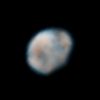
021-Vesta-2.jpg4-Vesta, from HST56 visiteHubble observation of Vesta: picture taken with the Wide Field Planetary Camera 2 on May 14 and 16, 2007.
MareKromiumGiu 29, 2007
|
|

021-Vesta-3.jpgMoments of 4-Vesta56 visiteTo prepare for the Dawn spacecraft's visit to Vesta, astronomers used Hubble's Wide Field Planetary Camera 2 to snap new images of the asteroid. These images were taken on May 14 and 16, 2007. Each frame shows time in hours and minutes based on Vesta's 5,34-hour rotation period. Using Hubble, astronomers mapped Vesta's Southern Hemisphere, a Region dominated by a giant impact crater formed by a collision billions of years ago. The crater is 285 miles (456 Km) across, which is nearly equal to Vesta's 330-mile (530-Km) diameter.
Hubble's sharp "eye" can see features as small as about 37 miles (60 Km) across. The images show the difference in brightness and color on the asteroid's surface. These characteristics hint at the large-scale features that the Dawn spacecraft will see when it arrives at Vesta in 2011.
Hubble's view reveals extensive global features stretching longitudinally from the Northern Hemisphere to the Southern Hemisphere.
The images also show widespread differences in brightness in the east and west, which probably reflects compositional changes. Both of these characteristics could reveal volcanic activity throughout Vesta. The size of these different regions varies. Some are hundreds of miles across.
The brightness differences could be similar to the effect seen on the Moon, where smooth, dark regions are more iron-rich than the brighter highlands that contain minerals richer in calcium and aluminum. When Vesta was forming 4.5 billion years ago, it was heated to the melting temperatures of rock. This heating allowed heavier material to sink to Vesta's center and lighter minerals to rise to the surface.
Astronomers combined images of Vesta in two colors to study the variations in iron-bearing minerals. From these minerals, they hope to learn more about Vesta's surface structure and composition. Astronomers expect that Dawn will provide rich details about the asteroid's surface and interior structure.
MareKromiumGiu 29, 2007
|
|
| 55 immagini su 5 pagina(e) |
 |
|
4 |
|





