| Ultimi arrivi - 1-Ceres and 4-Vesta |
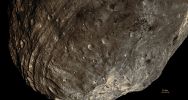
065-Vesta-PIA14322-PCF-LXTT.jpgThe South Pole of 4-Vesta (Enhanced Natural Colors; credits for the additional process. and color.: Dr Paolo C. Fienga - Lunar Explorer Italia) 189 visitenessun commentoMareKromiumAgo 07, 2011
|
|
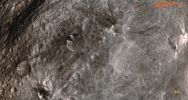
066-Vesta-PIA14324-PCF-LXTT.jpgBizarre-looking Surface Feature of 4-Vesta (Natural Colors; credits for the additional process. and color.: Dr Paolo C. Fienga - Lunar Explorer Italia) 177 visitenessun commentoMareKromiumAgo 07, 2011
|
|

064-Vesta-Dawn_1024-PCF-LXTT.jpgFeatures of 4-Vesta (Enhanced Natural Colors; credits for the additional process. and color.: Dr Paolo C. Fienga - Lunar Explorer Italia)183 visiteCaption NASA:"Why is the Northern Half of Asteroid 4-Vesta more heavily cratered than the Southern one? No one is yet sure. This unexpected mystery has come to light only in the past few weeks since the robotic Dawn Mission became the first Spacecraft to orbit the second largest object in the Asteroid Belt between Mars and Jupiter. The Northern Half of 4-Vesta, seen on the upper left of the above image, appears to show some of the densest cratering in the Solar System, while the Southern Half is unexpectedly smooth. Also unknown is the origin of Grooves that circle the Asteroid nears its Equator, and the nature of the Dark Streaks that delineate some of 4-Vesta's Craters (for example the Crater just above the the image center). As Dawn spirals in toward 4-Vesta over the coming months, some answers may emerge, as well as Higher Resolution and color images".MareKromiumAgo 02, 2011
|
|

063-Vesta-Dawn-image-072311-PCF-LXTT.jpgFeatures of 4-Vesta (Natural Colors; credits for the additional process. and color.: Dr Paolo C. Fienga - Lunar Explorer Italia)180 visiteCaption NASA:"NASA's Dawn spacecraft obtained this image with its framing camera on July 23, 2011. It was taken from a distance of about 3200 miles (approx. 5200 Km) away from the giant Asteroid 4-Vesta".MareKromiumAgo 02, 2011
|
|

008-Ceres-Dumas_300-PCF-LXTT.jpg1-Ceres from Keck Observatory107 visitenessun commentoMareKromiumLug 26, 2011
|
|

062-Vesta-071811-PCF-LXTT.jpgFeatures of 4-Vesta (Natural Colors; credits for the additional process. and color.: Dr Paolo C. Fienga - Lunar Explorer Italia)135 visiteCaption NASA:"NASA's Dawn Spacecraft obtained this image with its framing camera on July 18, 2011. It was taken from a distance of about 6500 miles (approx. 10.500 Km) away from the Protoplanet 4-Vesta. The smallest detail visible is about 1,2 miles across (approx. 2 Km).MareKromiumLug 26, 2011
|
|

054-Vesta-571329-PCF-LXTT.jpgApproaching 4-Vesta (Natural Colors; credits for the additional process. and color.: Dr Paolo C. Fienga - Lunar Explorer Italia)133 visiteCaption NASA:"NASA's Dawn Spacecraft obtained this image with its framing camera on July 17, 2011. It was taken from a distance of about 9500 miles (approx. 15.000 Km) away from the Protoplanet 4-Vesta. Each pixel in the image corresponds to roughly 0,88 miles (about 1,4 Km)".MareKromiumLug 26, 2011
|
|

056-Vesta-3D-PIA14314.jpgThe South Pole of 4-Vesta in 3D107 visiteCaption NASA:"This anaglyph image of the South Polar Region of the Asteroid 4-Vesta was put together from two clear filter images, taken on July, 9th, 2011 by the framing camera instrument aboard NASA's Dawn Spacecraft. Each pixel in this image corresponds to roughly 2,2 miles (about 3,5 Km)".MareKromiumLug 19, 2011
|
|
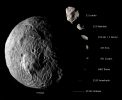
060-Vesta_and_Friends-PIA14316.jpg4-Vesta and "Friends"...88 visiteCaption NASA:"This composite image shows the comparative sizes of 8 (eight) Asteroids. Up until now, Lutetia, with a diameter of about 81 miles (approx. 130 Km), was the largest Asteroid visited by a Spacecraft.
Vesta, which is also considered a protoplanet because it's a large body that almost became a planet, dwarfs all other small bodies in this image, with its diameter sizing up at approximately 330 miles (about 530 Km)".
MareKromiumLug 19, 2011
|
|
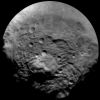
055-Vesta-PIA14315.jpgThe South Pole of 4-Vesta111 visiteCaption NASA:"This image, taken by the framing camera instrument aboard NASA's Dawn Spacecraft, shows the South Polar Region of 4-Vesta, which has a diameter of about 330 miles (approx. 530 Km). The image was taken through the clear filter on July, 9th, 2011, as part of a rotation characterization sequence, and it has a scale of about 2,2 miles (approx. 3,5 Km) per pixel.
To enhance details, the resolution was enlarged to .6 miles (roughly 1 Km) per pixel.
This Region is characterized by rough topography, a large Mountain, Impact Craters, Grooves and steep Scarps. The original image was map-projected, centered at 55°
South Latitude and 210° East Longitude".MareKromiumLug 19, 2011
|
|

049-Vesta-PIA14124.jpg4-Vesta in Spectrometer View (Visible Light and IR)76 visiteCaption NASA:"On June 8, 2011, the Visible and InfraRed Mapping Spectrometer aboard NASA's Dawn Spacecraft captured the instrument's first images of 4-Vesta that are larger than a few pixels, from a distance of about 218.000 miles (approx. 351.000 Km). The images were taken for calibration purposes.
Images obtained in the Visible part of the light Spectrum, at about 0,55 microns in wavelength, appear on the left. Images obtained in the InfraRed Spectrum, at around 3 microns in wavelength, appear on the right. The spatial resolution of these images is about 60 miles (approx. 90 Km) per pixel.
The Visible and InfraRed mapping spectrometer will be able to provide images of 4-Vesta in 432 wavelengths, which will help scientists determine the basic composition of the Asteroid".MareKromiumLug 17, 2011
|
|

051-569825main_dawn-image-070111-43_946-710.jpgApproaching 4-Vesta79 visitenessun commentoMareKromiumLug 17, 2011
|
|
| 55 immagini su 5 pagina(e) |
 |
3 | |
|





