| Ultimi arrivi - Mars Reconnaissance Orbiter (MRO) |

ESP_013533_1560_RED_abrowse.jpgProposed MSL Landing Site inside Eberswalde Crater (Natural Colors; credits: Lunexit)59 visitenessun commentoMareKromiumNov 19, 2009
|
|

ESP_014261_0930_RED_abrowse.jpgSouth Polar Residual Cap Monitoring (Natural Colors; credits: Lunexit)63 visiteThis HiRISE image is of a portion of Mars' South Polar Residual Ice Cap. Like Earth, Mars has concentrations of water ice at both Poles.
Because Mars is so much colder, however, the seasonal ice that gets deposited at high latitudes in the Winter and is removed in the Spring (generally analogous to winter-time snow on Earth) is actually Carbon Dioxide Ice. Around the South Pole there are areas of this CO2 ice that do not disappear every Spring, but rather survive Winter after Winter. This persistent Carbon Dioxide Ice is called "South Polar Residual Cap", and is what we are looking at in this HiRISE image.
Relatively high-standing smooth material is broken up by semi-circular depressions and linear, branching troughs that make a pattern resembling those of your fingerprints. The high-standing areas are thicknesses of several meters of CO2 Ice.
The depressions and troughs are thought to be caused by the removal of Carbon Dioxide Ice by Sublimation (the change of a material from solid directly to gas). HiRISE is observing this CO2 Terrain to try to determine how these patterns develop and how fast the depressions and troughs grow.
While the South Polar Residual Cap as a whole is present every year, there are certainly changes taking place within it. With the high resolution of HiRISE, we intend to measure the amount of expansion of the depressions over multiple Mars years.
Knowing the amount of Carbon Dioxide removed can give us an idea of the atmospheric, weather, and climate conditions over the course of a year.
In addition, looking for where CO2 Ice might be being deposited on top of this terrain may help us understand if there is any net loss or accumulation of the CO2 Ice over time, which would be a good indicator of whether Mars' climate is in the process of changing, or not. (Written by: Patrick Russell)MareKromiumNov 19, 2009
|
|

ESP_013533_2170_RED_abrowse.jpgUnnamed Crater with Gullies (Natural Colors; credits: Lunexit)60 visitenessun commentoMareKromiumNov 19, 2009
|
|
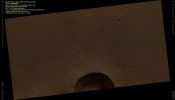
ESP_014262_1510_RED_abrowse.jpgEjecta Blanket - West Side of Zumba Crater (Natural Colors; credits: Lunexit)63 visitenessun commentoMareKromiumNov 18, 2009
|
|

ESP_014267_1460_RED_abrowse.jpgGullies in Dao Vallis (Natural Colors; credits: Lunexit)85 visitenessun commentoMareKromiumNov 18, 2009
|
|
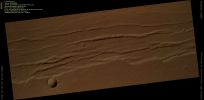
ESP_014278_2050_RED_abrowse.jpgContact between Lava Flows (Natural Colors; credits: Lunexit)58 visitenessun commentoMareKromiumNov 17, 2009
|
|

ESP_014417_1975_RED_abrowse-00.jpgChrise Planitia (Natural Colors; credits: Lunexit)60 visitenessun commentoMareKromiumNov 14, 2009
|
|
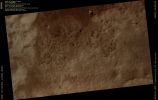
ESP_014356_2090_RED_abrowse.jpgNorth of Tartarus Fossae (Natural Colors; credits: Lunexit)60 visitenessun commentoMareKromiumNov 08, 2009
|
|
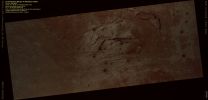
ESP_014304_1895_RED_abrowse.jpgSouth-Eastern Margin of Athabasca Valles (Natural Colors; credits: Lunexit)57 visitenessun commentoMareKromiumNov 08, 2009
|
|
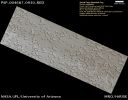
PSP_004687_0930_RED_abrowse.jpgSouth Polar Residual Cap Monitoring (Natural Colors; credits: Lunexit)60 visiteAs on Earth, the seasonal frost caps of Mars grow and recede each year. But seasonal frost on Mars is composed of Carbon Dioxide Ice (also known as Dry Ice), not water ice as on our Planet.
Near the South Pole of Mars, the seasonal CO2 frost never completely disappears, leaving a residual ice cap of CO2 ice throughout the Summer. This HiRISE image shows part of the South Polar Residual Cap, with many shallow Pits dubbed "Swiss Cheese Terrain". Because the Sun is always low in the sky at this latitude, the steep walls of the Pits receive more solar energy than the high-standing, flat areas between the Pits.
This causes the walls of the Pits to retreat several meters per year as Sunlight causes the CO2 ice to evaporate directly to gas, a process called "sublimation".
In some depressions, ridges or blocks of material a couple of meters (several feet) across are visible at the base of the depression walls, likely fallen from the walls during the sublimation and retreat process. At this rate, the layer of Carbon Dioxide ice could completely disappear in about 100 years from now, if not replenished.
Nota Lunexit: interessanti annotazioni. Peccato che la maggiore implicazione da esse derivante (quote: "...lo strato di CO2 che ricopre la Regione Sud Polare di Marte SCOMPARIRA' entro 100 anni da oggi, se non reintegrato...") non è stata minimamente toccata.
Stile NASA, of course. Nihil sub Sole novi, quindi...MareKromiumNov 08, 2009
|
|
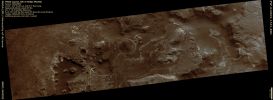
PSP_010839_1525_RED_abrowse.jpgPitted Layers, N/E of Hellas Planitia Region (Natural Colors;: credits: Lunexit)76 visitenessun commentoMareKromiumNov 08, 2009
|
|
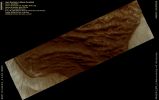
ESP_014291_1120_RED_abrowse.jpgSouthern Dunefield (Natural Colors; credits: Lunexit)59 visitenessun commentoMareKromiumNov 07, 2009
|
|
| 2237 immagini su 187 pagina(e) |
 |
|
|
|
|
99 | |
|
|
|
|





