| Ultimi arrivi - Mars Reconnaissance Orbiter (MRO) |

PSP_002066_1425_RED_browse-01~0.jpgGullies and Ice-rich Material (EDM - Natural Colors; credits: Lunexit)57 visiteIn this EDM (approx. 500 mt across) we can notice that the crater floor is covered in boulders, dunes and textured material.
The boulders are likely a “sublimation lag” that provides evidence that material on the crater floor is, or once was, ice-rich. A sublimation lag forms when ice-rich material sublimates leaving the boulders and rocks behind. It is possible that the boulders on this crater floor represent such a process.
The pitted texture around boulders may also be an indicator of ice sublimation.MareKromiumNov 25, 2009
|
|

PSP_001942_2310_RED_abrowse-01.jpgSigns of Fluids and Ice in an Unnamed Crater in Acidalia Planitia (EDM - Absolute Natural Colors; credits for the additional process. and color.: Dr Paolo C. Fienga - Lunexit Team) 58 visiteThe South-looking (or Equator facing) walls of this Unnamed Crater are cut by numerous Gullies such as the ones shown here (500 x 600 mt or 550 x 650 yards), with well developed Alcoves, sinuous Channels and Terminal Fan Deposits.
These Gullies seem to originate at the same height, suggesting that the carving agent may have emanated from one single layer exposed in the Crater's Wall.
Contrastingly, no Gullies are observed in the North-looking (or Pole facing) wall of this Crater. Terrestrial Gullies very similar to the ones shown in this image are produced by surface water.
The arrows in this frame show fissures that may indicate detachment of surficial materials possibly held together by subsurface ice, sliding en masse down the crater's wall.MareKromiumNov 25, 2009
|
|

ESP_014342_0930-00.jpgSouth Polar Residual Cap Intraseasonal Change Monitoring (CTX Frame - Natural Colors; credits: Lunexit)58 visitenessun commentoMareKromiumNov 24, 2009
|
|
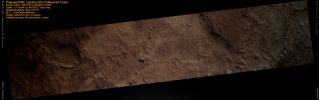
PSP_007124_1765_RED_abrowse~0.jpgProposed MSL Landing Site in Miyamoto Crater (MULTISPECTRUM; credits: Lunexit)58 visiteMiyamoto Crater is located in South-Western Meridiani Planum (and South-West of the Mars Exploration Rover Opportunity Landing Site).
This image shows fairly smooth plains and some areas covered by Windstreaks.
The streaks suggest that wind is an active process here, depositing surface material downwind in this distinctive form. This Landing Site is adjacent to the Hematite-bearing plains unit where the Opportunity Rover sits.
The CRISM instrument has detected Phyllosilicates (Clay Minerals) at this Landing Site, which scientists believe to have formed in the presence of water.
The Mars Science Laboratory rover would investigate the mineral diversity here, which includes Phyllosilicates and Sulfate Minerals.
MareKromiumNov 24, 2009
|
|
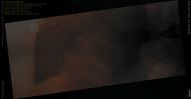
PSP_007126_1210_RED_abrowse~0.jpgLike a "dried-up" Waterfall (True Colors + MULTISPECTRUM; credits: Lunexit)58 visiteThis image shows a large gully in the wall of a crater in the Southern Hemisphere. Such gullies are among the most recent landforms on Mars, and were probably carved by liquid water.
The source of the water is still unknown; it could have been groundwater from a shallow aquifer or melted snow or ground ice from a different climate.
This gully is not particularly fresh, but it is among the largest observed; several sub-channels merge in the alcove on the upper slope, in the north part of the image (Dx).
Numerous faint troughs and lineations are visible downslope, likely indicating old channels that have been buried or reworked. The upper alcove exposes a dense cluster of boulders not seen on the adjacent slope. This could indicate that smaller material has been removed by the gullies, exposing the boulders without transporting them far.MareKromiumNov 24, 2009
|
|
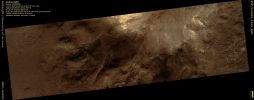
ESP_014439_1505_RED_abrowse.jpgCentral Uplift (Natural Colors; credits: Lunexit)58 visitenessun commentoMareKromiumNov 24, 2009
|
|
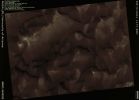
ESP_014441_1275_RED_abrowse.jpgHellespontus' Dunefield (Natural Colors; credits: Lunexit)59 visitenessun commentoMareKromiumNov 24, 2009
|
|

ESP_013557_1245_RED_abrowse-02.jpgThe "Argyre Lineae" (EDM n.1 - Natural Colors; credits: Dr G. Barca & Lunexit)58 visite...Probabilmente, anche se nel CTX Frame queste "Linee" apparivano più nette e più profonde, si tratta davvero solo di DD Tracks.
Molto probabilmente.MareKromiumNov 20, 2009
|
|

ESP_013557_1245_RED_abrowse-03.jpgThe "Argyre Lineae" (EDM n.2 - Natural Colors; credits: Dr G. Barca & Lunexit)58 visitenessun commentoMareKromiumNov 20, 2009
|
|

ESP_013557_1245_RED_abrowse-06.jpgThe "Argyre Lineae" (EDM n.3 - Natural Colors; credits: Dr G. Barca & Lunexit)59 visitenessun commentoMareKromiumNov 20, 2009
|
|

ESP_013557_1245_RED_abrowse-07.jpgThe "Argyre Lineae" (EDM n.4 - Natural Colors; credits: Dr G. Barca & Lunexit)59 visitenessun commentoMareKromiumNov 20, 2009
|
|

ESP_013557_1245_RED_abrowse-01.jpgThe "Argyre Lineae" and the "Lineae" seen on the Jovian moon "Europa": a comparison (CTX-Frame - image-mosaic by Lunexit)65 visitePer il momento, il nostro parallelo è solo un azzardo, giustificato - si fa per dire... - dalla notevole somiglianza esistente fra le linee che caratterizzano la Superficie della Luna Gioviana "Europa" (pensate, ad esempio, alla "Minos Linea" - in basso a Dx - che la NASA stessa ritiene essere la "Prova Geologica" dell'esistenza di un Oceano Sotterraneo - liquido! - situato ad un centinaio di Km di profondità) e queste "linee" che caratterizzano il Terreno Marziano intorno alla Latitudine 55° Sud. e 32° Est - Regione della Pianura di Argyre, a circa 2° di Lat. di distanza dal Distretto Montuoso di Charitum (il quale costituisce, nella sua interezza, il margine - Rim - Sud del Bacino di Argyre).
Certo, la NASA dice che queste "Linee Marziane" sono i soliti segni lasciati dal transito dei Dust Devils ma, se osservate con attenzione, potreste notare che esistono - invece - delle nette ed indubitabili differenze fra queste "Linee di Argyre" ed i DD-Tracks.
(nota: la definizione di questi segni della Superficie Marziana come "Argyre Lineae" è stata operata da Lunexit e non dalla NASA)MareKromiumNov 19, 2009
|
|
| 2237 immagini su 187 pagina(e) |
 |
|
|
|
|
98 | |
|
|
|
|





