| Ultimi arrivi - Mars Reconnaissance Orbiter (MRO) |

PSP_001390_2290_RED_abrowse.jpgLobate Debris Apron in Tempe Terra/Mareotis Fossae (Natural Colors; credits: Lunexit)99 visiteThis image shows a portion of a large Lobate Debris Apron along the bottom of a hill in the Tempe Terra/Mareotis Fossae Region of Mars.
Debris Aprons were first discovered in Regions of "Fretted Terrain" from analyses of images sent back by the Viking Orbiter Spacecrafts in the 1970s. Features in areas of Fretted Terrain appear "softened" as if some geologic process(es) had smoothed and rounded features that normally would be sharply defined, such the crest of a narrow, steep ridge.
Scientists inferred that the processes causing this degradation must have involved the incorporation and creep of ice in the surface materials. If so, these mixtures of ice and debris could have flowed away from topographically high areas leaving features much less sharply-defined.
The flow behavior described here is similar to slow-moving glacial or permafrost features on Earth. The Debris Apron in this image also has several subtle "ridge" features on its surface from low Sun illumination. The Ridges are roughly parallel to the base of the hill and their shapes mimic one another along their lengths.
Similar Ridges are seen on other Debris Aprons in this Region where the Aprons are located directly below large piles of debris accumulating along the bottom of hillslopes. These observations have led to the hypothesis that Ridges on Debris Aprons are accumulated piles of debris from a period of abnormally high erosion. If this was indeed the case, each Ridge may indicate a change in the climate or local environment that would have implications for our overall understanding of the Martian Climate.MareKromiumDic 05, 2009
|
|

PSP_001390_1735_RED_abrowse.jpgCandor Chasma (Natural Colors; credits: Lunexit)73 visitenessun commentoMareKromiumDic 05, 2009
|
|

PSP_001408_1900_RED_abrowse.jpgFlows in Athabasca Valles (Natural Colors; credits: Lunexit)57 visiteThin Flows cover the Plains just North of the Source Region for the Athabasca Valles Channel System. The Flows are mostly confined by a Scarp (Cliff) that can be seen in the North-Western corner of the image.
The more heavily Cratered Terrain above the Scarp is part of a tectonic ridge known as a "Wrinkle Ridge". A few Flows can be seen atop the Wrinkle Ridge, but they are not as ubiquitous as those on the Plains below. The Flows on the Plains frequently intersect, with younger ones cutting across older ones.
The prominent dark swathes along their edges have particularly rough textures.
The darker shade is due to thousands of shadows cast by small bumps on the Surface, which HiRISE is able to resolve.
Dozens of bright, narrow Rifts (Cracks) zigzag across the Flows. They appear bright because they are filled with light-toned, windblown material. Wind-sculpted Knobs and Ridges of similar light-toned material are scattered throughout the imaged area.
The orientations of the Ridges indicate that the Winds primarily blow from the South-East. Several impact craters are captured in this image, the largest being about 50 meters (160 feet) in diameter. Many bear the distinctive bright rays characteristic of secondary craters associated with the larger impact crater, Zunil.
Some craters penetrated the surface of the Flows, and the boulders strewn around them suggest that the material they excavated was rocky.MareKromiumDic 05, 2009
|
|
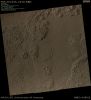
PSP_001456_2010_RED_abrowse.jpgFlood-carved Canyon in Kasei Valles (Natural Colors; credits: Lunexit)61 visiteThis HiRISE image shows a wonderfully complex surface on the floor of this ancient Flood-carved Canyon.
The floor of this Canyon, now, does not show any kind of landform that scientists expect to see from the occurrence of flood erosion phenomena.
Instead, it appears that the floor of the valley has been covered, after the inundation that first designed it, by another flow made by some very dense material that also contained huge ridged plates.
Some of the plates are more than 1 Km (0,6 miles) across. The ridges appear to have formed when the solid crust on the flow crumpled; the plates are pieces of the crust that were rafted apart.
Actually, very large Lava Flows can produce a surface like this, but also water-ice and frozen mud can create similar features.MareKromiumDic 05, 2009
|
|

ESP_013948_1410_RED_abrowse-00.jpgUnnamed Craters with Gullies in Sirenum Fossae (Natural Colors; credits: Lunexit)59 visiteThis image covers parts of two different Unnamed Craters, both with Gullies in the Inner Walls. Gullies are a popular target because their formation is still being debated.
The powerful HiRISE camera reveals many details of Gullies that have never been seen before. Some hypotheses about the formation of Gullies involve the flow of some amount of liquid (water, brine, or some other substance - Nota Lunexit: QUALE???), and others postulate that Gullies could be formed by the downhill movement of dry material such as Dust or Sand.
To further complicate things, different Gullies could have formed by different methods.
The many Gullies visible in this image look quite different from each other. This EDM n.1 - from the South/Western part of the Crater to the South - Dx) shows a Gully with a smaller Alcove (source region at the top) and a deep Main Channel. The material in the Channel is a different color than the Alcove, indicating they may contain different minerals or different grain sizes.
Another Gully (EDM n.2), located in the Northern side of the same Crater, has almost no Alcove and very little material deposited at the bottom. However, this Gully is marked by a distinct bright-colored deposit along its length. This could be a sign of recent activity where material has moved downhill.
And yet another site nearby (EDM n.3) within the same Crater has multiple overlapping Gullies of different types. Most of these have large fan-shaped deposits at the bottom, and a few to the left side of the EDM n.3 have bright deposits where new material may have been deposited or exposed.
Some of the Channels and Fans contain Ripples; this might be where wind eroded loose material, or it may be a texture that formed as sand or liquid moved down the slope. Some of the gully-like features in this image are more likely Dry Landslide Chutes (Dust Avalanches).MareKromiumDic 04, 2009
|
|

ESP_013948_1410_RED_abrowse-01.jpgGullies in Sirenum Fossae (EDM n.1 - Natural Colors; credits: Lunexit)57 visitenessun commentoMareKromiumDic 04, 2009
|
|

ESP_013948_1410_RED_abrowse-02.jpgGullies in Sirenum Fossae (EDM n.2 - Natural Colors; credits: Lunexit)59 visitenessun commentoMareKromiumDic 04, 2009
|
|

ESP_013948_1410_RED_abrowse-03.jpgGullies in Sirenum Fossae (EDM n.3 - Natural Colors; credits: Lunexit)58 visitenessun commentoMareKromiumDic 04, 2009
|
|

PSP_001510_2195_RED_abrowse.jpgAlba Patera (Natural Colors; credits: Lunexit)55 visiteThis HiRISE image shows a small portion of the Rim of the Caldera at the top of the Volcano Alba Patera. This Volcano has shallower slopes than most of the other large Volcanoes on Mars. Unfortunately, this image is not able to help us understand what is unique about Alba Patera because of the thick Dust Cover that covers almost every surface detail but, instead, it shows that the Dust has been carved into streamlined shapes by the wind, cut by small Landslides.
Interestingly, there are some isolated patches that appear smooth and undisturbed by the wind.MareKromiumDic 04, 2009
|
|

PSP_002184_2005_RED_browse-1.jpgOn the Edge of Olympus (Natural Colors; credits: Lunexit)61 visiteOlympus Mons, the largest volcano in the Solar System, has a mysterious halo (or "Aureole") of material on its Western and Northern Sides. There have been many ideas about how this feature may have formed over the years, but the hypothesis that this is a giant landslide deposit has gained favor.
Many large volcanoes on the Earth collapse under their own weight, so it seems reasonable that Olympus Mons would do the same. The edge of the Aureole is seen on the left (North) part of the image.
It is interesting that the main part of the Aureole seems sunk down compared to the edge. It is possible that the ridge along the outer margin of the Aureole formed as the flow turned around after pushing uphill for a ways. Imagine a giant wave of rock pushing up onto the "beach" and then receding. It might leave a deposit like this.
Alternatively, glaciers push up a ramp of rock at their fronts.
After they retreat, the ridge of rock is left at the furthest extent of the glacier. These are called "Terminal Moraines" by geologists.MareKromiumDic 03, 2009
|
|

PSP_001558_1325_RED_abrowse.jpgSouthern Dunefield (Natural Colors; credits: Lunexit)58 visitenessun commentoMareKromiumNov 29, 2009
|
|

PSP_002066_1425_RED_browse-00~0.jpgGullies and Ice-rich Material (CTX Frame - Natural Colors; credits: Lunexit)59 visiteThis picture shows Gullies in an Unnamed Southern Crater.
Gullies typically form when flowing water has sufficient energy to erode soil and soft rock in a channelized flow.
The Gullies in this image have narrow, overlapping channels and are deeply incised into the slope. Overlapping channels may suggest multiple flow events on this slope wall.
It is unknown what happened to the water that flowed in these Gullies. Some of the water may have evaporated or gradually sublimated into the Atmosphere or became incorporated as ice in the Gully Debris Aprons located downslope at their Termini.
Sublimation is a process similar to evaporation, except that solid ice (instead of liquid water) returns to the atmosphere as a gas. Sublimation is common on Mars because the temperature and pressure are so low on Mars today that liquid water is only rarely stable.
Nota Lunexit: la NASA dice che "...liquid water on Mars is only RARELY stable...". Raramente, quindi, e NON "mai"!
A questo punto ci piacerebbe davvero sapere quando ed a quali condizioni occorre questa "stabilità" (che, a nostro parere, potrebbe e dovrebbe occorrere ANCHE oggi)...MareKromiumNov 25, 2009
|
|
| 2237 immagini su 187 pagina(e) |
 |
|
|
|
|
97 | |
|
|
|
|





