| Ultimi arrivi - Mars Reconnaissance Orbiter (MRO) |

PSP_001602_1700_red-00~0.jpgThe "Central Uplift" of Oudemans Crater (CTX Frame - possible Natural Colors; credits: Lunexit)58 visiteBased on estimates of the depth of excavation for a crater the size of Oudemans, these Layers originated from just as deep as those exposed in Valles Marineris and possibly deeper.
A comparison of the Layers in Valles Marineris and in the Oudemans Central Uplift may prove that they are similar rock types that share the same mode of origin. The fact that these Layers are so well intact gives planetary scientists specific clues regarding the Subsurface and history of the general area.
Additionly, three other craters, Martin (21,2° S and 290,7° E), Mazamba (27,3° S and 290,2° E) and a yet unnamed crater (28,4° S and 305° E) also possess finely Layered Materials in their Central Uplift features and lie within the circum-Tharsis Region.
The preservation of the layering and geographical occurrence of these 4 craters suggests that they could be ash layers deposited from numerous episodes from the Tharsis Volcanoes.
Voluminous volcanic episodes could have produced large volumes of Layered Rock that could have been rapidly buried and protected from cratering.MareKromiumDic 15, 2009
|
|

PSP_001602_1700_red_01~0.jpgThe "Central Uplift" of Oudemans Crater (EDM - possible Natural Colors; credits: Lunexit)57 visiteThis HiRISE image covers a portion of the Central Uplift of the 120-Km diameter Oudemans Crater.
Oudemans is located at the Western end of Valles Marineris and just South of the Great Canyon System by the Noctis Labyrinthus.
Images from the Mars Orbital Camera (MOC) were the first to reveal that this large impact crater exposed Layered Rock in its Central Uplift Feature.
Such beautifully preserved Layered Rocks, although rare, are no surprise to planetary scientists.
First, Layered Rocks exposed in the Central Uplifts are common in terrestrial impact structures. Secondly, there is abundant layering exposed in the nearby Valles Marineris Canyon System — a gash that exposes layering down to 7 Km beneath the mean Surface.
This suggests that Layered Materials exist to great depths in the Subsurface, which is supported by the Oudemans Central Uplift observation. MareKromiumDic 15, 2009
|
|
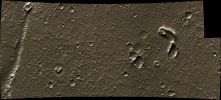
PSP_001578_2000-MF-LXT.jpgFaulting in Amazonis Planitia (Natural Colors; credits: Dr M. Faccin & Lunexit)58 visiteThis HiRISE image is centered on a long "Strike-Slip Fault" on the Young Plains of the Amazonis Planitai Region.
The most famous example of a Strike-Slip Fault on Planet Earth is probably the San Andreas Fault in California.
The Plains of Amazonis, as seen here, show only a few large and medium-sized craters, indicating that the Surface has been "remodeled" relatively recently.
The fact that the Fault visible here has cut the Plains, indicates that tectonic processes (as well as Marsquakes) have occurred even more recently (whereas that the word "recently", on Mars, is a relative term - since it is likely that both the Surface and the Fault are more than a billion years old.
Other interesting features that can be seen in this frame are "Moats" (---> fossi e fossati) - visible around Knobs (---> colline a ceppo) - and a few Impact Craters.MareKromiumDic 15, 2009
|
|

ESP_011386_2065_and_ESP_011531_2065.jpgCollapse Features in Tractus Fossae (High-Def-3D; credits: Dr M. Faccin)63 visiteAcquisition date: 30 December 2008
Mars Local Time: 15:46 (middle afternoon)
Latitude (centered): 26,1° North
Longitude: 259,4° East
Range to target site: 281,9 Km (approx 176,2 miles)
Original image scale range: 28,2 cm/pixel (with 1 x 1 binning) so objects ~85 cm across are resolved
Map projected scale: 25 cm/pixel and North is up
Map projection: EQUIRECTANGULAR
Emission angle: 6,7°
Phase angle: 54,5°
Solar Incidence Angle: 61° (with the Sun about 29° above the Local Horizon)
Solar Longitude: 182,8° (Northern Autumn)MareKromiumDic 15, 2009
|
|
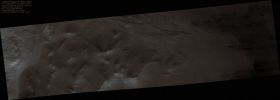
PSP_003176_1745_RED_browse-00~0.jpgLayered Region in Gale Crater (CTX Frame - Natural Colors; credits: Lunexit)58 visiteThis observation shows a portion of the Gale Crater Floor. Gale Crater is approx. 150 Km in diameter and it located in the Elysium Planitia, near the so-called "Dichotomy Boundary" - such as the Martian Region separating the Southern Highlands from the Northern Lowlands.
The paucity of Impact Craters indicates that the Layered Deposits are either very young or that erosion has removed evidence of past cratering.
Wind erosion, in particular, might have modified the Layers by creating relatively sharp edges and rounded depressions. In general, the fact that Layers are found on isolated mounds indicates that some process has eroded an originally more extensive Layered Deposit.
Large Dunes are also visible in the lower portion of the EDM. MareKromiumDic 14, 2009
|
|

PSP_003176_1745_RED_browse-01~0.jpgLayered Region in Gale Crater (EDM - Natural Colors; credits: Lunexit)60 visiteThis EDM shows several Light-Toned Layers.
The origin of the sediments composing the Layers is unknown and could have included deposition in an ancient flood or lake or the deposition of windblown particles such as Dust or Volcanic Ash.
The relatively uniform character of the Layers and the manner of erosion suggests that the sediments are fine-grained. MareKromiumDic 14, 2009
|
|
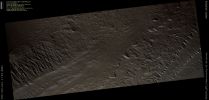
PSP_001422_1750_RED_abrowse.jpgLayers in Gale Crater Central Mound (Natural Colors; credits: Lunexit)58 visiteThis image shows a portion of the Central Mound in the Gale Crater (Central Mound that is of interest to scientists because of the light-toned Layered Deposits that can be found inside it).
The Layered Deposits could have formed in a water environment if, for instance, a lake - once - filled the Crater. Alternatively, particles suspended in the Atmosphere, such as Dust or Volcanic Ashes, could have built up the Layers over time.
By using HiRISE images to see details in the Layers, such as how their thicknesses vary horizontally and vertically, scientists can narrow down the potential origins.
The paucity of Impact Craters on the Layered Deposits indicates that either the Deposits are very young, or more likely that they are being eroded up to the point where such (alleged) Impact Craters were erased.
Wind Erosion modified the Layers after they formed, creating both sharp corners and rounded depressions along the Surface.
A few meter-size Boulders are visible at the base of some steep Cliffs, but the really poor amount of visible Boulders elsewhere suggests that most of the erosion occurred (and it is still occurring) because of eolic processes (such as wind action) rather than downslope movement of material.MareKromiumDic 14, 2009
|
|
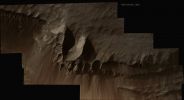
PSP_001456_1695_RED_abrowse-01.jpgLight Layered Deposits in Valles Marineris Region (EDM - Superdef. + Natural Colors; credits: Dr M. Faccin & Lunexit)60 visiteL'estrazione del dettaglio in formato JP2 e Superdefinizione è del Dr Faccin; la colorizzazione Multispettrale e la calibrazione sono del Dr Fienga. A nostro parere, il risultato si commenta da solo...MareKromiumDic 14, 2009
|
|

PSP_001410_2210_RED_abrowse.jpgUnnamed Craters with Layered Deposits in Utopia Planitia (Natural Colors; credits: Lunexit)58 visiteThis image shows an Unnamed Impact Crater located in Utopia Planitia (Northern Hemisphere of Mars) that is filled with layered material.
The layered character of these Deposits is consistent with episodic deposition. Each distinct layer represents a period of sediment deposition. The layers are parallel to each other, indicating that deposition occurred by material settling onto the Surface, rather than being blown across the Surface in Sand Dunes.
The hummocky texture of these deposits suggests that volatiles (such as Carbon Dioxide Ice) are mixed in with the rocky sediment.MareKromiumDic 14, 2009
|
|
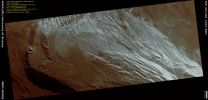
PSP_001456_1695_RED_abrowse-00.jpgLight Layered Deposits in Valles Marineris Region (CTX Frame - Natural Colors; credits: Lunexit)63 visiteThis image shows bright Layered Deposits near the junction of Coprates Chasma and Melas Chasma, both part of the Valles Marineris Canyon System.
The Outcrop visible in this frame is found in a wide Alcove located in the Northern Wall and it forms a broad mound which is several kilometers wide; dark, wind-blown materials cover it in places.
Similar light-toned rock occurs in many places of the Valles Marineris.
An important question is when these materials formed: were they deposited within the Troughs after they opened and then eroded, or are they remnants of the Wall Rock?
Analysis of the orientation of the layers using HiRISE images may help scientists answer this question.
There are no fresh Impact Craters preserved on the Outcrop Surface, suggesting that the Layered Deposits are being eroded rapidly enough to erase the Craters.
In many places, the light rocks have regular fractures called "Joints". Joints are common in Earthly rocks and HiRISE images show them in many places on Mars as well.
These Joints can provide information about the forces that affected - in time - the rocks of this area, and therefore they could also help us to (at least partially) unravel the Geologic History of Mars in general and this Outcrop in particular.MareKromiumDic 14, 2009
|
|

ESP_013726_1475_RED_abrowse.jpgGullies and Flow Features on an Unnamed Crater Wall (Natural Colors; credits: Lunexit)60 visiteThis HiRISE image shows a sample of the variety and complexity of processes that may occur on the walls of Martian Craters, well after the impact crater formed.
At the very top of the image is the high Crater Rim; at the bottom of the image is the Crater's Central Peak - a dome of material rising above the surrounding Crater Floor uplifted during the impact event. Reaching down the Walls of the crater are windy and crooked troughs, or Gullies. Some of these Gullies may have formed with the help of liquid water, melted from ice or snowpack on the Crater Walls or from groundwater within the Walls. Also notable is the long tongue-like lobe stretching down the middle of the image, with a darker, rounded snout, and prominent parallel grooves on its surface. These characteristics, together with faint cracks on its surface, suggest that this lobe may have formed by movement of ice-rich material from up on the Crater Wall down to the floor.
Because surface features on this lobe, as well as most Gullies, do not appear sharp and pristine, and wind-blown dunes have blown up on the front snout of the lobe, and because there are several small craters on the lobe's surface, the movement of ice-rich material, and possibly water, have probably not occurred very recently.
MareKromiumDic 10, 2009
|
|

PSP_001414_2165_RED_abrowse.jpgThe Dichotomy Boundary (Natural Colors; credits: Lunexit)56 visiteThis observation crosses over a part of the so-called "Dichotomy Boundary" of Mars, which is a Region of the Red Planet that separates the low-lying Northern Plains from the older Southern Highlands.
In the northern part of the scene (Dx), much of the surface is covered with small boulders, most only 1 to 2 meters wide (1 meter is approx. 1 yard). In other areas, it appears that sand or dust has accumulated in depressions, forming light patches. These areas also show short sinuous or linear features, likely ripples formed from wind-blown material.
The southern part (Sx) contains an old valley, now mantled by later deposits, and has a pitted texture due to erosion.
It has been proposed that the Lowlands were once filled by an ocean. If that is the case, then several arcuate or linear features along the Boundary slope could be old shorelines - but this interpretation is still debated. The features have been modified by erosion, and in some cases appear to slope towards the Highlands.MareKromiumDic 10, 2009
|
|
| 2237 immagini su 187 pagina(e) |
 |
|
|
|
|
96 | |
|
|
|
|





