| Ultimi arrivi - Mars Reconnaissance Orbiter (MRO) |

ESP_013951_1955_RED_abrowse-01.jpgDark Syrtis Major (EDM - Natural Colors; credits: Dr Paolo C. Fienga - Lunexit Team)58 visiteIn this EDM of Syrtis Major, ancient Noachian Bedrock is exposed. This is rock made in the early Soles of Martian History.
An Impact Crater (about 50 Km in diameter) into this rock exposes Layers along its Wall. These Layers may be made from several different geologic materials, such as Lava Flows, Debris from nearby impact craters, or deposits of Dust or Sand.
They may also represent different periods of deposition and erosion. The Layers are of varying thickness: some of the lighter, resistant units are less than 10 meters thick, while some of the darker layers might be over 100 meters thick.MareKromiumDic 25, 2009
|
|
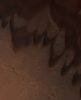
ESP_014404_1765_RED_abrowse-01.jpgEquatorial Martian Barchans (EDM - Natural Colors; credits: NASA/JPL/Univ. of Arizona)57 visiteBarchan Dunes are common on both Earth and Mars. These Dunes are very distinctive in shape, and are important because they can tell scientists about the environment in which they formed.
Barchans form in wind regimes that blow in one Dominant Direction. The ridged arcs of sand that define the Barchan Dunes end in horns that point downwind. Sand is transported up the broad, relatively shallow windward slopes and once it overtops the Dune Crest, the sand falls down a shorter steeper slope between the horns, known as the "Slip Face". Over time, the Barchans migrate downwind, following their horns.
This HiRISE image shows an example of several Barchans merging to form an even larger Barchan Dune. This can happen through a variety of circumstances, such as when smaller, faster dunes collide with larger, slower-moving dunes that absorb them, resulting in single, larger dunes. The distance between the merging horns of the large dune in this highlighted region is a little over 500 meters (about 1600 feet).
Coord.: 3,3° South Lat. and 307,6° East Long.
Spacecraft altitude: about 268 Km
M.L.T.: 14:17 (early afternoon)
S.I.A.: 36° (with the Sun about 54° abov the Local Horizon)
MareKromiumDic 23, 2009
|
|
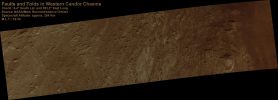
PSP_003540_1735_RED_browse~0.jpgFaults and Folds in West Candor Chasma (Natural Colors; credits: Lunexit)64 visiteThis image shows various interesting structures along the Floor of Candor Chasma, a major canyon of Valles Marineris.
The rocks along the floor of the chasma consist of multiple layers of light-toned material, possibly windblown or water-lain sediment. These layers have been shifted along faults and also folded, giving the layers an apparent wavy appearance as they are exposed at the Surface through erosion.
Some waviness in the Layers may also have formed as these sediments were laid down (for example, in Dunes or large Ripples. Detailed mapping of these Faults and Folds may help reveal the origin of these Layered Deposits and if water played any role in their formation.MareKromiumDic 22, 2009
|
|
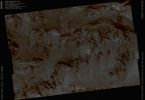
PSP_001415_1875_RED_abrowse.jpgAlluvial Fans in Mojave Crater (Natural Colors; credits: Lunexit)84 visiteAptly-named Mojave Crater in the Xanthe Terra Region has Alluvial Fans that look remarkably similar to landforms in the Mojave Desert of South-Eastern California and portions of Nevada and Arizona.
Alluvial Fans are "fan-shaped deposits of water-transported material" (---> Lat.: alluvium). They typically form at the base of hills or mountains where there is a marked break, or flattening of slope.
They typically deposit big rocks near their Mouths (close to the mountains) and smaller rocks at greater distances. Alluvial Fans form as a result of heavy desert Downpours, typically "Thundershowers" (Nota Lunexit: piogge torrenziali che occorrono durante violenti temporali, per lo più di tipo tropicale).
Because deserts are poorly vegetated, heavy and short-lived Downpours create a great deal of erosion and nearby deposition.
There are Fans inside and around the outsides of Mojave Crater on Mars that perfectly match the morphology of Alluvial Fans on Earth, with the exception of a few small impact craters dotting this Martian Landscape.
Channels begin at the apex of topographic Ridges, consistent with precipitation as the source of water, rather than groundwater. This remarkable landscape was first discovered from Mars Orbital Camera images. Mars researchers have suggested that impact-induced Atmospheric Precipitation may have created these unique landscapes.
This HiRISE image at up to 29 cm/pixel scale supports the Alluvial Fan interpretation, in particular by showing that the sizes of the largest rocks decrease away from the Mouths of the Fans.MareKromiumDic 22, 2009
|
|
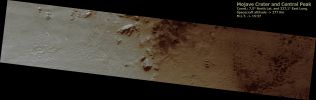
PSP_002101_1875_red-00~0.jpgMojave Crater Floor and Central Uplift (CTX Frame - Natural Colors; credits: Lunexit)59 visiteThis full HiRISE image shows that the Crater Floor - South of the Central Uplift - is densely pitted and fractured. These Pits, many of which are partially filled with dark sand, lack raised rims and a circular form.
This suggests that they are not impact craters. In fact, very few definite impact craters are seen on the Floor and Walls of Mojave, implying that it is incredibly young and relatively well preserved for a crater of its size.
HiRISE images covering Mojave Crater and the surrounding Region are yielding new insights into impact processes on Mars. MareKromiumDic 22, 2009
|
|
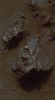
PSP_002101_1875_red-01.jpgMojave Crater Floor and Central Uplift (EDM - Natural Colors; credits: Lunexit)59 visiteThis HiRISE sub-image shows a portion of the Central Uplift structure in Mojave Crater.
Central Uplifts are a typical feature of large impact craters on the Earth, the Moon and Mars; craters larger than 6 or 7 Km in diameter on Mars typically form this mountain-like peak in the central portion of the crater interior.
This peak consists of rocks originating from several kilometers beneath the pre-impact surface. Mojave has a very prominent Central Uplift as it has a diameter of approx. 60 Km (about 37 miles).
In this image, Boulders as large as 15 mt (50 feet) across have been eroded from the massive uplifted rock and have rolled downslope.
Fine-grained Debris has also collected in the topographic lows and has been shaped by the wind into Dunes and Ripples. Notably absent from this image are the striking Drainage Channels and Alluvial Fans that are abundant on the Wall-Terraces and Ejecta of Mojave Crater (see PSP_001415_1875).
These features were likely formed by Surface Runoff of liquid water, which may have been released from the Subsurface during the impact event that formed Mojave.
Previously, it had been suggested that a brief, torrential downpour over Mojave Crater delivered the water. However, Mars Orbiter Camera's (MOC) images of Mojave's Central Uplift have previously shown no evidence for Surface Runoff, and the higher resolution of this HiRISE image (2.4 MB) confirms that this part of the Crater appears untouched by liquid water.
So the question remains: by what means was the water, in the form of Runoff, supplied to Mojave? This question, in addition to several others regarding this phenomenon, are currently being investigated by the HiRISE team and their collaborators.MareKromiumDic 22, 2009
|
|
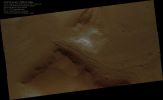
PSP_001420_2045_RED_browse-00~0.jpgSmall Channel in Tartarus Colles (CTX Frame - Natural Colors; credits: Lunexit)59 visiteThis observation shows a thin channel between knobs in the Northern Hemisphere. These knobs are part of a local group of knobs called the "Tartarus Colles".
Both knobs visible in this image have dark slope streaks. It was originally thought that slope streaks might be locations of surface water wetting and darkening soil, but it is now commonly believed that slope streaks are mini-avalanches of dust. Slope streaks fade over time as wind erosion blends them in with their surroundings.MareKromiumDic 21, 2009
|
|
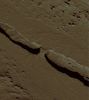
PSP_001420_2045_RED_browse-01~0.jpgSmall Channel in Tartarus Colles (EDM - Natural Colors; credits: Lunexit)70 visiteThe Channel between the Knobs has a variable depth as seen by the varying shadow lengths. The origin of the Channel is unknown, but it is probably NOT a Fluvial Channel because there are no obvious source or Deposit Regions; the Channel, therefore, is probably a Collapse Feature.
One portion of it, (see this EDM, approx. 375 meters across), contains a Bridge, and is probably a remnant of the original surface.
A depression that extends from the Channel Northwards — but which is not as deep as the majority of the Channel — might be in the process of collapsing and enlarging the Channel. MareKromiumDic 21, 2009
|
|

PSP_001666_1530_RED.jpgHolden Crater (Natural Colors; credits: Lunexit)57 visitenessun commentoMareKromiumDic 21, 2009
|
|
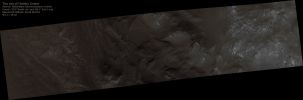
PSP_003710_1530_RED_browse~0.jpgHolden Crater's Rim (Natural Colors; credits: Lunexit)61 visiteThe formation of the approximately 150 Km diameter Holden Crater interrupted the Northward flowing Uzboi Vallis Channel System. Relief associated with the Rim of Holden effectively blocked the Channel.
HiRISE image PSP_003710_1530 covers the portion of Holden Crater's Rim where it was overtopped by water that had backed up in Uzboi Vallis to the South. Water flowing over the Rim in multiple locations eventually focused on a single Channel that then cut deeply into the Rim.
After the impounded water drained into the Crater, the steep Wall on the East side of the main Channel collapsed in a Landslide that remains visible along the Floor.
Several Outcroppings of variably bright material are visible in the scar produced by the Slide. MareKromiumDic 21, 2009
|
|
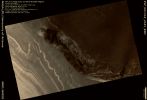
PSP_001334_2645_RED_abrowse-00.jpgNorth Polar Layered Deposits in Head Scarp of Chasma Boreale (CTX Frame - Natural Colors; credits: Lunexit)58 visitenessun commentoMareKromiumDic 19, 2009
|
|
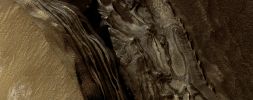
PSP_001334_2645_RED_abrowse-01.jpgNorth Polar Layered Deposits in Head Scarp of Chasma Boreale (EDM - Natural Colors; credits: Lunexit)59 visiteThis EDM shows the NPLD at top and darker materials at bottom exposed in a Scarp at the head of Chasma Boreale, a large canyon eroded into the Layered Deposits.
The Polar Layered Deposits appear of a brown/reddish color because of dust mixed within them, but they are ice-rich as indicated by previous observations. The water ice in the Layered Deposits is probably responsible for the pattern of fractures seen near the top of the scarp.
The darker material below the Layered Deposits may have been deposited as sand dunes, as indicated by the cross-bedding (truncation of curved lines) seen near the middle of the Scarp.
It appears that brighter, ice-rich layers were deposited between the dark dunes in places.
Exposures such as these are useful in understanding the recent climate variations that are likely recorded in the Polar Layered Deposits.MareKromiumDic 19, 2009
|
|
| 2237 immagini su 187 pagina(e) |
 |
|
|
|
|
95 | |
|
|
|
|





