| Ultimi arrivi - Mars Reconnaissance Orbiter (MRO) |
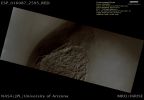
ESP_016087_2595_RED_abrowse.jpgFrost-covered Dunes (Natural Colors; credits: Dr Paolo C. Fienga - Lunexit Team)58 visiteDunes are often found on Crater Floors. In the Winter time, at high Northern Latitudes, the Terrain is covered by Carbon Dioxide Ice (Dry Ice - CO2 Ice). In the Spring, as this seasonal ice evaporates or sublimates, many unusual features - certainly unique to Mars - become visible.
On the Floor of this Crater, where there are no Dunes, the ice forms an uninterrupted layer. On the Dunes, however, Dark Streaks form as surface material from below the ice is mobilized and deposited on top of the ice. In some cases this mobile material probably slides down the steep face of the Dunes, while in other cases it may be literally blown out in a process of gas release similar to the one that we could obtain by removing a cork from a champagne bottle.
Nota Lunexit: ma i commenti NASA ai frames (non tutti, ma certamente alcuni, tipo questo) li fanno scrivere ai bambini ed alle bambine di Scuole Medie e/o Licei, per caso? Lo avevamo già stigmatizzato in passato ma, a volte, repetita juvant: alcuni commenti non solo sono, in sè, piuttosto naif (diciamo "ingenui", valà...) ed alquanto banali ma - e questa è la cosa più grave - essi contengono degli strafalcioni grammaticali (frequenti) e sintattici (meno di frequente) che fanno rabbrividire noi, poveri "ignoranti Italiani".
Bah...MareKromiumGen 16, 2010
|
|
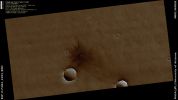
ESP_015962_1695_RED_abrowse-00.jpgRelatively fresh Impact Crater (CTX Frame - Natural Colors; credits: Dr Paolo C. Fienga - Lunexit Team)76 visiteThis image shows a very fresh-looking Impact Crater with an extensive Radial Ejecta Blanket.
The Crater was first seen in an image acquired with MRO's Context Camera (CTX). The best image of this Region prior to CTX was from one of the Viking Orbiters, and the Crater is not visible in it.
This could either mean that the Crater formed sometime between 1976 and 1999, or that there might have been more Dust on the Surface in 1976, or that maybe the air could have been hazy, thus obscuring the Crater.
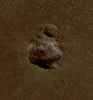
Based on the HiRISE image, we suspect that the Crater is more than several decades old, because at full resolution we see a "Textured Surface" (see EDM n.2) that is common in Dust-Mantled Regions of Mars, but absent in the youngest craters.MareKromiumGen 16, 2010
|
|

ESP_015962_1695_RED_abrowse-01.jpgRelatively fresh Impact Crater (EDM n.1 - Natural Colors; credits: Dr Paolo C. Fienga - Lunexit Team)62 visitenessun commentoMareKromiumGen 16, 2010
|
|
ESP_015962_1695_RED_abrowse-02.jpgRelatively fresh Impact Crater (EDM n.2 - Natural Colors; credits: Dr Paolo C. Fienga - Lunexit Team)62 visitenessun commentoMareKromiumGen 16, 2010
|
|

PSP_001916_2220_RED_abrowse.jpgKnobs and Mounds on the Northern Plains (Natural Colors; credits: Dr Paolo C. Fienga - Lunexit Team)58 visiteLight-toned Mounds occur across the image.
The northern part of the image is dominated by small Knobs or Patches, while there are features hundreds of meters across to the South. The larger features frequently have one or more craters and an irregular shape; it has been proposed that these features are Mud Volcanoes, which erupt mud instead of lava.
On Earth, Mud Volcanoes usually form in conditions of tectonic pressurization or rapid burial of sediments.
At high resolution, the Knobs show some fine lineations which may be wind-blown material, but are otherwise very smooth. In between the Mounds, the Surface is rough and rich in Boulders. The few Boulders on the Mounds were likely ejected from nearby Impact Craters.
Information like this from HiRISE images provides useful constraints on the formation and material of these Knobs and Cones.MareKromiumGen 12, 2010
|
|

ESP_014423_1040_RED_abrowse.jpgSouth Polar Region (Natural Colors; credits: Dr Paolo C. Fienga - Lunexit Team)60 visiteSomewhere in this patterned landscape, less than 1000 Km (about 600 miles) from the South Pole of Mars, a treasure may be hiding.
In January 1999, NASA launched a rocket containing the Mars Polar Lander (MPL), an exploration vehicle with a weather station and a subsurface probe designed to search for water ice, towards the Layered Terrain near the Martian South Pole. The layers are thought to be a sequence of alternating dust-rich and dust-poor ice deposited by the seasonal advance and retreat of the South Polar Ice Cap and could be an important record of climate on the Red Planet.
On 3 December 1999, just before the Lander entered the Martian Atmosphere, MPL went silent. Investigations propose the most likely cause of the mission failure is that the Spacecraft’s computers misinterpreted the release of the Lander’s legs in preparation for descent as touch-down on the Martian Surface, causing descent engines to shut off when the lander was still 40 meters (130 feet) above ground.
However, no one knows for sure.
An immediate search began for the remains of the MPL using images from Mars Global Surveyor. HiRISE is continuing the search with high resolution images of the area in which MPL could, most likely, have crash-landed. MareKromiumDic 27, 2009
|
|
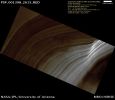
PSP_001398_2615_RED_abrowse.jpgExposure of NPLD with "Unconformities" (Natural - but enhanced - Colors; credits: Dr Paolo C. Fienga - Lunexit Team)84 visiteThis image shows a portion of the North Polar Layered Deposits (NPLD). The NPLD are layers that have been deposited over an extensive area at both Poles, possibly throughout Martian History. They likely contain ice-rich and dust-rich layers, with the darker layers being probably more dust-rich than the bright layers.
The NPLD holds clues to past climate regimes similar to ice cores on Earth. Several of the layers occur in fairly regular sequences, as seen in this image, suggesting that Mars underwent cyclic climate changes in the past.
Towards the top left side of the image, there is a series of layers that appears truncated at an angle, forming what geologists call "Angular Uncomformity". They typically form by first laying down a series of continuous beds. Then erosion cuts through the beds at an angle. Aferwards, a new set of beds are laid over this partially eroded sequence. A similar Unconformity exists at the bottom right of the image.MareKromiumDic 27, 2009
|
|

PSP_001406_2680_red-00.jpgLonely and (almost) buried crater in the North Polar "Permanent Cap" (CTX Frame - Natural Colors; credits: Dr Paolo C. Fienga - Lunexit Team)57 visitenessun commentoMareKromiumDic 25, 2009
|
|
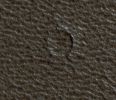
PSP_001406_2680_red-01.jpgLonely and (almost) buried crater in the North Polar "Permanent Cap" (EDM - Natural Colors; credits: Dr Paolo C. Fienga - Lunexit Team)59 visitenessun commentoMareKromiumDic 25, 2009
|
|
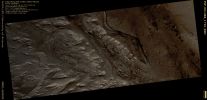
PSP_001488_1750_RED_abrowse.jpgEdge along Gale Craters's Interior Mound (Natural Colors; credits: Dr Paolo C. Fienga - Lunexit Team)58 visiteGale Crater is one of several craters around the Equator that show the presence of Light-Toned Layered Deposits (or LTLD). This HiRISE image covers the northern edge of the LTLD in the Central Mound of Gale Crater, as well as a small portion of the Crater Floor. The right side of the image shows a relatively flat surface with some Impact Craters.
Moving to the left (Southward), there is a large Canyon where Dark Sands have accumulated and formed Ripples and Dunes.
As one moves further to the South, the LTLD rises upward in topography and Layering is visible in some locations. The Surface of the LTLD is very fractured, producing meter-size blocks.
The fact that we don't see many loose rocks along the Surface suggests that the rocks are quickly being destroyed by winds due to their fragile nature.
Resistant Hills, on the other side, tend to be elongated, which is consistent with upslope or downslope winds eroding the rocks themselves.MareKromiumDic 25, 2009
|
|

PSP_001493_1815_RED_abrowse-1.jpgTerra Meridiani (possible True Colors; credits: Dr Paolo C. Fienga - Lnexit Team)57 visiteThis HiRISE image shows dark sand covering bright Bedrock in the Terra Meridiani (Meridiani Planum) Region of Mars.
The MER Opportunity Rover is currently exploring Meridiani, but is located about 500 Km to the West-South/West from this area.
There are three broad classes of Terrain in this image: the regular spacing of the Dark Ridges, with one side of the Ridges (in this case generally facing North/West) shallower than the other, indicates that the material is windblown sand deposited in the form of Dunes or large Ripples. On the slopes of and in between the Dunes and Ripples are smaller-scale Ripples.
The dark orangish tone of the Sand and the analysis of analogous material by Opportunity indicates that is composition might be Basaltic and this is in contrast to most sand on Earth, which is dominated by Quartz.MareKromiumDic 25, 2009
|
|

ESP_013951_1955_RED_abrowse-00.jpgDark Syrtis Major (CTX Frame - Natural Colors; credits: Dr Paolo C. Fienga - Lunexit Team)58 visiteOn 13 October 1659, Dutch Astronomer Christiaan Huygens turned one of his telescopes towards a bright orange spot in the sky and produced what Percival Lowell would later call “the first drawing of Mars worthy of the name ever made by man”.
Huygens included a "dark spot" in his drawing that is thought to represent Syrtis Major, a small sliver of which is visible in this HiRISE image.
Syrtis Major is a Shield Volcano and its dark color comes from the dark Basaltic Rock present in the area, visible because it lacks the Dust that paints the rest of the Planet its distinct, rusty orangish color. By tracking this "dark spot" in repeated observations, Huygens concluded that Mars rotated every 24 hours: a time not too far off from its true rotation period of approx. 24 hours and 39,58 minutes.MareKromiumDic 25, 2009
|
|
| 2237 immagini su 187 pagina(e) |
 |
|
|
|
|
94 | |
|
|
|
|





