| Ultimi arrivi - Mars Reconnaissance Orbiter (MRO) |

ESP_016173_2005_RED_abrowse-3.jpgSmall Shield Volcano with "Summit Caldera" (Saturated and Enhanced Natural Colors; credits: Dr M. Faccin - Lunexit Team)56 visiteAlthough there are a few truly giant Shield Volcanoes on Mars, there are also many smaller ones.
There's a strong interest in imaging the Volcanic Vent Regions of Mars, in order to understand not only the Volcanic Processes themselves, but also to search for any signs of recent activity.
In fact, it has been suggested that active volcanism is one possible explanation for the Methane gas that has been detected in the Atmosphere of Mars.
This HiRISE image shows that the Summit Caldera of a small Shield Volcano is mantled by Dust and covered by tiny Impact Craters. And it is just this last element (such as the existence of Impact Craters all over the Caldera) the one that allows us to believe that there are basically no chances that the imaged Volcano was active recently enough to affect the Atmosphere of Mars through the release of any gas whatsoever.MareKromiumGen 25, 2010
|
|

PSP_007767_1970_RED_abrowse-01.jpgMegabreccia inside Toro Crater (EDM - Natural - but strongly enhanced - Colors; credits: NASA/JPL/Univ. of Arizona and Dr Paolo C. Fienga - Lunexit Team)59 visiteThis EDM shows a close-up of one of the features that make Toro Crater a great target for HiRISE images: colorful patches of Megabreccia.
Breccia is a mixture of chunks of rock (clasts) that have been broken by an energetic geologic event, such as a Landslide or Crater-forming Impact, and then that got cemented together in a finer grained material.
Megabreccia features very large clasts that are big enough for HiRISE to see on the surface - some even larger than 30 feet across.
In this 200 meter (about 1/8 of a mile) diameter exposure of Megabreccia, clasts of various colors (indicating different kinds of rocks) and sizes have been exposed in the Uplifted Central Peak of Toro Crater.MareKromiumGen 21, 2010
|
|
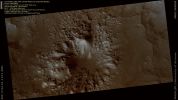
ESP_016136_1525_RED_abrowse-00.jpgColourful Streaks (CTX Frame - Natural Colors; credits: NASA/JPL/Univ. of Arizona and Dr Paolo C. Fienga - Lunexit Team)58 visiteThis is an image of the Central Pit of an Unnamed Impact Crater located in the ancient Southern Highlands.
The Central Uplifts of large Impact Craters often collapse to form Pits on Mars, but they are still structural Uplifts and often expose deep Bedrock with diverse rock types which, like in this case (see the EDM that follows) may show a variety of colors.MareKromiumGen 21, 2010
|
|

ESP_016136_1525_RED_abrowse-01.jpgColourful Streaks (EDM - possible True Colors; credits: NASA/JPL/Univ. of Arizona and Dr Paolo C. Fienga - Lunexit Team)82 visiteIn this enhanced True Color EDM, we see colorful Streaks, where the bedrock is eroding, moving downhill a bit, then getting swept by the wind.MareKromiumGen 21, 2010
|
|

ESP_016160_2485_cut1.jpgPhoenix Lander in Springtime (Natural Colors; credits: Dr Paolo C. Fienga - Lunexit Team)59 visiteWith early Spring at the Phoenix Landing Site comes the progressive sublimation of the Carbon Dioxide frost that has blanketed the Lander and surrounding terrain throughout the Winter.
During the long Polar-Winter Night, atmospheric CO2 freezes onto the Surface building up a layer of frost roughly 30 cm (about one foot) thick.
In the Spring this frost returns to the Atmosphere as gas (sublimates) over the course of several months. This image, part of a seasonal frost monitoring sequence, shows some areas of bare ground are beginning to be exposed. However, extensive frost patches remain in the topographic lows, such as the Troughs of the local polygonally patterned surface.
Even when the frost has completely sublimated, it must be underlined that the Dust deposited during the Winter could actually obscure (and "erase", in a view from atop) any and all the "Man-Made Features" that are still barely visible here (Backshell and Parachute, Heat-Shield and Lander).
The Parachute that is attached to the Backshell, in fact, is not apparent in this image, and we'll see if it reappears in later images.
Also gone are the dark halos around Lander, Backshell and Heat-Shield - again, this is due to seasonal frost and/or dust.
This and future images will help calibrate expectations for finding the Mars Polar Lander hardware which encountered Mars in 1999.MareKromiumGen 19, 2010
|
|
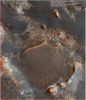
PSP_007454_2020.jpgPossible Phyllosilicates in Mclaughlin Crater (High-Def-3D and Natural Colors; credits: Dr M. Faccin - Lunexit Team)60 visiteAcquisition date: 28 February 2008
Mars Local Time: 14:47 (early afternoon)
Latitude (centered): 21,7° North
Longitude: 337,8° East
Range to target site: approx. 287,5 km (about 179,7 miles)
Original image scale range: 28,8 cm/pixel (with 1 x 1 binning) so objects ~86 cm across are resolved
Map projected scale: 25 cm/pixel and North is up
Map projection: EQUIRECTANGULAR
Emission Angle: 0,2°
Phase (Sun-Target-Spacecraft) Angle: 40,1°
Solar incidence angle: 40° (with the Sun about 50° above the Local Horizon)MareKromiumGen 17, 2010
|
|

PSP_007962_2635_RED_abrowse-00.jpgNorthern Dunes (CTX Frame - Possible Natural Colors; credits: Dr Paolo C. Fienga - Lunexit Team)57 visiteThere is a vast Region of Sand Dunes at high Northern Latitudes on Mars.
In Winter, a layer of CO2 ice covers the Dunes, and in the Spring - as the Sun warms the ice - it sublimates.
This is a very active process causing the sand to dislodge from the Dunes' Crests to cascade, often (NOT always!) forming Dark Streaks.MareKromiumGen 17, 2010
|
|

PSP_007962_2635_RED_abrowse-01.jpgNorthern Dunes (EDM - Possible Natural Colors; credits: NASA/JPL/Univ. of Arizona and Dr Paolo C. Fienga - Lunexit Team)59 visiteIn this EDM, falling material has kicked up a small cloud of dust. The color of the ice surrounding adjacent streaks of material suggests that dust has settled on the ice at the bottom after similar events.
Also discernible here are Polygonal Cracks in the ice formed on the Dunes (of course the cracks shall disappear when the ice is gone).MareKromiumGen 17, 2010
|
|
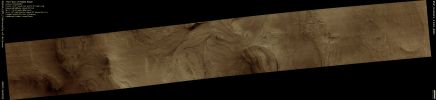
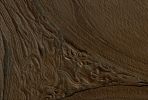
ESP_016022_1420_RED_abrowse-00.jpgThe Floor of Hellas Basin (CTX Frame - Natural Colors; credits: Dr Paolo C. Fienga - Lunexit Team)63 visiteHiRISE images are revealing some very strange landforms on the Floor of Hellas. Materials appear to have flowed in a viscous manner, like ice.
Viscous flow features are common over the Middle Latitudes of Mars, but those in Hellas are often distinctive for unknown reasons.
MareKromiumGen 16, 2010
|
|
ESP_016022_1420_RED_abrowse-01.jpgThe Floor of Hellas Basin (EDM - Natural Colors; credits: NASA/JPL and Dr Paolo C. Fienga - Lunexit Team)61 visitenessun commentoMareKromiumGen 16, 2010
|
|
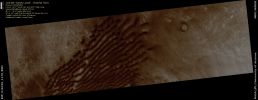
ESP_016036_1370_RED_abrowse-00.jpgDunes in Noachis Terra (CTX Frame - Natural Colors; credits: Dr Paolo C. Fienga - Lunexit Team)58 visiteDunes of sand-sized materials have been trapped on the floors of many Martian Craters.
This is one example, from an Unnamed Crater located in Noachis Terra, West of the giant Hellas Impact Basin.
The most extensive Linear Dunefields known in the Solar System are on Saturn's largest moon Titan.
But Titan, as to Mars, has a very different environment and composition and so, at a meter-scale resolution (not available yet, unfortunately) the Titanian Dunes should look (better yet: they certainly ARE) very different from the Martian ones.MareKromiumGen 16, 2010
|
|

ESP_016036_1370_RED_abrowse-01.jpgDunes in Noachis Terra (EDM n.1 - Natural Colors; credits: Dr Paolo C. Fienga - Lunexit Team)59 visiteThe Dunes here are linear, thought to be due to shifting wind directions.
In places, each Dune is remarkably similar to the adjacent one, including a reddish (or dust colored) band on the North-Eastern facing slopes.
Furthermore, very large Angular Boulders litter the floor between the Dunes.MareKromiumGen 16, 2010
|
|
| 2237 immagini su 187 pagina(e) |
 |
|
|
|
|
93 | |
|
|
|
|





