| Ultimi arrivi - Mars Reconnaissance Orbiter (MRO) |

PSP_001808_1875_RED_abrowse-00.jpgSlope Streaks in Terra Sabaea (CTX Frame - Natural Colors; credits: Dr Paolo C. Fienga - Lunexit Team)59 visiteThis observation shows part of the rim of an Unnamed Crater in the Terra Sabaea Region - Northern Hemisphere of Mars. MareKromiumFeb 12, 2010
|
|

PSP_001808_1875_RED_abrowse-01.jpgSlope Streaks in Terra Sabaea (EDM - Natural Colors; credits: Dr Paolo C. Fienga - Lunexit Team)58 visiteThis EDM is a close-up view of the Crater Rim revealing dark and light-toned Slope Streaks. Slope Streaks' formation is among the few known processes currently active on Mars. While their mechanism of formation and triggering is debated, they are most commonly believed to form by downslope movement of extremely dry sand or very fine-grained dust in an almost fluidlike manner (analogous to a terrestrial snow avalanche) exposing darker underlying material.
Other ideas include the triggering of Slope Streaks' formation by possible concentrations of near-Surface ice or scouring of the Surface by running water from aquifers intercepting slope faces, Spring Discharge (perhaps brines) and/or hydrothermal activity.
Several of the Slope Streaks seen here, particularly the 3 longest darker Streaks, show evidence that downslope movement is being diverted around obstacles such as large boulders. Several Streaks also appear to originate at boulders or clumps of rocky material.
In general, the Slope Streaks do not have large deposits of displaced material at their downslope ends and do not run out onto the Crater Floor suggesting that they have little reserve kinetic energy. The darkest Slope Streaks are the youngest and can be seen to cross cut and superpose older and lighter-toned Streaks.
The lighter-toned streaks are believed to be dark streaks that have lightened with time as new dust is deposited on their surface.MareKromiumFeb 12, 2010
|
|
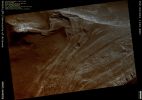
PSP_001662_1520_RED_abrowse.jpgLayered Deposits in Terby Crater (Natural - but enhanced - Colors; credits: Dr Paolo C. Fienga - Lunexit Team)91 visiteTerby Crater is a large (approximately 165 Km), Noachian-aged crater located on the Northern Rim of the Hellas Impact Basin.
Terby hosts a very impressive sequence of predominantly light-toned Layered Deposits, up to 2,5 Km thick that are banked along its Northern Rim and extend toward the center of the Crater.
The full image shows this stack of layered rocks as they are exposed Westward facing scarp. The layered sequence consists of many beds that are repetitive, relatively horizontal and laterally continuous on a kilometer scale. Many beds are strongly jointed and fractured and exhibit evidence of small-scale wind scour.
The light-toned layers are typically at least partially covered with dark mantling material that obscures the layers as well as debris and numerous, meter-scale boulders that have cascaded down slope. The processes responsible for formation of these layers remain a mystery, but could include deposition in water, by the wind, or even volcanic activity.
This HiRISE image is a proposed landing site for the Mars Science Laboratory (MSL) in Terby Crater.MareKromiumFeb 07, 2010
|
|
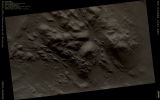
PSP_010888_2030_RED_abrowse.jpgMojave Crater's Floor and Central Uplift (Natural Colors; credits: Dr Paolo C. Fienga - Lunexit Team)62 visiteThis observation shows a portion of the Central Uplift structure in Mojave Crater.
Central Uplifts are a typical feature of large Impact Craters on Earth, Moon and Mars; craters larger than 6 or 7 Km in diameter on Mars typically form this mountain-like peak in the central portion of the crater interior.
This Peak consists of rocks originating from several kilometers beneath the pre-impact surface.
Mojave has a very prominent Central Uplift as it has a diameter of about 60 Km (apprx. 37 miles). In this image, boulders as large as about 15 meters (50 feet) across have been eroded from the massive uplifted rock and have rolled downslope. Fine-grained debris has also collected in the topographic lows, and has been shaped by the wind into Dunes and Ripples.
Notably absent from this image are the striking Drainage Channels and Alluvial Fans that are abundant on the wall-terraces and ejecta of Mojave Crater (see PSP_001415_1875). These features were likely formed by Surface Runoff of liquid water, which may have been released from the Subsurface during the impact event that formed Mojave.
Previously, it had been suggested that a brief, torrential downpour over Mojave Crater delivered the water. However, Mars Orbiter Camera's (MOC) images of Mojave's Central Uplift have previously shown no evidence for Surface Runoff, and the higher resolution of this HiRISE image confirms that this part of the Crater appears untouched by liquid water.
So the question remains: by what means was the water, in the form of Runoff, supplied to Mojave? This question, in addition to several others regarding this phenomenon, are currently being investigated by the HiRISE team and their collaborators.MareKromiumFeb 07, 2010
|
|
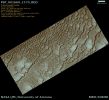
PSP_001660_2570_RED_abrowse.jpgFrost-covered Dunes (Natural Colors; credits: Dr Paolo C. Fienga - Lunexit Team)59 visiteThis image shows Dunes on the Northern Plains of Mars, and appears similar to images taken when the Surface was covered by Frost.
However, CRISM spectra taken at the same time do not show evidence for either water or CO2 frost here. Possibly, and consistent with the CRISM spectra, this area is covered by Dust, obscuring the dark material that is typically present in Dunes of this type.
The orientation of the Dunes indicates that they were formed by winds blowing generally from upper right to lower left. Ripples on the Dunes show that the wind patterns that formed them are more complex, with the dune shapes affecting the wind direction.
It is not known whether these Dunes are currently active (such as if thy're being moved by wind still today) or have been in this location for a very long time; however, if they are indeed covered by Dust, the they cannot have been recently active.
Between the Dunes, the underlying Surface of the Northern Plains can be seen. In places, it has been fractured into polygonal blocks, suggesting that water ice is or was present below the Surface. Meter-size blocks are also seen in places in this image and elsewhere on the Northern Plains.
The origin of these blocks is not known, but they may be remnants of erosion of material that once covered this Region.MareKromiumFeb 04, 2010
|
|

PSP_001370_2505_RED_abrowse.jpgIce Patch or Frozen Lake? (Natural Colors; credits: Dr Paolo C. Fienga - Lunexit Team)58 visitenessun commentoMareKromiumFeb 04, 2010
|
|

PSP_001700_2505_RED_abrowse-01.jpgThe "Frozen pseudo-Lake" of Vastitas Borealis (EDM - Natural Colors; credits: Dr Paolo C. Fienga - Lunexit Team)64 visiteLa parte realmente "interessante" del frame è proprio nella texture della porzione più chiara e profonda del "Frost Patch", perchè è in quel punto della Surface Feature che, volendo, si riesce a vedere qualcosa di significativo e quindi si può anche provare a ragionare e ad osservare con estrema attenzione eppure...eppure la NASA ci mostra le dunette (fangose?) che lo delimitano ed ignora il resto.
Beh, vorrà dire che l'Analisi sulla porzione più "bianca e profonda" del Frost Patch la faremo noi, con calma.
E che i Signori di Pasadena ci scusino tanto per aver osato dubitare della correttezza del loro (pseudo) "Metodo Scientifico"!MareKromiumFeb 04, 2010
|
|

PSP_001700_2505_RED_abrowse-00.jpgThe "Frozen pseudo-Lake" of Vastitas Borealis (CTX Frame - Natural Colors; credits: Dr Paolo C. Fienga - Lunexit Team)72 visiteThe right side (Dx) of this observation shows a portion of a "Frost Patch" on a mound inside a Northern Hemisphere Crater. This is the same frosted mound shown in this image. The Frost Patch has remained largely stable at least since the Viking era (late 1970s).
The bright frost region is bounded by a Dunefield on the N/E. Several sizes of Dunes are visible. The size classes probably represent generations of dunes that formed under a variety of dominant wind conditions.
The EDM shows the Dunes and Frost Boundary up-close. The Frost is largely absent over the Dunes and is more stable over the ground that does not have dune-shaped landforms.
Note Lunexit: il Cratere, che la NASA stessa si affrettò a battezzare "Louth" (nonostante fosse ancora pending l'approvazione del nome da parte dell'International Astronomical Union (IAU) - un'Entità tanto enorme e pesante quanto, nei fatti, inutile...), è tornato ad essere un Cratere senza Nome dell'Emisfero Nord.
Il "presunto" Lago ghiacciato è diventato un "Frost Patch" (lett.: una "chiazza di brina") e le sue caratterizzazioni - ed implicazioni, come a suo tempo espresse dall'ESA - sono...sparite! Nelle pagine NASA (ed ESA, recenti) non vi è traccia di investigazioni o analisi più approfondite su questo - comunque intrigante - Rilievo Superficiale. Nulla.
Il possibile Laghetto del Cratere Louth, Regione di Vastitas Borealis - Marte -, di fatto non solo non esiste (e su questo potremmo anche essere d'accordo, sebbene a malincuore), ma non è MAI esistito (e su questo modo di pensare e di agire, invece, NON SIAMO ASSOLUTAMENTE D'ACCORDO: perchè è scorretto, intrinsecamente contraddittorio, nonchè scientificamente e logicamente viziato).
Curioso, quindi, (e "curioso" è un puro eufemismo) il modo in cui tutta questa storia è stata (mal)trattata dalle "Potenze Spaziali"... Veramente curioso.MareKromiumFeb 04, 2010
|
|
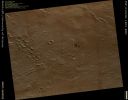
PSP_010200_1805_RED_abrowse-00.jpgFresh Crater Cluster (CTX Frame - Natural Colors; credits: Dr Paolo C. Fienga - Lunexit Team)58 visiteAlthough most of the craters HiRISE usually images are ancient, impact cratering is an ongoing process on the Martian Surface.
While very large craters are rare, smaller ones with diameters of a few meters form on timescales rapid enough for Mars missions to confirm the presence of a new crater. Data from the Mars Orbiter Camera (MOC) on the (now defunct) Mars Global Surveyor, the Context Camera (CTX) on MRO, and HiRISE have dated craters to within a few years or even months, based on repeat images that show no craters in the earlier image and craters present in the later image.
Most of the new craters identified by CTX and HiRISE have been located in Mars' dustiest areas, where a new impact will scour dust from the Surface and reveal darker underlying rock. This color difference makes the craters easier to spot. Other, less dusty areas of Mars are certainly being bombarded as well, but the size of the craters makes them difficult to detect without stark color contrasts.
Once a new dark spot has been identified by CTX, HiRISE will take a follow-up image to confirm that the dark spots are in fact Impact Craters.MareKromiumGen 31, 2010
|
|
PSP_010200_1805_RED_abrowse-01.jpgFresh Crater Cluster (EDM - Natural Colors; credits: Dr Paolo C. Fienga - Lunexit Team)69 visiteMany of the newest craters are part of a crater cluster, like this one. This cluster is about 350 meters (almost a quarter mile) across at its longest, and the largest crater in the image is 5 meters (16 feet) in diameter.
These clusters likely result from breaking up of the impactor before it strikes the surface. How widely dispersed the craters are depends on the strength and density of the impactor. Scientists can study these clusters to learn more about the object that created them.MareKromiumGen 31, 2010
|
|

ESP_016173_2005_RED_abrowse-1.jpgSmall Shield Volcano with "Summit Caldera" (CTX Frame - Saturated and Enhanced Natural Colors; credits: Dr Paolo C. Fienga - Lunexit Team) 59 visitenessun commentoMareKromiumGen 28, 2010
|
|
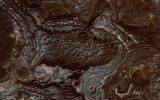
Juventae_Chasma-PIA12489.jpgBright Layered Deposits near Juventae Chasma (Natural Colors; credits: Dr Paolo C. Fienga - Lunexit Team)58 visiteThis view shows color variations in bright Layered Deposits on a plateau near Juventae Chasma in the Valles Marineris egion of Mars. A brown mantle covers portions of the bright deposits. The view covers an area about of 1,2 Km (three-fourths of a mile) across.
The image comes from an observation made by the High Resolution Imaging Science Experiment (HiRISE) camera on NASA's Mars Reconnaissance Orbiter on May 2, 2007.
Researchers have found that these bright Layered Deposits contain Opaline Silica and Iron Sulfates, consistent with low-temperature, acidic aqueous alteration of basaltic materials. They conclude that aqueous activity affected this plateau after formation of the nearby canyons. Although the source of water and sediment remains uncertain, the strong correlation between fluvial landforms and bright Layered Deposits in this Region argues for sustained precipitation, surface runoff, and fluvial deposition occurring during Mars' Hesperian Era on the plateaus adjacent to Valles Marineris and along portions of the canyon walls.
This image is one product from HiRISE observation PSP_003579_1755, centered at 4,7° South Lat. and 296,4 East Long.MareKromiumGen 28, 2010
|
|
| 2237 immagini su 187 pagina(e) |
 |
|
|
|
|
92 | |
|
|
|
|





