| Ultimi arrivi - Mars Reconnaissance Orbiter (MRO) |

Vastitas_Borealis-DD-PIA12876.jpgCaught in the Act (Natural Colors; credits: NASA/JPL-Caltech/University of Arizona - Additional process. and color.: Dr Paolo C. Fienga - Lunexit Team)76 visiteThis image was targeted to study Knobs in Mars' Northern Plains (Vastitas Borealis), just North of Scandia Crater. What surprised scientists was the presence of a Dust Devil passing by.
As on Earth, Dust Devils form when ground heated by sunlight warms the air above it. The hot air rises, forming an updraft accompanied by vortical motions.
Because warm ground is a requirement, Dust Devils on Mars generally form in late Spring to Summer, especially at high Latitudes.
This image was taken in early Spring (2010), at a latitude of about 61° North. No Dust Devil has been seen this far from the Equator at such an early season before.MareKromiumMar 24, 2010
|
|

Mars3-MF.jpgIs this "CCCP-Mapc 3" or just a Boulder? (an Image-Mosaic by Dr Marco Faccin)90 visitenessun commentoMareKromiumMar 12, 2010
|
|
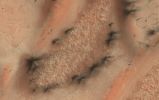
ESP_016032_2600_RED_abrowse-02.jpgNorthern Spring (EDM - Natural Colors; credits: NASA/JPL/Univ. of Arizona)60 visitenessun commentoMareKromiumMar 12, 2010
|
|

ESP_016032_2600_RED_abrowse-00.jpgNorthern Spring (CTX Frame - Natural Colors; credits: Dr Paolo C. Fienga - Lunexit Team)58 visiteIn the Winter a layer of Carbon Dioxide (CO2) ice (such as Dry Ice) covers the North Polar Sand Dunes.
In the Spring the sublimation of the ice causes a host of uniquely Martian Phenomena.MareKromiumMar 12, 2010
|
|
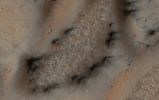
ESP_016032_2600_RED_abrowse-01.jpgNorthern Spring (EDM - Natural Colors; credits: Dr Paolo C. Fienga - Lunexit Team)57 visiteIn this EDM, Streaks of dark Basaltic Sand have been carried from below the ice layer to form Fan-shaped Deposits on top of the seasonal ice.
The similarity in the directions of the fans suggests that they formed at the same time, when the wind direction and speed was the same. They often form along the boundary between the dune and the Surface below the Dunes.MareKromiumMar 12, 2010
|
|

PIA12882.jpgNorthern Meridiani Planum (Natural Colors; credits: Dr Paolo C. Fienga - Lunexit Team)58 visitenessun commentoMareKromiumMar 08, 2010
|
|
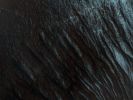
Gullies-Terra_Sirenum-PIA12881.jpgGullies in Terra Sirenum (credits: NASA/JPL-Caltech/University of Arizona)59 visiteThis observation shows part of an Unnamed Crater, located inside the much larger Newton Basin, in the Terra Sirenum Region of Mars.
This Unnamed Crater is approx. 7 Km in diameter (over 4 miles) and some 700 meters (760 yards) deep.
Numerous Gully Systems are visible on the East- and South-facing Walls of the Crater; their characteristics are astonishingly diverse.
This EDM covers an area of nearly 610 x 740 meters (670 x 800 yards). North is up; illumination is from the North-West.
This EDM depicts several Gullies carved in the South-West-facing Wall of the Crater.
These troughs are extremely rectilinear, lack tributaries, and do not seem to have Terminal Fan Deposits: they terminate rather abruptly, some of them in a spatula-like shape.
Their characteristics contrast sharply with those of other Gully Systems located elsewhere in this same Crater, which are sinuous, have numerous tributaries, and show distinct Fan Deposits.MareKromiumMar 08, 2010
|
|
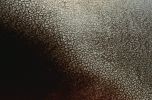
Polar_Polygons-PIA07354.jpgPolar Polygons (Natural Colors; credits: Dr Paolo C. Fienga - Lunexit Team)63 visitenessun commentoMareKromiumMar 06, 2010
|
|

Slope_Streaks-MRO.jpgSlope Streaks (Natural Colors; credits: Dr Paolo C. Fienga - Lunexit Team)59 visitenessun commentoMareKromiumMar 05, 2010
|
|
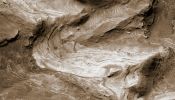
Gale_Crater-PIA12508.jpgLayers in lower formation of Gale Crater Mound (Natural Colors; credits NASA/Dr Paolo C. Fienga - Lunexit Team)115 visiteLayers of rock exposed in the lower portion of a tall Mound near the center of Gale Crater on Mars exhibit variations in layer thickness and range between dark and light tones. The Crater's Mound of layered material is over 4 Km (approx. 2,4 miles) high, making it more than twice as thick as the stack of rocks exposed in the Grand Canyon on Earth.
Gale Crater is approx. 152 Km (about 94 miles) in diameter.
This view of layering in the Mound's lower formation covers an area about 950 meters (3100 feet) wide. It was taken by the High Resolution Imaging Science Experiment (HiRISE) camera on NASA's Mars Reconnaissance Orbiter on April 23, 2009.
Observations of the lower formation by the Compact Reconnaissance Imaging Spectrometer for Mars, on the same orbiter, have indicated the presence of Sulfate Salts and clay minerals in these rock layers. The changes in composition from the lower (older) to the upper (younger) layers in the Gale Crater Mound may record stages in water loss and the drying out of Mars.
This image is one product from HiRISE observation ESP_012841_1750, centered at 4,9° South Lat., 137,2° East Long.MareKromiumFeb 15, 2010
|
|

PSP_001503_1645_RED_abrowse-01.jpgEroding Layers in an Unnamed Southern Crater (EDM - Natural Colors; credits: Dr Paolo C. Fienga - Lunexit Team)59 visiteThis EDM is approx. 250 meters wide.
Boulders are visible on the Slopes of the Ridges along with thin Dark Layers including the Cap Layer, but they are absent on the Spurs, where the resistant cover has been eroded.
This demonstrates that the Boulders come only from the Dark Layers, and are not embedded in the rest of the Deposit.MareKromiumFeb 12, 2010
|
|

PSP_001503_1645_RED_abrowse-00.jpgEroding Layers in an Unnamed Southern Crater (CTX Frame - Natural Colors; credits: Dr Paolo C. Fienga - Lunexit Team)59 visiteThis image shows a stack of Rocky Layers on the Floor of an Unnamed Impact Crater, roughly 30 Km across. Many of the layers appear to be extremely thin, and barely resolved.
In broad view, it is clear that the deposit is eroding into a series of Ridges, likely due to the wind.
Below the Ridges, additional dark-toned Layered Deposits crop out. These exhibit a variety of textures, some of which may be due to transport of material.
The light Ridges are often capped by thin Dark Layers, and similar Layers are exposed on the Flanks of the Ridges. These Layers are likely harder than the rest of the material, and so armor the surface against erosion. They are shedding boulders which roll down the slope, as shown in the following EDM.
Although these Cap Layers are relatively resistant, the boulders do not seem to accumulate at the base of the slope, so it is likely that they also disintegrate relatively quickly. MareKromiumFeb 12, 2010
|
|
| 2237 immagini su 187 pagina(e) |
 |
|
|
|
|
91 | |
|
|
|
|





