| Ultimi arrivi - Mars Reconnaissance Orbiter (MRO) |

Noachis_Terra-PIA13074.jpgNoachis Terra (Natural Colors; credits for the additional process. and color.: Dr Paolo C. Fienga - Lunexit Team)59 visiteThis observation shows Gullies in a semi-circular Trough in Noachis Terra. The Gullies are observed to face all directions.
It is interesting to note that the Gully Morphology seen here depends on the orientation of the Gullies. The morphology differences are most pronounced on the sunlit slope, with the Gullies facing South (down) being more deeply incised than those facing the West. It is unknown what caused the different Gully Morphologies, but there are several possibilities.
Gullies are proposed to form at locations determined by the availability of a forming liquid (thought to be water) and/or the amount of insolation the Slope receives, among other factors. It is possible that the deeper Gullies experienced more erosional events or that their erosional events were more effective for undetermined reasons. It is also possible that the Gullies formed at different times such that they did not have the same amount of water -- either for an individual flow or total -- available to them. Also, the underlying topography could make the Gullies appear relatively more incised without this actually being the case.
The majority of the Gullies on both sides of the Trough appear to originate at a boulder-rich layer visible in the subimage. The layer appears dark on the sunlit slope because the boulders sticking out from the slopes cast shadows. If these Gullies formed by water from the Subsurface, then it is possible that this layer is a permeable layer that conducted water to the Surface.
The layer is deteriorating and traveling down slope in the form of Boulders. These Boulders can clearly be seen in the alcoves of the Gullies on both sides of the Trough.MareKromiumMag 10, 2010
|
|

North_Polar_Layered_Deposits-PIA12997.jpgNorth Polar Layered Deposits (Natural Colors; credits for the additional process. and color.: Dr Paolo C. Fienga - Lunexit Team)71 visiteThe Martian North Polar Layered Deposits (NPLD) are an ice sheet much like the Greenland ice sheet on the Earth. Just as with the ice sheet in Greenland this Martian ice sheet contains many layers that record variations in the Martian Climate. Sometimes icy layers can be ablated away during warm climates. Later the ice sheet can be buried by new ice layers and grow in size again. It's likely that many of these cycles have occurred over the ice sheet's history.
The High Resolution Imaging Science Experiment (HiRISE) camera on NASA's Mars Reconnaissance Orbiter recorded this image of NPLD on March 11, 2010. The target for this observation was a suggestion submitted by Greg Clements through the camera team's HiWish public-suggestion program. For more information about how to submit target suggestions, see http://uahirise.org/hiwish/.
Fluctuations in the thickness of the ice sheet are most pronounced at the edges of the sheet, where this HiRISE image was taken. The ice sheet ends here in a gentle scarp that slopes about 8° downhill from bottom to top in this image. The layering within the ice is exposed on this Sloping Surface. The thickness of the ice here is about 1 Km (approx. 3300 feet). Scientists are analyzing these layers to see what information they might hold regarding previous Martian Climates.
This image covers a swath of ground about 1 Km (approx. two-thirds of a mile) wide.
It is a portion of HiRISE observation ESP_016973_2595, which is centered at 79,30° North Latitude and 351,46° East Longitude.
The season on Mars is Northern-Hemisphere Spring.MareKromiumMag 10, 2010
|
|

Craters-Palos_Crater-PIA12994.jpgDeposits on the Floor of Palos Crater (Possible Natural Colors; credits for the additional process. and color.: Dr Paolo C. Fienga - Lunexit Team)96 visiteThis image shows a portion of the Floor of Palos Crater, on Equatorial Mars.
The High Resolution Imaging Science Experiment (HiRISE) camera on NASA's Mars Reconnaissance Orbiter recorded this image on March 8, 2010.
The target for this HiRISE observation was a suggestion submitted through the camera team's HiWish public-suggestion program. For more information about how to submit target suggestions, see http://uahirise.org/hiwish/.
The Floor appears bumpy with high-standing layered Knobs. Most of the Terrain on the Floor is weathering into meter-size (yard-size) polygonal blocks. The circular structures in the image, many of which are filled with darker wind-blown material, are eroded impact craters.
Palos Crater is breached in the South by the approx. 180-Km-long (about 112-mile-long) Tinto Vallis. Water transported along Tinto Vallis could have could have collected into Palos Crater to form a lake that later drained to the North.
Sediments carried by Tinto Vallis would have also been deposited within Palos Crater, so the layered unit we see along the floor today could represent these fluvial sediments.
This image covers a swath of ground about 1 Km (approx. two-thirds of a mile) wide. It is a portion of HiRISE observation ESP_016943_1775, which is centered at 2,67° South Latitude and 111,13° East Longitude. The season on Mars is southern-hemisphere autumn. Other image products from this observation are available at http://hirise.lpl.arizona.edu/ESP_016943_1775.MareKromiumMag 10, 2010
|
|

Craters-Proctor_Crater-PIA13076.jpgProctor's Dunes (Possible Natural Colors; credits for the additional process. and color.: Dr Paolo C. Fienga - Lunexit Team)92 visiteThis observation shows the edge of a dark Dunefield on the Floor of Proctor Crater, an about 150 Km (approx. 93 miles) diameter crater in the Southern Highlands of Mars.
This subimage is a close-up view of the dark dunes. These dunes are most likely composed of basaltic sand that has collected on the bottom of the crater. Superimposed on their surface are smaller secondary dunes which are commonly seen on terrestrial dunes of this size. Near the crests of the dark dunes are bright patches of frost. Dark spots within the frost patches are areas where defrosting is occurring.
Many smaller and brighter bed forms, most likely small dunes or granule ripples, cover the substrate between the larger dark dunes as well as most of the Floor of Proctor Crater. In many locations, large boulders are seen on the same surfaces as the bright bed forms.
The dark dunes stratigraphically overlie the small bright bed forms indicating that the darker dunes formed more recently.
However in several areas, the dark dunes appear to influence the orientation of the small bright dunes, possibly by wind flowing around the larger dunes, suggesting that both dark and bright bed forms are coeval.MareKromiumMag 10, 2010
|
|

Deuteronilus_Mensae-PIA12996.jpgDeuteronilus Mensae (Natural Colors; credits for the add. process, and color.: Dr Paolo C. Fienga - Lunexit Team)85 visiteThe Terrain in this image lies in the Deuteronilus Mensae Region, along the highland-lowland Dichotomy Boundary in the Northern Hemisphere of Mars.
The High Resolution Imaging Science Experiment (HiRISE) camera on NASA's Mars Reconnaissance Orbiter recorded this image on March 9, 2010.
The target for this HiRISE observation was a suggestion submitted through the camera team's HiWish public-suggestion program. For more information about how to submit target suggestions, see http://uahirise.org/hiwish/.
This Region contains many Mesas surrounded by Lobate Debris Aprons that are thought to be ice-rich. These Aprons have been interpreted as a variety of possible features including rock glaciers, ice-rich mass movements, or debris-covered glacial flows. Recent radar data from the Shallow Radar instrument on the Mars Reconnaissance Orbiter has shown them to be composed of nearly pure ice. This image shows an area at the edge of one of these Mesas with a Lobate Debris Apron extending from its base.
Both the Mesa top and the Surface of the Debris Apron appear covered with ice-rich mantling materials characteristic of the Martian Mid-Latitudes and thought to have been deposited around 10 million years ago during a period of high obliquity.
This image covers a swath of ground about 1 Km (about two-thirds of a mile) wide. It is a portion of HiRISE observation ESP_016959_2240, which is centered at 43,62° North Latitude and 28,62° East Longitude. The season on Mars is Northern-Hemisphere Spring. MareKromiumMag 10, 2010
|
|
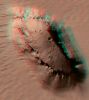
ESP_16978_1730-MF-LXTT2.jpgFalling Down... (High-Def-3D; credits: Dr Marco Faccin - Lunexit Team)76 visiteAcquisition date: 11 March 2010
Local Mars Time (m.l.t.): 15:07 (early afternoon)
Latitude (centered): 6,8° South
Longitude: 236,6° East
Range to target site: 255,4 km (159,6 miles)
Original image scale range: 25,6 cm/pixel (with 1 x 1 binning) so objects ~77 cm across are resolved
Map projected scale: 25 cm/pixel and North is up
Map projection: EQUIRECTANGULAR
Emission Angle: 1,5°
Phase Angle: 53,2 °
Solar Incidence Angle (S.I.A.): 54° - meaning that the Sun is about 36° above the Local Horizon
Solar Longitude: 62,5° (Northern Spring)MareKromiumApr 24, 2010
|
|

ESP_16978_1730-MF-LXTT1.jpgFalling Down... (an Image-Mosaic by Dr Marco Faccin - Lunexit Team)71 visiteThe lower flanks of Arsia Mons, one of the giant volcanoes on Mars, is riddled with Pits of various sizes. These have been of great interest to a number of researchers because they have the potential to be openings into underground caverns.
Such caverns have some potential for holding ice and offer protection from radiation and small meteorites. These are good things if one is looking for a safe place for current life on Mars or future human life.
However, this image shows some of the pitfalls of such hopes. Most of these pits are largely filled with rubble and dust that hide any potential links to larger underground areas. Furthermore, the entrances are steep and rocky, making them difficult areas to traverse. They would be a very exciting, if not safe, place to visit!MareKromiumApr 24, 2010
|
|
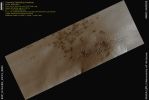
ESP_016280_2655_RED_abrowse.jpgMartian Tears... (possible Natural Colors; credits: Dr Paolo C. Fienga - Lunexit Team)67 visitenessun commentoMareKromiumMar 29, 2010
|
|

ESP_016288_2610_RED_abrowse.jpgHigh Northern Latitudes (possible Natural Colors; credits: Dr Paolo C. Fienga - Lunexit Team)59 visitenessun commentoMareKromiumMar 29, 2010
|
|

ESP_016276_2575_RED_abrowse.jpgTranslucent Ice-Patches in the Northern Plains (possible Natural Colors; credits: Dr Paolo C. Fienga - Lunexit Team)58 visitenessun commentoMareKromiumMar 29, 2010
|
|
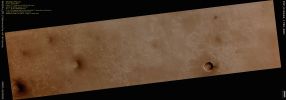
ESP_016644_1780_RED_abrowse-00.jpgOn the Edge of Concepción (CTX Frame - Natural Colors; credits: Dr Paolo C. Fienga - Lunexit Team)73 visiteThis image was acquired by HiRISE on 13 February 2010, on Sol 2153 of Opportunity’s Mission on Mars.
Note the Rover Tracks in the Ripples to the North and North-West of the Rover. Scientists use these high-resolution images (about 25 cm/pixel) to help navigate the Rover. In addition, Rover exploration of areas covered by such high-resolution images provides “ground truth” for the orbital data.MareKromiumMar 26, 2010
|
|

ESP_016644_1780_RED_abrowse-01.jpgOn the Edge of Concepción (EDM - Natural Colors; credits: Dr Paolo C. Fienga - Lunexit Team)58 visiteThis EDM shows the Mars Exploration Rover Opportunity perched on the edge of Concepción Crater in Meridiani Planum, Mars.
Concepción Crater is a fresh, 10 meter-diameter crater with dark rays that clearly overprint the North trending Aeolian Ripples.
The dark rays are produced by shadows cast by blocky ejecta and the presence of the rays and similar relationships with other fresh craters in Meridiani Planum indicate that this is likely the youngest crater visited by either Rover on Mars (estimated to have impacted thousands to tens of thousands of years ago).MareKromiumMar 26, 2010
|
|
| 2237 immagini su 187 pagina(e) |
 |
|
|
|
|
90 | |
|
|
|
|





