| Ultimi arrivi - Mars Reconnaissance Orbiter (MRO) |

ESP_017900_2185_RED_abrowse.jpgUnnamed Impact Crater cut by Faults (Natural Colors; credits: Dr Paolo C. Fienga - Lunexit Team)57 visiteThis image reveals an interesting coincidence of two important Planetary Processes: Cratering by Impacts and Tectonism.
Here we have an Impact Crater (the large round feature, approx. 6,2 Km, or 3,9 miles, across) that intersects a series of Faults (the linear features). The Faults are seen to cut the circular Rim of the Impact Crater. Also, the impact did not destroy the adjacent faults. These observations tell us that the Fault was active after the impact occurred.
In addition, by measuring the distance of offset of the different pieces of the Crater Rim separated by the Fault Line (assuming that when the Crater formed, the Rim was continuous around its circumference), the amount of movement along the Fault can be estimated, laterally and vertically. Faults like these cause Troughs to form, called "Graben", of which the heavily shadowed one is a good example. The center (shadowed) section has been dropped downwards relative to the surrounding Terrain, forming the Trough.
It is also clear that parts of the Crater Rim are lower than others where the Graben intersects the Crater. The sides of the Graben (the Faults forming the Walls of the Trough) are sloped, so that the dropped-down part of the Crater Rim has also moved horizontally away from its higher part. The combined down-dropping and moving apart indicates that the land here is being stretched and pulled apart, called "extension". By measuring the amount of offset on all the Faults, we can estimate how much extension has occurred in this part of the Planet.
This location is especially helpful because, as mentioned above, we have a good knowledge of the “before-faulting” configuration of the land, in which the Crater Rim was continuous. Finally, it is interesting that there is no sign of the Fault on the Floor of the Crater – its Floor has not been faulted and no part is down-dropped and stretched apart as the Rim has been. This indicates that some infilling of the Crater (perhaps by Lava or Airborne Sediment) has likely occurred since the Fault was active, burying the trace of the Fault and representing a third stage of geologic history in this area.MareKromiumGiu 18, 2010
|
|

ESP_017693_1795_RED_abrowse.jpgThermal Anomaly in Aeolis and Zephyria Regions (Saturated Natural Colors; credits for the additional process. and color.: Dr Paolo C. Fienga - Lunexit Team)130 visiteThis image is taken of an interesting Linear Surface Feature in the Aeolis and Zephyria regions. Using the daytime IR imaging data from the THEMIS instrument, this feature has a higher daytime temperature than its surroundings while also being relatively dark.
When viewed at full HiRISE resolution, this area contains Sand Ripples with some consolidated, Bedrock-like material poking through. These Bedrock Outcrops are more pronounced along the southern portion of the image and are most apparent in the region of the Thermal Anomaly. The Outcrops trend generally East-West and appear sculpted by aeolian erosion.
In the area of the Anomaly, the sand between these Outcrops has a darker tone and gradually blends with the lighter material to either side. This darker sand may be the reason why the material has a "hot" signature compared to its surroundings, because dark materials absorb sunlight more efficiently.
Features similar to the one in this image help researchers to characterize such features and to understand whether such exposures may indicate possible Hydrothermal Fissures, or perhaps be just an exposure of a darker underlying material.
Written by: Shawn Hart and Ginny GulickMareKromiumGiu 06, 2010
|
|

ESP_017581_1765_RED_abrowse.jpgExposed Light Material in Upland Region in Aureum Chaos (Natural Colors; credits for the additional process. and color.: Dr Paolo C. Fienga - Lunexit Team)131 visiteThe Plateau visible in this image is located within Aureum Chaos. Chaotic Terrains on Mars are blocky, fractured regions of flat-topped hills, plateaus, plains and depressions thought to have formed by the collapse of the heavily cratered uplands.
Large Outflow Channels appear to emerge from Aureum Chaos and other Chaotic Terrains leading researchers to posit that these large collapse regions were formed by the catastrophic release of ground water. Aureum Chaos is located just to the North-East of Valles Marineris adjacent to Margaritifer Terra, and it has a diameter of approximately 368 kilometers.
The steep-sided Plateau in this image has a sharp, undulating surface possibly etched out and eroded by persistent winds. These same winds may well have transported the resulting sediment to the surrounding plains helping to form the Dunes below. The Plateau slopes are steep and consist of a series of parallel bright, more resistant cliff forming layers and darker, less resistant slope material. A good way to see the differences in color between the plateau's bright layered deposits and the surrounding area is to look at some of the blocks that have fallen off the cliff onto the the dark sands below.
By studying areas of Mars such as this one, researchers hope to understand how the chaos regions formed and how their formation related to the release of ground water to form the outflow channels, if indeed the two are connected in this way.
Written by: Shawn Hart and Ginny GulickMareKromiumGiu 06, 2010
|
|
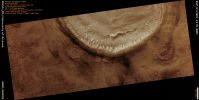
ESP_017405_2270_RED_abrowse.jpgNorthern Hemisphere Gullies on West-Facing Crater Slope (Natural Colors; credits for the additional process. and color.: Dr Paolo C. Fienga - Lunexit Team)167 visiteThis image shows the Eastern (West-facing) side of an Unnamed Impact Crater in the Mid-Latitudes of the Northern Hemisphere.
Like many Mid-Latitude Craters, this one has Gullies along its Walls that are composed of Alcoves, Channels and Debris Aprons. The origins of these Gullies have been the subject of much debate; they could have formed by flowing water, liquid Carbon Dioxide, or dry granular flows. The orientation of these Gullies is of interest because many Craters only contain Gullies on certain Walls, such as those that are Pole-facing. This could be due to changes in orbital conditions and differences in solar heating along specific Walls.
Many of the other features observed in and around this Crater however are indicative of an ice-rich terrain, which may lend credence to the water formation hypothesis, at least for the Gullies visible here. The most notable of these features is the "Scalloped Terrain" in and around the Crater.
This type of Terrain has been interpreted as a sign of surface caving, perhaps due to sublimation of underlying ice.
Another sign of ice is the presence of parallel lineations and pitted material on the Floor of the Crater, similar to what is referred to as concentric Crater Fill. Parallel linear cracks are also observed along the Crater Wall over the Gullies, which could be due to thermal contraction of ice-rich material.
All of these features taken together are evidence for ice-rich material having been deposited in this Region during different climatic conditions that has subsequently begun to melt and/or sublimate under current conditions. More recently, Aeolian Deposits have accumulated around the Crater as evidenced by the parallel ridges dominating the landscape.
Dust Devil Streaks are also visible crossing the Aeolian Ridges.
Written by: Dan BermanMareKromiumGiu 06, 2010
|
|
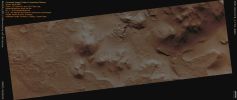
PSP_002478_1770_RED_abrowse-00.jpgEroding Crater Fill (CTX Frame - Natural Colors; credits for the additional process. and color.: Dr Paolo C. Fienga - Lunexit Team) 109 visiteThis image shows the edge of a Mound (----> terrapieno) of sediments in the center of a large Impact Crater near Amenthes Planum.
The Mound probably once filled much more of the Crater, but it is now eroding away. A broad view shows several small plateaus which have likely been preserved by a relatively resistant cap layer, while other levels are exposed elsewhere.MareKromiumGiu 02, 2010
|
|
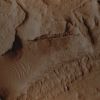
PSP_002478_1770_RED_abrowse-01.jpgEroding Crater Fill (EDM - Natural Colors; credits for the additional process. and color.: Dr Paolo C. Fienga - Lunexit Team)96 visiteThis EDM shows several types of Layers exposed in a Pit. These variations point to a relatively complex geologic history at this site.
Some Layers appear to be fracturing into boulders which roll downslope, while others appear relatively smooth. There are also variations in tone, from light to dark. This diversity may be due to different types of rock, as well as varying strength.
Images such as this one indicate that rocks formed on Mars in a variety of ways, and by careful analysis it may be possible to deduce some of the history that has produced the geology at this site.MareKromiumGiu 02, 2010
|
|
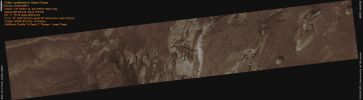
ESP_017528_1830_RED_abrowse.jpgGully-like Landforms in Aram Chaos (Natural Colors; credits for the additional process. and color.: Dr Paolo C. Fienga - Lunexit Team)113 visiteThis observation shows erosional features on light-toned rocks in Aram Chaos, a crater near the Equator of Mars that has been nearly filled with sedimentary rocks.
In enhanced color, the sediments are very distinctive. The rocks show a sharp change in color partway down the slope, indicating a change in the properties of the rock, probably to a different composition.
The erosional features have Alcoves with Aprons downslope, and in some cases have hints of channels, potentially due to abrasion by falling debris.
These morphologies bear some resemblance to Gullies commonly found in the Mid-Latitudes, which are often thought to have formed due to erosion by liquid water from melting snow.
Near the Equator, however, snowmelt in Mars' recent climate is less likely.MareKromiumGiu 02, 2010
|
|

PSP_002419_1675_RED_abrowse-01.jpgLayers and Dark Debris in Melas Chasma (EDM - Natural Colors; credits for the additional process. and color.: Dr Paolo C. Fienga - Lunexit Team)98 visiteThis EDM shows layering in a light-toned deposit in Melas Chasma.
The layers are sedimentary in origin, but there are many processes that could have deposited them, such as volcanic airfall from explosive eruptions, or dust-size particles settling out of the Atmosphere due to cyclic changes, and deposition in standing bodies of water.
By looking at the slopes in the layers and how the layers intersect each other, scientists can rule out various origins. A darker material can be seen covering much of the Layered Deposit.
Some of this dark material is loose and can be seen accumulating as debris aprons at the base of steep slopes. Other dark material appears indurated and has been eroded by the wind to form etched edges with topographic expressions.
The lack of impact craters on the Layered Deposit indicates that it is a relatively young deposit, or the craters have been removed by the wind, or the deposit was quickly buried and is now being exhumed.MareKromiumGiu 02, 2010
|
|
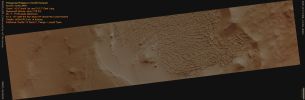
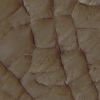
ESP_017348_1910_RED_abrowse-00.jpgPolygonal Ridges in Gordii Dorsum (CTX Frame - Natural Colors; credits for the additional process. and color.: Dr Paolo C. Fienga - Lunexit Team)85 visiteThis image from the Gordii Dorsum Region of Mars shows a large area covered with Polygonal Ridges in an almost geometric pattern.
The Ridges may have originally been Dunes which hardened (indurated) through the action of an unknown process.
Groundwater might have been involved.MareKromiumGiu 02, 2010
|
|
ESP_017348_1910_RED_abrowse-01.jpgPolygonal Ridges in Gordii Dorsum (EDM - Natural Colors; credits for the additional process. and color.: Dr Paolo C. Fienga - Lunexit Team)124 visitenessun commentoMareKromiumGiu 02, 2010
|
|

PSP_002419_1675_RED_abrowse-00.jpgLayers and Dark Debris in Melas Chasma (CTX Frame - Natural Colors; credits for the additional process. and color.: Dr Paolo C. Fienga - Lunexit Team)107 visitenessun commentoMareKromiumGiu 02, 2010
|
|

Volcanoes-Olympus_Mons-PIA12992.jpgOlympus' Edge (Extremely Enhanced Absolute Natural Colors; credits for the additional process. and color.: Dr Paolo C. Fienga - Lunexit Team)61 visiteThis image covers the Northern Edge of the largest Volcano of the Solar System: Olympus Mons.
The margin of Olympus Mons is defined by a massive Cliff which is several kilometers tall. At this location, the Cliff is nearly 7 Km (about 23.000 feet) tall.
The Cliff exposes the guts of the volcano, revealing interbedded hard and soft layers. The hard layers are Lava and the soft layers may be Dust (from large Dust Storms) or Volcanic Ash.
The High Resolution Imaging Science Experiment (HiRISE) camera on NASA's Mars Reconnaissance Orbiter recorded this image on March 2, 2010.
Most scientists think the the Cliffs formed by Landslides. This collapse is driven by the weight of the huge volcano exceeding the strength of the rocks it is built of.
This image covers a swath of ground about 1 Km (such as approx. two-thirds of a mile) wide. It is a portion of HiRISE observation ESP_016886_2030, which is centered at 22,95° North Lat. and 224,76° East Long. The season on Mars is Northern-Hemisphere Spring.
Other image products from this observation are available at http://hirise.lpl.arizona.edu/ESP_016886_2030.MareKromiumMag 11, 2010
|
|
| 2237 immagini su 187 pagina(e) |
 |
|
|
|
|
89 | |
|
|
|
|





