| Ultimi arrivi - Mars Reconnaissance Orbiter (MRO) |
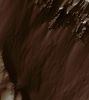
ESP_017736_1550_RED-EB-PCF-LXTT2.jpgRolling Rocks (Absolute Natural Colors; credits: Dr Paolo C. Fienga - Lunexit Team)59 visitenessun commentoMareKromiumLug 06, 2010
|
|

PSP_001936_1370_RED_abrowse-01.jpgScarp and Channels in a Crater in Terra Cimmeria (Natural Colors; credits: Dr Paolo C. Fienga - Lunexit Team)64 visitenessun commentoMareKromiumLug 04, 2010
|
|

ESP_018011_2565_RED_abrowse.jpgBetween Abalos and Olympia Undae... (Absolute Natural Colors; credits: Dr Paolo C. Fienga - Lunexit Team)56 visiteThis HiRISE image shows some large Sand Dunes near the North Pole of Mars. The picture was taken in summertime, with only small patches of ice remaining on the Surface: this show up as bright, somewhat blue, spots on slopes that provide some shading from the Sun.
Geologists would classify these Dunes as "sand-starved" because the ground between the Dunes has almost no sand; in addition, this ground shows a pattern of cracks that is typical of icy permafrost undergoing through seasonal expansion and contraction.
It is also possible that some Subsurface Ice exists inside the Dunes themselves; if so, the Dunes are not currently moving, and the ice is acting as a "stabilizer".
This idea is supported by the observation that there are small Landslide Gullies being cut into the Dunes, something not seen if the Dunes are rejuvenated as they move in the wind. However, to test this idea this area has been repeatedly imaged by multiple cameras on different spacecrafts.
With meticulous care it will be eventually possible to determine just how much the Dunes have moved or changed over the past years.MareKromiumLug 04, 2010
|
|
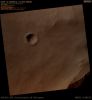
ESP_018094_1720_RED_abrowse.jpgRelatively recent Impact Crater in Meridiani Planum (Absolute Natural Colors; credits: Dr Paolo C. Fienga - Lunexit Team)62 visiteThe approximately 650-mt (2135 foot) diameter Crater in this image is relatively fresh, as evidenced by its sharp Rim and unmodified shape. Ejecta appears on top of pre-existing craters, and stands out against the background, again indicating relative youth.
However, there is something else interesting about the ejecta for this Crater: it is butterfly-shaped, with much more expansive ejecta along one axis, and much less along the other one.
Butterfly-shaped ejecta indicate that the body that caused the crater struck Mars at an oblique (or very shallow) angle. When this happens, the crater shape may be elliptical, although round craters can result from oblique impacts, too. During an oblique impact, much more ejecta is thrown out perpendicular to the direction of impact, and relatively little material is ejected along the impactor's trajectory.
Oblique impacts are relatively rare, and so a fresh, oblique impact like this one is an attractive target.MareKromiumLug 04, 2010
|
|

ESP_017897_2045_RED_abrowse-PCF-LXTT.jpgMawrth Vallis (Absolute Natural Colors; credits: Dr Paolo C. Fienga - Lunexit Team)57 visitenessun commentoMareKromiumLug 04, 2010
|
|

PSP_001816_1410_RED_abrowse-00.jpgGullies and arcuate Ridges in Terra Cimmeria (Natural Colors; credits for the additional process. and color.: Dr Paolo C. Fienga - Lunexit Team)57 visitenessun commentoMareKromiumGiu 26, 2010
|
|
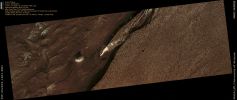
PSP_002839_1825_RED_abrowse-1.jpgAram Chaos (Absolute Natural Colors; credits for the additional process. and color.: Dr Paolo C. Fienga - Lunexit Team)64 visiteAram Chaos appears to be a former impact crater. The terrain is disrupted, giving it a chaotic appearance (hence the name "chaos"). Scientists have postulated that a lake may have once existed inside the crater and sediments were laid down within the lake. The mineral Hematite (rich in Iron) has been detected by orbiting spacecraft within Aram Chaos. Hematite has been identified in several other locations on Mars, including at the Mars Exploration Rover Landing Site in Meridiani Planum. The Hematite at both Meridiani and Aram Chaos most likely formed by precipitation in water.
This HiRISE image shows the light-toned sediments inside Aram Chaos that could have formed in a former lake. Unfortunately, dark debris now obscures much of this sediment, making it difficult to view and interpret the rocks. The light-toned Layered Deposit in the South (left) of the image is higher standing and has a peculiarly-looking pitted surface.
Circular structures with dark centers are likely to be impact craters that have been partly filled with dark debris, including sand. More irregular depressions appear to result from erosion of layered beds within the sediments. Wind could erode materials that are slightly weaker more quickly and produce the irregular topography seen along the surface of the deposit.MareKromiumGiu 25, 2010
|
|

PSP_002630_1695_RED_abrowse.jpgMelas Chasma (Natural Colors; credits for the additional process. and color.: Dr Paolo C. Fienga - Lunexit Team)57 visiteThis observation shows an Outcrop of bright material in Melas Chasma, part of the giant Valles Marineris Trough (Canyon) System.
These Troughs contain many bright Deposits, often layered. The origin of these materials is still not known, but is the subject of much study because answering this question will provide important information regarding the Geologic History of Mars.
In this image, some layers are visible, but much of the surface has a strange scalloped texture.
The cause of this texture is unclear, but it is likely related to the mechanism of erosion of these Deposits as well as their physical nature. These materials are being eroded by winds, forming elongated ridges called Yardangs.
These winds may also be responsible for the small-scale scalloped texture.
Also, Landslides have produced some Talus Cones, composed of piles of loose debris; these are visible in places, mostly near the base of the Mound, as wedge-shaped features containing many Boulders.MareKromiumGiu 25, 2010
|
|
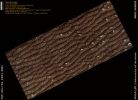
PSP_001736_2605_RED_abrowse.jpgOlympia Undae (Natural Colors; credits for the additional process. and color.: Dr Paolo C. Fienga - Lunexit Team)72 visiteThis observation shows Dark Dunes and light Polygonal Terrain in Olympia Undae, also known as the North Polar Erg.
Two sets of Dunes are obvious. The major set trends North-South, indicating winds from the East or West. Between the crests of these Dunes is a second set oriented mostly East-West.
Zooming in on the Dunes, a rippled texture is apparent, probably due to redistribution of sand at the scale of meters and less. Near the crests of some Dunes are Channel-like features, with some branching downslope. The origin of these Channels is unknown, but they may result from the flow and displacement of sand that was fluidized by sublimating CO2 or water frost.
Bright patches of ground are found in some inter-dune areas, with many having a polygonal texture.
Polygons on Earth form from contraction induced by stresses from dehydration, cooling and other processes, so these features may have a similar origin. The CRISM instrument on MRO and OMEGA on Mars Express indicates that many dunes in Olympia Undae are rich in the mineral Gypsum (---> gesso).MareKromiumGiu 25, 2010
|
|
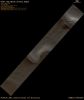
PSP_002804_0930_RED_abrowse.jpgSouth Polar Trough (Natural Colors; credits for the additional process. and color.: Dr Paolo C. Fienga - Lunexit Team)59 visiteThis image is taken in one of the Troughs that are typical within the stack of Martian South Polar Layered Deposits (SPLD).
Viewed at low resolution, sequences of layers of different albedos, or brightnesses, and/or textures can be seen. At full resolution, the different tones and textures can be seen to be due to different shapes and sizes of polygonal fractures, surface knobiness, and surface cover and concentration of frost, often within polygonal fractures.
Faint criss-crossing Troughs and Dimples can be discerned on even the smoothest surfaces. Perhaps the most notable features in the image are the distinct round to heart-shaped to blob-shaped depressions scattered throughout the smooth areas, dubbed "Swiss-Cheese Terrain".
The smooth material is solid CO2 ice representing the uppermost layer of the South Polar Residual Cap. The retention of CO2 ice throughout the year by the Southern Polar Cap is one characteristic that distinguishes it significantly from Mars' North Polar Cap. The Swiss-Cheese depressions are areas in which sublimation of the CO2 ice was initiated at a particular location and spread laterally from that point, creating rounded depressions typically several to 10 meters deep.
In HiRISE images, it is evident that this CO2-rich material is actually comprised of several individual horizontal layers. In this particular location, several images had been acquired over the previous decade by the Mars Orbiter Camera (MOC) at slightly lower resolutions. In a series of those MOC images, the Swiss-Cheese depressions were seen to enlarge radially, or grow over a time period of several years.
Part of the HiRISE imaging campaign includes continued monitoring of these features (at higher resolution) to understand their growth rates and patterns. In turn, we can better comprehend the role of CO2 — the main component of the Martian Atmosphere — in the current Martian Climate Regime.MareKromiumGiu 25, 2010
|
|
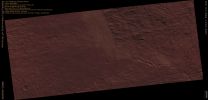
ESP_017888_1950_RED_abrowse.jpgOlympus' Lava Flows (Extremely Enhanced Natural Colors; credits for the additional process. and color.: Dr Paolo C. Fienga - Lunexit Team)57 visiteThe flanks of Olympus Mons are covered with Lava Flows (one on top of the other) Most of these Flows are relatively narrow, with a channel running down the middle. They appear similar to the Lava Flows found on Mt. Etna in Sicily (Italy).
However, in this image, we see these typical Flows partially covered by another, more recent one. This last one also shows a Central Channel, and it is about 10 times wider than the more typical Lava Flows. At the center of the HiRISE image the Channel disappears.
This is probably because the Channel was blocked here and Lava spilled out of it and covered a broad, fan-shaped, area. The eruption that produced this unusual flow was probably more vigorous and perhaps lasted longer than the more common ones.MareKromiumGiu 25, 2010
|
|

PSP_002439_2265_RED_abrowse.jpgScalloped Depressions with Layering (False Colors; credits: Dr Paolo C. Fienga - Lunexit Team)57 visiteThis image of the Northern Plains of Mars is marked by depressions in a layer of material that covers the Region. The depressions, several of which have coalesced together, have scalloped edges and layers in their walls.
Features such as these are most commonly found at approx. 55° North and South latitude.
Their presence has led to hypotheses of the removal of subsurface material, possibly ground ice, by sublimation, and this process is believed to be ongoing today.
In this image, steeper scarps with layers consistently face the North Pole while more gentle slopes without layers face in the direction of the Equator. This is most likely due to differences in Solar Heating.
Large boulders, some several meters in length, are scattered within the depressions and on the surrounding Surface. Also on the Surface surrounding the scalloped depressions is a polygonal pattern of fractures.
This is commonly associated with Scalloped Terrain and indicates that the surface has undergone stress potentially caused by Subsidence (Collapse), Desiccation (Drying-out), or Thermal Contraction.
MareKromiumGiu 25, 2010
|
|
| 2237 immagini su 187 pagina(e) |
 |
|
|
|
|
88 | |
|
|
|
|





