| Ultimi arrivi - Mars Reconnaissance Orbiter (MRO) |
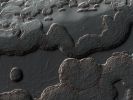
SPLD-PIA13269-0.jpgSouth Polar Layered Deposits and Residual Cap (Natural Colors; credits for the additional process. and color.: NASA/JPL-Caltech and Univ. of Arizona)59 visiteThis image from NASA's Mars Reconnaissance Orbiter (MRO) shows a variety of surface textures within the South Polar Residual Cap of Mars.
It was taken during the Southern Spring, when the Surface was covered by seasonal CO2 Frost, so that Surface relief is easily seen. Illumination is from the bottom left, highlighting long Troughs at to the right and round pits and irregular Mesas to the left of center.
These unique landforms are common in the South Polar Residual Cap, which is known from previous Mars Global Surveyor images to be eroding rapidly in places. Right of center, SPLDs are exposed on a Sun-facing Scarp. These Deposits are older than the Residual Ice Cap, and the Layers are thought to record climate variations on Mars similar to ice ages on Earth. MareKromiumLug 15, 2010
|
|
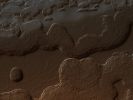
SPLD-PIA13269-PCF-LXTT2.jpgSouth Polar Layered Deposits and Residual Cap (Absolute Natural Colors; credits for the additional process. and color.: Dr Paolo C. Fienga - Lunexit Team)77 visiteThis image from NASA's Mars Reconnaissance Orbiter (MRO) shows a variety of surface textures within the South Polar Residual Cap of Mars.
It was taken during the Southern Spring, when the Surface was covered by seasonal CO2 Frost, so that Surface relief is easily seen. Illumination is from the bottom left, highlighting long Troughs at to the right and round pits and irregular Mesas to the left of center.
These unique landforms are common in the South Polar Residual Cap, which is known from previous Mars Global Surveyor images to be eroding rapidly in places. Right of center, SPLDs are exposed on a Sun-facing Scarp. These Deposits are older than the Residual Ice Cap, and the Layers are thought to record climate variations on Mars similar to ice ages on Earth. MareKromiumLug 15, 2010
|
|
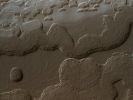
SPLD-PIA13269-PCF-LXTT3.jpgSouth Polar Layered Deposits and Residual Cap (Natural Colors; credits for the additional process. and color.: Dr Paolo C. Fienga - Lunexit Team)61 visiteThis image from NASA's Mars Reconnaissance Orbiter (MRO) shows a variety of surface textures within the South Polar Residual Cap of Mars.
It was taken during the Southern Spring, when the Surface was covered by seasonal CO2 Frost, so that Surface relief is easily seen. Illumination is from the bottom left, highlighting long Troughs at to the right and round pits and irregular Mesas to the left of center.
These unique landforms are common in the South Polar Residual Cap, which is known from previous Mars Global Surveyor images to be eroding rapidly in places. Right of center, SPLDs are exposed on a Sun-facing Scarp. These Deposits are older than the Residual Ice Cap, and the Layers are thought to record climate variations on Mars similar to ice ages on Earth.MareKromiumLug 15, 2010
|
|
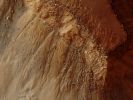
Gullies-_Gorgonum_Chaos-PIA13267.jpgGullies in Gorgonum Chaos (Natural Colors; credits for the additional process. and color.: Dr Paolo C. Fienga - Lunexit Team)59 visiteThis observation from NASA's Mars Reconnaissance Orbiter (MRO) shows part of Gorgonum Chaos, a large cluster of Chaotic Terrain found in the Southern Hemisphere.
Many Regions of Chaotic Terrain are found at the head of large Outflow Channels that were scoured by ancient floods. Gorgonum Chaos is one Region that is NOT associated with an Outflow Channel.
Chaotic Terrain can form when Subsurface Volatiles (such as water) are catastrophically released and the overlying surface collapses. It is not known whether isolated Chaotic Terrain -- such as that shown in this image -- formed in the same way that the ones near the Outflow Channels did. However, some wind-erosion activity might have played a role in their formation.
Gorgonum Chaos is an especially interesting area because Gullies thought to have been eroded by liquid water are located on its Mesas. The Gullies have a wide range of orientations and many appear to emanate from a distinct layer in the Mesas. It is not known why Gullies form on one slope rather than another, but the "Insolation" (sucgh as the amount of sunlight received), availability of water, and regional slope are possible contributing factors.MareKromiumLug 15, 2010
|
|

Dunes-PIA13268-PCF-LXTT.jpgDunes in Richardson Crater (EDM - Natural Colors; credits for the additional process. and color.: Dr Paolo C. Fienga - Lunexit Team)61 visiteThis observation from NASA's Mars Reconnaissance Orbiter (MRO) is a view of the Sand Dunefield in Richardson Crater, still partually covered with seasonal frost.
This EDM is a close-up view of defrosting patterns on the Dunes. The frost is a combination of frozen CO2 and some water ice that covers the Dunes in the Winter and Spring. As the seasonal frost sublimes away, odd features such as spots, fans, and streaks form.
Small dark streaks on the dune slip-face slopes may be where recent avalanches of sand, or perhaps wind, has moved the dark sand underlying the frost, or where frost has been removed to expose the sand. Alternatively, the dark streaks may be patches of coarse-grained ice that are clear enough so that the dark material below the ice is visible.
The slip-faces indicate the general direction of sand transport.
It has been hypothesized that the Dark Spots and Fans may be "geysers" or "cold gas jets" that form when sublimation processes trap gas at the bottom of the ice. The gas is released through cracks in the ice, entraining dust from below the ice and scattering it onto the Surface to form the Dark Spots and Fans.MareKromiumLug 15, 2010
|
|
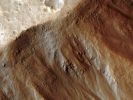
Kasei_Valles-PIA13265.jpgFeatures of Kasei Valles (EDM - Saturated Natural Colors; credits for the additional process. and color.: Dr Paolo C. Fienga - Lunexit Team)57 visiteThis observation from NASA's Mars Reconnaissance Orbiter (MRO) shows the very steep side of a Plateau, part of the Northern Limit of the Kasei Valles System, which is one of the largest Outflow Channel Systems on Mars. The difference in elevation here between the mostly flat Channel's Floor (bottom right) and the top of the Plateau (top left) is over 1300 meters (about 0,8 miles), comparable in height to the Grand Canyon Walls. The Kasei Valles System is much wider than the Grand Canyon, though, getting to be in places approx. 500 Km (such as about 300 miles) wide. (The Grand Canyon's maximum width is approx. 30 Km, or about 18 miles).
This EDM shows numerous paths with the appearance of dotted lines, criss-crossing the steep side of the Plateau. The carving agents can be found at the end of some of these paths: rocky blocks such as the ones in this subset, up to 2 meters (2,2 yards) across (4 meters or 4,4 yards across elsewhere in the image). Some of these blocks traveled downhill several hundred meters (yards) as they rolled and bounced leaving behind a trail of indentations or poke marks in the surface's fine-grained, light-toned soils. The raised borders in some of these poke marks indicate they are relatively recent features, unaffected by wind erosion, or that this soil has cohesive properties, such as if it was cemented.
The sound of these blocks falling did not travel very far, though. According to computer simulations sound in Mars travels only 1,5% (per-cent) the distance it would travel on Earth. (No Martian sound has ever been officially recorded) Hence, the same sound which would travel one Km (0,6 miles) on Earth, would travel only 15 meters (16 yards) on Mars. This is due to the lower Martian Atmospheric Pressure, which is approximately 1% of that of the Earth.MareKromiumLug 15, 2010
|
|
Psp_001497_2480_red-00~0.jpgThe Northern Lakes: Lake "Ginny" (CTX Frame - Natural Colors; credits: Dr Paolo C. Fienga - Lunexit Team) 125 visitenessun commentoMareKromiumLug 12, 2010
|
|
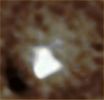
Psp_001497_2480_red-01~0.jpgThe Northern Lakes: Lake "Ginny" (EDM - Natural Colors; credits: Dr Paolo C. Fienga - Lunexit Team) 133 visiteProbabilmente (a differenza di quanto da noi supposto e speculato in passato) questa surface feature non è altro che un deposito di ghiaccio persistente - o di neve - il quale è sopravvissuto al disgelo sia grazie alla sua particolare posizione (in effetti giace leggermente infossato), sia in conseguenza di un benevolo regime dei Venti Dominanti (i quali non sono riusciti a spazzarlo via).
Certo, potrebbe anche trattarsi di un mini-laghetto, però...MareKromiumLug 12, 2010
|
|

Psp_001488_2665_red.jpgNorth Polar Layers and WInd-caused Striations (Natural Colors; credits for the additional process. and color.: Dr Paolo C. Fienga - Lunexit Team)62 visitenessun commentoMareKromiumLug 12, 2010
|
|
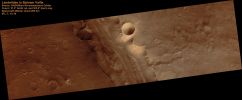
PSP_003605_2015_RED_browse~0.jpgLandslides along the Walls of Bahram Vallis (Absolute Natural Colors; credits for the additional process. and color.: Dr Paolo C. Fienga - Lunexit Team)60 visiteLandslides are one of the most spectacular mass wasting features on Mars in terms of their areal extent and volume. Some of the best preserved landslides are in the Valles Marineris canyon system, but that's not the only place we see evidence for landslides.
This image of Bahram Vallis, a valley along the edges of the circum-Chyrse Basin, has large mounds of material at the base of the valley floor. These deposits of material are different from those deposits seen at Valles Marineris. They do not have a "ribbed" surface of transverse ridges. They also do not have a semi-circular distal margin giving it a lobate appearance and they have not travelled for many kilometers away from their source region like most Valles Marineris landslides do.
These particular deposits have the characteristic shape of rotational landslides or slumps on Earth where material along the entire wall slumps down and piles debris at the base of the slope, much like a person who slumps down the back of a chair. Right at the cliff edge at the top of the slope, the shape of the area where the valley wall gave way to a landslide is not straight, but rather curved or semi-circular. This is typical of large landslides where the failure area has an arcuate "crown" shape. The fact that landslides have occurred here indicates that the valley walls are not stable and the materials respond to Martian gravity with mass movements.
Scientists studying landslides can use these images along with topographic data to model how the wall failed, which can give clues to the nature of the materials (type, strength, etc.) in this region. Another consequence of landslide activity in Bahram Vallis is that the overall width of the valley will increase over time. MareKromiumLug 06, 2010
|
|

PSP_003595_2115_RED_browse~0.jpgOlympus' Aureole (Absolute Natural Colors; credits for the additional process. and color.: Dr Paolo C. Fienga - Lunexit Team)69 visiteThis image samples the rugged central portion of the mysterious "aureole" that extends to the West and North of Olympus Mons.
While many ideas for its formation have been advanced over the decades, these days it is generally thought to be a giant landslide deposit. The scene here fits that model with kilometer-scale (mile-sized) rocky hummocks and blocks strewn about. The blocks themselves are now covered with dust that is slumping off in small landslides or avalanches. These leave dark streaks on the sides of the blocks. MareKromiumLug 06, 2010
|
|

ESP_017736_1550_RED-EB-PCF-LXTT1.jpg15-Km Diameter Unnamed Impact Crater (Absolute Natural Colors; credits: Dr Paolo C. Fienga - Lunexit Team)59 visitenessun commentoMareKromiumLug 06, 2010
|
|
| 2237 immagini su 187 pagina(e) |
 |
|
|
|
|
87 | |
|
|
|
|





