| Ultimi arrivi - Mars Reconnaissance Orbiter (MRO) |

PSP_002390_1320_RED_abrowse-00.jpgGullies in a Trough-Crater's Edge (CTX Frame - Absolute Natural Colors; credits for the additional process. and color.: Dr Paolo C. Fienga - Lunexit Team)74 visitenessun commentoMareKromiumOtt 20, 2010
|
|

PSP_002390_1320_RED_abrowse-01.jpgGullies in a Trough-Crater's Edge (EDM - Absolute Natural Colors; credits for the additional process. and color.: Dr Paolo C. Fienga - Lunexit Team)77 visitenessun commentoMareKromiumOtt 20, 2010
|
|
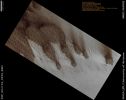
PSP_003734_0950_RED_abrowse-00.jpgSouthern Spring's Features (CTX Frame - Absolute Natural Colors; credits for the additional process. and color.: Dr Paolo C. Fienga - Lunexit Team)86 visitenessun commentoMareKromiumOtt 20, 2010
|
|
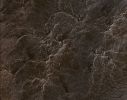
PSP_003734_0950_RED_abrowse-01.jpgSouthern Spring's Features (EDM - Absolute Natural Colors; credits for the additional process. and color.: Dr Paolo C. Fienga - Lunexit Team)84 visitenessun commentoMareKromiumOtt 20, 2010
|
|

ESP_019060_1330-LXTT0.jpgSouthern Gullies (CTX Frame - Natural Colors; credits for the additional process. and color.: Dr Paolo C. Fienga - Lunexit Team)74 visitenessun commentoMareKromiumOtt 15, 2010
|
|
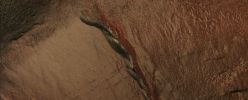
ESP_019060_1330-LXTT1.jpgSouthern Gullies (EDM n.1 - Enhanced True Colors; credits for the additional process. and color.: Elisabetta Bonora - Lunexit Team)106 visitenessun commentoMareKromiumOtt 15, 2010
|
|

ESP_019060_1330-LXTT2.jpgSouthern Gullies (EDM n.2 - Enhanced True Colors; credits for the additional process. and color.: Elisabetta Bonora - Lunexit Team)68 visitenessun commentoMareKromiumOtt 15, 2010
|
|
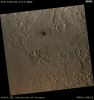
ESP_019195_2175_RED_abrowse.jpgRecent Impact (Natural Colors; credits for the additional process. and color.: Dr Paolo C. Fienga - Lunexit Team)134 visiteAcquisition Date: 31 August 2010
Mars Local Time (MLT): 15:22 (Early Afternoon)
Latitude (centered): 37,3° North
Longitude (East): 182,2°
Range to Target Site: 298,4 Km (such as about 186,5 miles)
Original image scale range: 29,8 cm/pixel (with 1 x 1 binning) so objects ~90 cm across are resolved
Map projected scale: 25 cm/pixel
Map projection: EQUIRECTANGULAR
Emission angle: 2,5°
Sun-Mars-Spacecraft (or Phase) Angle: 52,0°
Solar Incidence Angle: 49° (with the Sun about 41° above the Local Horizon)
Solar Longitude: 141,1° - Northern SummerMareKromiumOtt 11, 2010
|
|
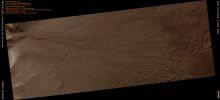
PSP_003269_1600_RED_abrowse.jpgSouthern Alluvial Fan (Natural Colors; credits for the additional process. and color.: Dr Paolo C. Fienga - Lunexit Team)102 visiteHiRISE image PSP_003269_1600 covers an Alluvial Fan along the wall of a large Unnamed Crater in the Mid Latitudes of the Southern Hemisphere of Mars.
The Fan was formed when water and sediments drained down the steep wall of the Crater creating a cone-shaped pile of debris at the base.
As the Fan grew with time, the Channels carrying water and sediment across its Surface changed locations, thus producing a Layered Deposit capped by Channels radiating from the Fan apex along the Crater Wall.
Subsequent stripping of the Fan Surface by the wind has left the coarser Channel Deposits in relief and exposed the fine scale layering within the Fan in many locations.
While is it is not known whether the source of the water responsible for creating the Fan was related runoff from precipitation or groundwater or perhaps both, Alluvial Fans of broadly similar form are observed in many locations on Earth and are usually formed by runoff from precipitation. MareKromiumOtt 11, 2010
|
|
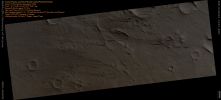
ESP_016916_1655_RED_abrowse-00.jpgLinear Dunes and Sand Sheets inside Herschel Crater (Natural Colors; credits for the additional process. and color.: Dr Paolo C. Fienga - Lunexit Team)111 visitenessun commentoMareKromiumOtt 11, 2010
|
|
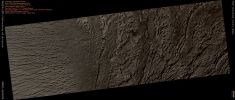
PSP_003656_2015_RED_abrowse-PCF-LXTT.jpgLayering in Becquerel Crater (Natural Colors; credits for the additional process. and color.: Dr Paolo C. Fienga - Lunexit Team)83 visiteBecquerel Crater is one of several impact craters in Arabia Terra that have light-toned layered deposits along the crater floor. The light-toned deposits are particularly striking to look at in this HiRISE image because they are stacked together to produce a thick sequence of layered beds. The layers appear to be only a few meters thick and show little variations in thickness.
On Earth, layered beds with these characteristics are typically formed in water environments, although aeolian (wind blown) deposition on Mars through a cyclic process is also possible. Volcanic eruptions would not be expected to produce ash or volcanic flows of such regular thickness, and there are no nearby volcanic vents.
Some of the layering in the image appears dark, probably due to deposition of basalt sand along flatter surfaces rather than any compositional variations in the layer beds themselves. Faults can also be seen displacing portions of the layered beds. The surface of the light-toned deposit is not smooth but instead appears disrupted into polygonal cracks and blocks.
Relative to most surfaces on Mars, there are almost no impact craters seen in this image. This is not due to a young age but rather to the friable (easily eroded) nature of the light-toned layered deposits that enable wind easily to erode the unit, thereby removing any impact craters. Evidence of erosion by the wind is most apparent in the bottom of the image where linear ridges most likely formed by wind scouring away material in a North-South direction and creating the ridges.
MareKromiumOtt 10, 2010
|
|
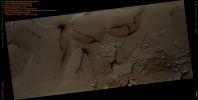
PSP_003597_1765_RED_abrowse-PCF-LXTT2.jpgPossible Smoke Emissions in Elysium Planitia (Natural Colors; credits for the additional process. and color.: Dr Paolo C. Fienga - Lunexit Team)125 visiteCaption NASA:"This observation shows fractured Mounds on the Southern Edge of Elysium Planitia. The Mounds are typically a few Km in diameter and about 200 feet tall. The fractures that crisscross their Surfaces are dilational (extensional) in nature, suggesting that the Mounds formed by localized uplift (i.e., they were pushed up from below).
The Mounds are probably composed of solidified Lava. They are contiguous with, and texturally similar to, the flood Lavas that blanket much of Elysium Planitia, and, where dilation cracks provide cross-sectional exposure, the uplifted material is rocky.
Patches of mechanically weak and disrupted material overlie the rocky mound material. This is particularly conspicuous in the Northeast corner of the HiRISE image. These patches may be remnants of a layer that was once more continuous but has been extensively eroded. Smooth Lava Plains fill the low-lying areas between the Mounds. They are riddled with sinuous pressure ridges.
The entire area is covered by a relatively thin layer of Dust and Sand".
Nota Lunexit: l'elemento più suggestivo dell'intero frame, completamente tralasciato dal commento NASA "Ufficiale", attiene quelle che a noi sembrano delle (evidenti e, riteniamo, anche piuttosto recenti) "emissioni di fumi", ben visibili in corrispondenza di quasi tutti i maggiori punti di fratturazione. E' proprio il dato, confermato dalla NASA stessa, per cui l'intera area ripresa è coperta da un sottile strato di sabbia e polvere (la quale dovrebbe conferire un colore denso e, soprattutto, uniforme a tutto il paesaggio) che ci fa ritenere recenti (se non recentissime) le summenzionate zone più scure ("macchiate", di fatto) e, dunque, molto probabilmente interessate da eventuali e persistenti emissioni di fumi, vapori (sulfurei?) e ceneri vulcaniche.MareKromiumOtt 10, 2010
|
|
| 2237 immagini su 187 pagina(e) |
 |
|
|
|
|
77 | |
|
|
|
|





