| Ultimi arrivi - Mars Reconnaissance Orbiter (MRO) |
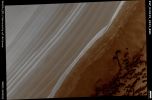
ESP_019195_2655_RED_abrowse.jpgNorth Polar Boundary (Absolute Natural Colors; credits for the additional process. and color.: Dr Paolo C. Fienga - Lunexit Team:)108 visiteMars Local Time: 14:09 (early afternoon)
Coord. (centered): 85,3° North Lat. and 160,3° East Long.
Spacecraft altitude: 324,6 Km (such as about 202,9 miles)
Original image scale range: 32,5 cm/pixel (with 1 x 1 binning) so objects ~97 cm across are resolved
Map projected scale: 25 cm/pixel
Map projection: POLAR STEREOGRAPHIC
Emission Angle: 10,8°
Sun-Mars-Spacecraft (or Phase) Angle: 61,9°
Solar Incidence Angle: 71° (meaning that the Sun is about 19° above the Local Horizon)
Solar Longitude: 141,1° (Northern Summer)
Credits: NASA/JPL/University of Arizona
Additional process. and coloring: Dr Paolo C. Fienga - Lunexit TeamMareKromiumNov 08, 2010
|
|

ESP_019151_1385_RED_abrowse-02.jpgUnnamed Shallow Craters in Northern Argyre Planitia (EDM n.2 - Absolute Natural Colors; credits for the additional process. and color.: Dr Marco Faccin - Lunexit Team)98 visiteMars Local Time: 15:36 (middle afternoon)
Coord. (centered): 41,1° South Lat. and 313,1° East Long.
Spacecraft altitude: 257,6 Km (such as about 161 miles)
Original image scale range: 51,5 cm/pixel (with 2 x 2 binning) so objects ~155 cm across are resolved
Map projected scale: 50 cm/pixel
Map projection: EQUIRECTANGULAR
Emission Angle: 9,2°
Sun-Mars-Spacecraft (or Phase) Angle: 83,0°
Solar Incidence Angle: 76° (meaning that the Sun is about 14° above the Local Horizon)
Solar Longitude: 139,4° (Northern Summer)
Credits: NASA/JPL/University of Arizona
Additional process. and coloring: Dr Marco Faccin - Lunexit TeamMareKromiumNov 08, 2010
|
|
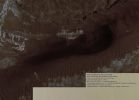
PSP_004026_1765_RED_abrowse-10-MF-PCF-LXTT.jpgVery strange "Dark Spot" in Aureum Chaos (EDM - RAW Natural Colors; credits for the additional process. and color.: Drr Marco Faccin and Paolo C. Fienga - Lunexit Team) 73 visitenessun commentoMareKromiumNov 05, 2010
|
|
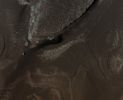
PSP_004026_1765-3-GB-PCF-LXTT.jpgVery strange "Dark Spot" in Aureum Chaos (EDM - Absolute Natural Colors; credits for the additional process. and color.: Dr Paolo C. Fienga - Lunexit Team)152 visiteAll'interno di questo canalone - uno dei tanti che si trovano nella Regione peri-Equatoriale conosciuta come Aureum Chaos (situata ad approx. 4° di Lat. Sud ed approx. 334° di Long. Est) -, assieme alle solite "ripples" (dunette), ho scorto una chiazza scura (che è emersa di un denso color nero, a seguito del processing Multispettrale da me abitualmente usato) la quale mi ha lasciato perplesso.
In attesa di esaminare il dettaglio in formato JP2, posso comunque dire che POTREBBE trattarsi di un'area infossata la quale si è, nel tempo, riempita di polveri sottilissime (tipo il nostro "particolato").
Polveri che, come sapete bene, se osservate a risoluzione modesta, appaiono come una (appunto) "chiazza scura" che ha, vagamente, le sembianze di un laghetto (o meglio: di una sorta di palude...).
Ritengo di poter ESCLUDERE l'eventualità per cui si tratti di una semplice ombra e mi piace considerare l'ipotesi (vista la curiosa - ma, a mio parere, davvero FORTISSIMA - somiglianza fra questa "chiazza nera" e le "chiazze nere" presenti sulla butterata Superficie della Luna Saturniana Iperione - Hyperion) per cui si possa trattare di un autentico affioramento di idrocarburi (surfacing hydrocarbons). Un "laghetto di petrolio" (o di sabbie intrise di petrolio), insomma...
Un'eventualità, quest'ultima, da me già ipotizzata (non solo per Iperione e Titano, ma anche per il Pianeta Rosso) da qualche anno e, al momento, non confermata nè smentita dalla NASA (sempre e solo per quanto attinente Marte).
Le Vostre opinioni saranno, come sempre, apprezzate.
Dr Paolo C. Fienga - Lunar Explorer ItaliaMareKromiumOtt 31, 2010
|
|

ESP_019197_2290_RED_abrowse-01.jpgExtremely unusually-looking Unnamed Northern Crater (EDM n.1 - Absolute Natural Colors; credits for the additional process. and color.: Drr Gianluigi Barca and Paolo C. Fienga - Lunexit Team)110 visitenessun commentoMareKromiumOtt 31, 2010
|
|

ESP_019197_2290_RED_abrowse-03.jpgExtremely unusually-looking Unnamed Northern Crater (EDM n.2 - Absolute Natural Colors; credits for the additional process. and color.: Drr Gianluigi Barca and Paolo C. Fienga - Lunexit Team)85 visitenessun commentoMareKromiumOtt 31, 2010
|
|

ESP_019360_1780_RED_abrowse-00.jpgFeatures of Meridiani Planum (CTX Frame - Natural Colors; credits for the additional process. and color.: Dr Paolo C. Fienga - Lunexit Team)110 visitenessun commentoMareKromiumOtt 30, 2010
|
|

ESP_019360_1780_RED_abrowse-01.jpgFeatures of Meridiani Planum (EDM n.1 - Natural Colors; credits for the additional process. and color.: Dr Paolo C. Fienga - Lunexit Team)98 visitenessun commentoMareKromiumOtt 30, 2010
|
|

ESP_019360_1780_RED_abrowse-02.jpgFeatures of Meridiani Planum (EDM n.2 - Natural Colors; credits for the additional process. and color.: Dr Paolo C. Fienga - Lunexit Team)86 visitenessun commentoMareKromiumOtt 30, 2010
|
|
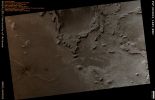
PSP_004091_1845_RED_abrowse.jpgRidges in Terra Meridiani (Absolute Natural Colors; credits for the additional process. and color.: Dr Paolo C. Fienga - Lunexit Team)97 visiteThis HiRISE image shows an arcuate ridge in Terra Meridiani. The ridge is most likely a former streambed, now exposed in inverted relief; the wandering path is not expected for an exhumed fault or volcanic dyke. The stream that formed this ridge must have been ancient as the ridge is buried by brighter rocks, which are themselves very old, having been thickly deposited and then heavily eroded.
The Mars Exploration Rover Opportunity landed in the same region of Mars, and the rocks it has examined are likely part of a sequence similar to that exposed here. The rocks exposed at the Opportunity landing site are mostly aeolian (wind-deposited) sandstone, but show evidence of past water, reaching the surface at times. Opportunity has access to only a few meters of a stack of sediments that is hundreds of meters thick.
Since water was present at times at the Opportunity landing site, surface water elsewhere in the sequence of sediments is perhaps not too surprising. However, evidence like this may indicate that sediments were deposited by a broader range of processes than just those inferred at the Opportunity site. This is important for unraveling the entire history of the region.
A stream channel could become inverted in several ways. Chemicals precipitating from the water could bind the streambed together, lava could fill the channel, or the bed could contain large boulders. In each case, the relatively resistant material of the stream channel could remain as the surrounding rock eroded. Here, the ridge is distant from any volcanic vent, and appears fractured, particularly in the southern portion. This indicates that the ridge material is consolidated and has some strength. Thus, the most likely mechanism for formation of this ridge is deposition of a chemical "cement" which hardened the streambed rock.
The plains surrounding the ridge are also fractured, indicating some degree of consolidation. These cracks could form by desiccation (water loss) from wet sediment or tensile fracturing as the weight of overlying rocks was removed. Cracks like this can also form in permafrost due to seasonal temperature changes; ground ice is unlikely this close to the equator, but it is possible that the cracks are a remnant of different climate conditions from the past.MareKromiumOtt 30, 2010
|
|
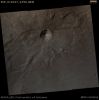
ESP_019197_2290_RED_abrowse-00.jpgExtremely unusually-looking Unnamed Northern Crater (Absolute Natural Colors; credits for the additional process. and color.: Dr Paolo C. Fienga - Lunexit Team)115 visiteAcquisition Date: 31 August 2010
Mars Local Time (MLT): 15:25 (Early Afternoon)
Latitude (centered): 48,7° North
Longitude (East): 127,6°
Range to Target Site: 311,5 Km (such as about 194,7 miles)
Original image scale range: from 31,2 to 62,3 cm/pixel (with 2 x 2 binning)
Map projected scale: 25 cm/pixel
Map projection: EQUIRECTANGULAR
Emission angle: 12,5°
Sun-Mars-Spacecraft (or Phase) Angle: 41,3°
Solar Incidence Angle: 53° (with the Sun about 37° above the Local Horizon)
Solar Longitude: 141,1° - Northern SummerMareKromiumOtt 29, 2010
|
|

ESP_019186_1525_RED_abrowse.jpgThe Central Structure of Jorn Crater (Absolute Natural Colors; credits for the additional process. and color.: Dr Paolo C. Fienga - Lunexit Team:)90 visitenessun commentoMareKromiumOtt 29, 2010
|
|
| 2237 immagini su 187 pagina(e) |
 |
|
|
|
|
75 | |
|
|
|
|





