| Ultimi arrivi - Mars Reconnaissance Orbiter (MRO) |

PSP_004006_1900_RED_abrowse-PCF-LXTT.jpgFissure in Cerberus Fossae (Absolute Natural Colors; credits for the additional process. and color.: Dr Paolo C. Fienga - Lunexit Team)92 visitenessun commentoMareKromiumNov 12, 2010
|
|
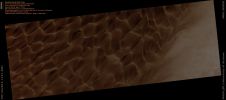
PSP_002824_1355_RED_abrowse-00.jpgDunefield inside Rabe Crater (CTX Frame - Natural Colors; credits for the additional process. and color.: Dr Paolo C. Fienga - Lunexit Team)100 visiteMareKromiumNov 10, 2010
|
|

PSP_002824_1355_RED_abrowse-01.jpgDunefield inside Rabe Crater (EDM - Natural Colors; credits for the additional process. and color.: Dr Paolo C. Fienga - Lunexit Team)79 visiteMareKromiumNov 10, 2010
|
|

ESP_019191_1750_RED_abrowse.jpgFeatures of Juventae Chasma (Absolute Natural Colors; credits for the additional process. and color.: Dr Paolo C. Fienga - Lunexit Team)91 visitenessun commentoMareKromiumNov 10, 2010
|
|

ESP_019482_2135_RED_abrowse-03.jpgEverything fades... (Absolute Natural Colors; credits for the additional process. and color.: Dr Paolo C. Fienga - Lunexit Team)94 visiteThis young impact site was discovered by the MRO CTX Science Team. A new "Dark Spot" appeared in a CTX image from July 2008 that was not seen when the region was previously imaged by the Mars Odyssey THEMIS VIS instrument in November 2004. High resolution imaging by HiRISE in November 2008 (left panel of the inset) confirmed that the Dark Spot was Ejecta from a Cluster of Craters.
Three large craters ranging from about 3 to 5 meters diameter and at least 5 smaller craters make up the Cluster. A smaller outlier (approximately 2 meters in diameter, not pictured in the inset) landed 300 meters away to the North/West. These craters were likely produced by a single Impactor that broke into pieces as it fell through the Martian Atmosphere.
The Impactor probably approached from the North/West, judging from the shape of the Ejecta Pattern and the location of the small outlier.
The impacts sprayed the site with Dark Ejecta excavated from beneath the bright Surface. The conspicuous, newly formed feature, will now provide an ideal location to monitor the effects of Winds on the (relatively) modern Martian Surface.
HiRISE imaged the site again in September 2010, after the passage of a full Martian year, when the illumination was similar to the previous HiRISE image. By luck, the SIA (Solar Incidence Angle, such as the Zenith Angle of the Sun) of the later image was only 0,2° different from that of the earlier image.
However, the Phase Angle (such as the angle between the Sun, the Target, and the Spacecraft Camera) was smaller by about 14° as the Spacecraft rolled in the opposite direction.
The new picture shows the Ejecta Pattern apparently faded in comparison to the previous image. The contrast of other features in the scene (such as the Hills and Boulders) is similar, but the Ejecta from the Crater Cluster are noticeably brighter in the HiRISE image from 2010. One possibility is that the Dark Ejecta reflects Sunlight differently than the bright surrounding Terrain - becoming darker more rapidly as Phase Angle increases.
Another possibility is that the Ejecta Pattern was mantled by a thin Layer of bright Dust that settled out of the Atmosphere during the 20 month interval between the two images.
Further monitoring of this site by HiRISE will help choose between these hypotheses.
This target illustrates how the various instruments on MRO work together. The spatial coverage of HiRISE is too limited to search for new impact craters across the Martian globe. Yet the spatial resolution of HiRISE can be used to verify and study details in sites identified as suspicious by CTX.
The complimentary capabilities of the MRO instruments provide a fuller understanding of Mars together than their insights taken separately.MareKromiumNov 09, 2010
|
|

Volcanoes-Arsia_Mons-PIA13540-1.jpgLayers in the lower West Flank of Arsia Mons (Natural Colors; credits for the additional process. and color.: Dr Paolo C. Fienga - Lunexit Team)119 visiteMareKromiumNov 09, 2010
|
|

Volcanoes-Arsia_Mons-PIA13540-2.jpgLayers in the lower West Flank of Arsia Mons (Absolute Natural Colors; credits for the additional process. and color.: Dr Paolo C. Fienga - Lunexit Team)124 visiteCaption NASA:"This image - dated July, 18th, 2007) covers a Pit in the lower West Flank of Arsia Mons, one of the four Giant Volcanoes of the Tharsis Volcanic District.
Many Layers are exposed in the Pit, probably marking individual Lava Flows, and they can provide useful information about the nature of some of the many Martian Volcanic Eruptions.
This image was acquired in the middle of a large Regional Dust Storm, but the Atmosphere over this image is only moderately dusty because the altitude is 6,5 Km higher than the Planetary Mean, so the air is quite thin and cannot hold as much Dust. Although the Atmosphere was not too dusty, the Surface is buried by a Dust Layer which is probably several meters thick.
These high-altitude locations on Mars have thick Dust Deposits because the thin air cannot blow away the Dust, or at least not as fast as it accumulates. On Earth the oceans serve as "Dust Traps", but on Mars, it is a job for the highest Volcanoes".MareKromiumNov 09, 2010
|
|
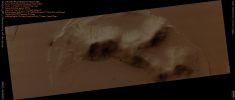
PSP_003570_1915_RED_abrowse-PCF-LXTT.jpgColourful Slope-Streaks in Marte Vallis (Natural Colors; credits for the additional process. and color.: Dr Paolo C. Fienga - Lunexit Team)75 visiteThis image of a large Hill in Marte Vallis has numerous dark- and light-toned Streaks along its Slopes, showing a variety of characteristics observed in other areas with these features.
For example, several dark Streaks have formed "fingers" at their Termini (such as the point where where the Streaks end).
Their formation may be due to the material "feeling" the roughness of the ground as it reaches shallower slopes near the base of the Hill. The dark Streaks also appear to travel over many obstacles along their paths, such as impact craters, small boulders, and rock outcrops. This indicates that the Slope Streaks have sufficient "momentum" and energy early in their descent downslope that they are not affected by such features or the ground.
The Slope Streaks also do not start at a common elevation along the sides of the Hill, suggesting that they are not related to any particular layer(s) of material.
Dark Slope Streaks are thought to fade over time by deposition of a new bright Dust Layer over the old streaked Surface. The presence of light-toned Streaks relative to their surrounding darker-toned surface is particularly interesting.
Scientists have wondered: if dark Streaks fade over time by deposits of new Dust, then how can there be light-toned streaks? Does this mean light-toned Streaks are formed differently? Are the materials of a light-toned Streak different from dark-toned Streaks?
Slope Streaks have been discovered and studied since the early Mariner and Viking Missions to Mars in the '60s and '70s. Scientists are hoping to resolve some of these questions using HiRISE images with its high spatial resolution compared to these previous Mars datasets.MareKromiumNov 09, 2010
|
|

ESP_019372_2300_RED_abrowse-00.jpgFeatures of Lyot Crater (Absolute Natural Colors; credits for the additional process. and color.: Dr Paolo C. Fienga - Lunexit Team)89 visitenessun commentoMareKromiumNov 08, 2010
|
|

ESP_019181_2655_RED_abrowse.jpgNorth Polar Boundary (Absolute Natural Colors; credits for the additional process. and color.: Dr Paolo C. Fienga - Lunexit Team:)80 visitenessun commentoMareKromiumNov 08, 2010
|
|

ESP_019188_2595_RED_abrowse.jpgNorth Presso-Polar Layers (Absolute Natural Colors; credits for the additional process. and color.: Dr Paolo C. Fienga - Lunexit Team:)79 visitenessun commentoMareKromiumNov 08, 2010
|
|

ESP_019193_2665_RED_abrowse.jpgExposed NPLD (Absolute Natural Colors; credits for the additional process. and color.: Dr Paolo C. Fienga - Lunexit Team)65 visitenessun commentoMareKromiumNov 08, 2010
|
|
| 2237 immagini su 187 pagina(e) |
 |
|
|
|
|
74 | |
|
|
|
|





