| Ultimi arrivi - Mars Reconnaissance Orbiter (MRO) |

PSP_002884_1395_RED_abrowse-00.jpgUnnamed Southern Crater with deep Gullies (CTX Frame - Absolute Natural Colors; credits for the additional process. and color.: Dr Paolo C. Fienga - Lunexit Team)97 visiteThis observation shows gullies in a Southern HemisphereUnnamed Crater whose Floor has large Mounds of material that are likely "Slump Blocks" that fell off the Crater Walls during a late stage of formation (---> this is a Gravity Wasting Event). There are also a large number of Dunes of different sizes and facing different directions on the Crater Floor.
A lot of Polygonal Fractures can also be seen on the Walls, inside the Gullies (see the following EDM). In addition, some of the Gullies facing the East were active more recently. They do not have Polygonal Fractures or they have fractures that are less well-developed.
A narrow, primarily unmodified Channel is also visible.
It is unknown over what period of time Gullies formed in individual settings and globally. It is possible that Gully formation continues today.MareKromiumNov 24, 2010
|
|

PSP_002884_1395_RED_abrowse-01.jpgUnnamed Southern Crater with deep Gullies (EDM - Absolute Natural Colors; credits for the additional process. and color.: Dr Paolo C. Fienga - Lunexit Team)85 visitenessun commentoMareKromiumNov 24, 2010
|
|

Dunes_and_DD_Tracks-PIA13538-PCF-LXTT-000.jpgUnnamed Southern Crater with Large Dunefield and DD Streaks (CTX Frame - Absolute Natural Colors; credits for the additional process. and color.: Dr Paolo C. Fienga - Lunexit Team) 113 visitenessun commentoMareKromiumNov 23, 2010
|
|

Dunes_and_DD_Tracks-PIA13538-PCF-LXTT-001.jpgSouthern Dunes and DD Tracks (Absolute Natural Colors; credits for the additional process. and color.: Dr Paolo C. Fienga - Lunexit Team)139 visiteUna "singolare" Anomalìa che non può e non deve passare inosservata (di qualsiasi evento o fenomeno - naturale o artificiale - Essa costituisca l'espressione visibile).MareKromiumNov 23, 2010
|
|

Dunes_and_DD_Tracks-PIA13538-PCF-LXTT-002.jpgSouthern Dunes and DD Tracks (Absolute Natural Colors; credits for the additional process. and color.: Dr Paolo C. Fienga - Lunexit Team)86 visitenessun commentoMareKromiumNov 23, 2010
|
|

ESP_019569_1640_RED_abrowse-PCF-LXTT.jpgPortion of Huygens Crater (Absolute Natural Colors; credits for the additional process. and color.: Dr Paolo C. Fienga - Lunexit Team)94 visitenessun commentoMareKromiumNov 21, 2010
|
|

PSP_002932_1445_RED_abrowse-00.jpgSection of the Outer Rim of Hale Crater (CTX Frame - Absolute Natural Colors; credits for the additional process. and color.: Dr Paolo C. Fienga - Lunexit Team)97 visiteThis observation shows Hale Crater, a rather large, pristine elliptical crater approximately 125 x 150 Km in diameter. Hale Crater possesses sharp features, impact melt bodies ponded through out the structure and few overprinting Impact Craters. These attributes indicate that it is relatively young and certainly well-preserved - likely the youngest crater of this size on Mars.
Present on the Crater Walls are a large number of Gullies, some with Light-Toned Deposits. The Gullies visible here are very well developed, and many are cut deeply into the Hale's Walls. Several have "Braided Channels" suggestive of repeated flow. Some of the Gullies have Boulders littered throughout their Channels. This could be a result of a fluid preferentially transporting smaller particles and leaving larger rubble behind.
The composition of the Light-Toned Deposits are currently unknown. The CRISM Visible-InfraRed Spectrometer, HiRISE's sister instrument on MRO, may be able to shed some light on the composition of these materials.
In one place along the Crater Rim, Gullies are visible on both sides of the Rim (see the EDM that follows). This has only been seen in a few locations on Mars.MareKromiumNov 21, 2010
|
|

PSP_002932_1445_RED_abrowse-01.jpgSection of the Outer Rim of Hale Crater (EDM - Absolute Natural Colors; credits for the additional process. and color.: Dr Paolo C. Fienga - Lunexit Team)80 visitenessun commentoMareKromiumNov 21, 2010
|
|
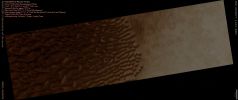
PSP_004077_1325_RED_abrowse-PCF-LXTT.jpgLarge Dunefield inside Proctor Crater (Absolute Natural Colors; credits for the additional process. and color.: Dr Paolo C. Fienga - Lunexit Team)88 visiteImage PSP_004077_1325 shows the edge of a Dark Dunefield on the Floor of Proctor Crater, an about 150 Km diameter Crater located in the Southern Highlands of Mars.
The Dark Dunes are composed of Basaltic Sand that has collected on the bottom of the Crater. Dark Dune "Slip Faces" - such as the steeper (---> più ripido) sides of the Dunes - are located on the Eastern side of the Dunes and are believed to have formed in response to Fall and Winter Westerly Winds caused by geostrophic forces (winds balanced by Coriolis and pressure gradient forces).
Superimposed on their Surface are smaller Secondary Dunes that are commonly seen on terrestrial Dunes of this size.
Many smaller and brighter bedforms, most likely small Dunes or granule Ripples, cover the substrate between the larger Dark Dunes as well as most of the Floor of Proctor Crater. The Dark Dunes overlie the small bright bedforms indicating that they formed more recently.
In several areas, however, the dark dunes appear to influence the orientation of the small bright Dunes, possibly by Wind flowing around the larger ones, suggesting that both dark and bright bedforms are coeval.
The Dunes in Proctor Crater may still be active today, moving in response to Martian Winds. MareKromiumNov 21, 2010
|
|

ESP_019669_2450_RED_abrowse.jpgMega-Polygons in Vastitas Borealis (Absolute Natural Colors; credits for the additional process. and color.: Dr Paolo C. Fienga - Lunexit Team)80 visitenessun commentoMareKromiumNov 21, 2010
|
|
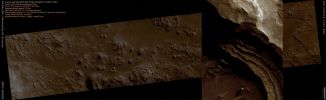
PSP_008338_1525_Erratic_Boulder-EB-LXTT-0.jpgLayers and "Monolith-like" Erratic Boulder in Uzboi Vallis (CTX Frame and EDM - an Image-Mosaic in Absolute Natural Colors by Elisabetta Bonora and Paolo C. Fienga - Lunexit Team)93 visiteMareKromiumNov 21, 2010
|
|

PSP_004072_1845_RED_abrowse-00.jpgThe "End" of Lethe Vallis (CTX Frame - Enhanced Natural Colors; credits for the additional process. and color.: Dr Paolo C. Fienga - Lunexit Team)104 visiteHiRISE image PSP_004072_1845 shows the funnel-shaped Terminus of Lethe Vallis, a winding Channel in the Elysium Planitia Region of Mars.
Lethe Vallis flows from South-West to North-East between 2 basins: Cerberus Palus and Eastern Elysium Plantia. Where it empties into the latter, the Channel abruptly widens (see the EDM n.1).
On the West side (up) of this HiRISE image, Lethe Vallis is approx. 800 mt wide; on the East side (down), it is more than 7 Km in width. As the fluid that carved the Channel spread out, its erosive power diminished. Thus, where the Channel is wider, it contains numerous high-standing Mesas that are primarily composed of pre-existing material that was not fully eroded away.
The Floor of Lethe Vallis is covered in solidified Lava and blanketed by a thin layer of light-toned Dust. The Lava has a rough, ridged appearance where its surface buckled as it cooled, and a smoother polygonal texture where it was not significantly deformed. Interestingly, Lava textures are visible high on the Banks and Terraces of the Lethe Vallis. Farther away from the Channel, the Terrain is older and more heavily cratered.MareKromiumNov 18, 2010
|
|
| 2237 immagini su 187 pagina(e) |
 |
|
|
|
|
72 | |
|
|
|
|





