| Ultimi arrivi - Mars Reconnaissance Orbiter (MRO) |

PSP_004052_2045_RED_abrowse-00.jpgUnnamed Crater with Layers near Mawrth Vallis (Absolute Natural Colors; credits for the additional process. and color.: Dr Paolo C. Fienga - Lunexit Team)91 visitenessun commentoMareKromiumDic 19, 2010
|
|

PSP_005514_1360_RED_abrowse.jpgDunes on Rabe Crater's Floor (Absolute Natural Colors; credits for the additional process. and color.: Dr Paolo C. Fienga - Lunexit Team)81 visitenessun commentoMareKromiumDic 19, 2010
|
|
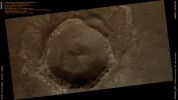
ESP_020086_2020_RED_abrowse-00.jpgUnnamed Crater with Light-toned Layered Bedrock (Absolute Natural Colors; credits for the additional process. and color.: Dr Paolo C. Fienga - Lunexit Team)83 visitenessun commentoMareKromiumDic 17, 2010
|
|

ESP_019747_1975_RED_abrowse.jpgGraben cutting Lava-Flow (Absolute Natural Colors; credits for the additional process. and color.: Dr Paolo C. Fienga - Lunexit Team)73 visitenessun commentoMareKromiumDic 17, 2010
|
|

ESP_019991_2440_RED_abrowse.jpgPossible Ice-Exposure in Vastitas Borealis (Absolute Natural Colors; credits for the additional process. and color.: Dr Paolo C. Fienga - Lunexit Team) 81 visitenessun commentoMareKromiumDic 17, 2010
|
|

Meridiani_Planum-PIA13598-PCF-LXTT.jpgOpportunity's "Martian Traverse" through Sol 2442 (Natural Colors; credits for the additional process. and color.: Dr Paolo C. Fienga - Lunexit Team)73 visiteThe white line on this map shows where NASA's Mars Rover Opportunity has driven from the place where it landed in January 2004 - inside Eagle Crater, at the lower left end of the track - to where it reached on the 2442nd Martian Day, or Sol, of its work on Mars (such as December 6, 2010).
The map covers an area about 14 Km (approx. 8,7 miles) wide.
South is at the top.
An Eastward drive of 124 meters (405 feet) on Sol 2442 brought Opportunity to within about 550 meters (1800 feet) of Santa Maria Crater.
Santa Maria, with a diameter about of about 90 meters (295 feet), is nearly as big as Endurance Crater, which Opportunity entered and explored from June to December 2004.
The Sol 2442 drive brought Opportunity's Total Odometry to 25,92 Km (such as 16,11 miles). The long-term destination of the Mission since mid-2008 has been Endeavour Crater, still more than 6 Km (about 3,7 miles) away. The western edge of Endeavour appears in the upper right, including Ridges that are part of the Crater's eroded Rim. This Crater is about 22 Km (approx. 14 miles) in diameter, dwarfing the largest crater that Opportunity has visited so far, Victoria, which is about 800 meters (approx. half a mile) in diameter. Opportunity explored the Rim and interior of Victoria from mid-2006 to mid-2008.
The base map for this traverse map is a mosaic combining images from the High Resolution Imaging Science Experiment camera and the Context Camera, both on NASA's Mars Reconnaissance Orbiter. It is used by Tim Parker of NASA's Jet Propulsion Laboratory, Pasadena, for mapping each of Opportunity's drives based on images taken by the rover after the drive.
Opportunity completed its three-month prime mission in April 2004 and has continued operations in extended missions since then. JPL, a division of the California Institute of Technology in Pasadena, manages the Mars Exploration Rover Project for the NASA Science Mission Directorate, Washington. The University of Arizona, Tucson, operates the High Resolution Imaging Science Experiment. Malin Space Science Systems, San Diego, operates the Context Camera.MareKromiumDic 13, 2010
|
|

PSP_004988_1085_RED_abrowse-00.jpgSouth Presso-Polar Pit Gullies (CTX Frame - Absolute Natural Colors; credits for the additional process. and color.: Dr Paolo C. Fienga - Lunexit Team)88 visiteThis observation shows partial views of two high latitude Pits. These Polar Pits contain Gullies, small-scale Slope Features that are proposed to require some amount of liquid water to form.
Several of the Gullies have multiple Channels and Debris-Aprons from numerous Flows that occurred throughout time. Many of the Gullies are seen to originate at a Boulder-Layer at the Pit Edges. This layer is deteriorating and releasing Boulders that can be seen rolling down the Pit Walls. The bright material near the Pit Edges is probably Seasonal Frost. MareKromiumDic 12, 2010
|
|

PSP_004988_1085_RED_abrowse-01.jpgSouth Presso-Polar Pit Gullies (EDM - Absolute Natural Colors; credits for the additional process. and color.: Dr Paolo C. Fienga - Lunexit Team)85 visiteWhat is particularly interesting about these Gullies is that some might be forming (see this EDM, approx. 800 meters across, of the South-facing Gullies in the bottom Pit). The Gullies on this Wall have incised Alcoves, but only a few have well-developed Channels.
This could be a Region of current Gully formation. Aiding this hypothesis is the fact that there are a couple of depressions between the visible Gullies, suggestive of a developing Gully where water and/or material removed from under the Surface caused the overlying ground to collapse. It is also possible that water originating on the Surface is carving out these depressions, although it is difficult to melt water ice at the temperatures found in this particular location.MareKromiumDic 12, 2010
|
|
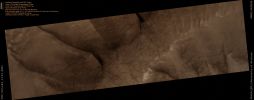
PSP_005383_1255_RED_abrowse-00.jpgDunefield with DD Tracks inside Russel Crater (Absolute Natural Colors; credits for the additional process. and color.: Dr Paolo C. Fienga - Lunexit Team)69 visiteDust Devils make dark, diffuse scribble markings on the Surface by kicking up Dust and are especially active in the Summertime over Dark Surfaces, such as those with many deposits of sand-sized material.
The Surface warms up in the Sunlight, creating the right conditions to form Dust Devils. Mars also has larger dust storms that can deposit a thin layer of Dust and eliminate the Dust Devil Tracks. MareKromiumDic 12, 2010
|
|

ESP_019992_1340_RED_abrowse.jpgSouthern Dunefield (Absolute Natural Colors; credits for the additional process. and color.: Dr Paolo C. Fienga - Lunexit Team)73 visitenessun commentoMareKromiumDic 12, 2010
|
|

PSP_005095_0935_RED_abrowse.jpgSouth Polar Residual Cap (Absolute Natural Colors; credits for the additional process. and color.: Dr Paolo C. Fienga - Lunexit Team)75 visitenessun commentoMareKromiumDic 12, 2010
|
|

Dunes_and_DD_Tracks-PIA13538-EB-LXTT-001.jpgSouthern Dunes and DD Tracks (Possible True Colors; credits for the additional process. and color.: Elisabetta Bonora - Lunexit Team)85 visitenessun commentoMareKromiumDic 10, 2010
|
|
| 2237 immagini su 187 pagina(e) |
 |
|
|
|
|
69 | |
|
|
|
|





