| Ultimi arrivi - Mars Reconnaissance Orbiter (MRO) |

PSP_005980_1725_RED_abrowse-PCF-LXTT.jpgLayered Collapse Pit in Noctis Labyrinthus (Absolute Natural Colors; credits for the additional process. and color.: Dr Paolo C. Fienga - Lunexit Team)109 visitenessun commentoMareKromiumDic 31, 2010
|
|
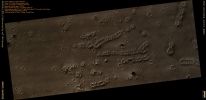
PSP_003494_2075_RED_abrowse.jpgCrater Cluster with Cones and Ridges in Utopia Planitia (Natural Colors; credits for the additional process. and color.: Dr Paolo C. Fienga - Lunexit Team)120 visiteThis image shows Cratered Cones in Utopia Planitia. Cones with Summit Craters join together in places to form Ridges up to several kilometers long, with Troughs running along the Summit.
In many of these cases it is evident that the Ridge Systems formed by merging of multiple Cones, since the arcs of individual Cones can be distinguished.
These features are probably formed by eruption of Subsurface material-Mud or Lava. Lava can form Cinder or Spatter Cones, and eruptions from localized sources along a single Fissure could produce the Ridges.
The absence of obvious (---> evidenti) Lava Flows near the Cones may argue against this mechanism, but ascending Lava could have interacted with Subsurface Water or Ice, leading to a more explosive eruption.
An alternative is eruptions of pressurized Mud from depth ("Mud Volcanism"), a process which occurs in certain environments on Earth.
This observation has a few minor gaps where transmission errors caused data to be lost. These appear as narrow black bars.MareKromiumDic 29, 2010
|
|

PSP_003830_1740_RED_abrowse-00.jpgLayered Bedrock in Candor Chasma (CTX Frame - Absolute Natural Colors; credits for the additional process. and color.: Dr Paolo C. Fienga - Lunexit Team)119 visiteThis image shows an area of Layered Deposits in Candor Chasma. Here, Sheets and Dunes of dark-toned Sand cover the light-toned, Layered Bedrock. Accumulations of dark Sand accentuate bedding within the light-toned Bedrock, giving some areas a sort of "zebra-striped" pattern.
In the left side of the scene, the Bedrock has been eroded into steep, craggy Cliffs. Some sections of these Cliffs are covered by triangular-shaped Debris Fans that are intermediate in color between the dark-toned Sand and light-toned Bedrock. These Fans may contain a mix of light-toned Bedrock that has crumbled away from the surrounding Cliffs as well as wind-blown Sand and Dust.
The Surfaces of some Fans are dissected by Gullies, which most likely formed through Dry Avalanching. The bottoms of the Gully Channels are often darker in tone than the surrounding Fan Surface. This may be due to accumulations of wind-blown Sand in the Gully Floor.MareKromiumDic 29, 2010
|
|
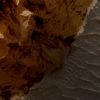
PSP_003830_1740_RED_abrowse-01.jpgLayered Bedrock in Candor Chasma (EDM n.1 - Absolute and Enhanced Natural Colors; credits for the additional process. and color.: Dr Paolo C. Fienga - Lunexit Team)125 visiteThis EDM shows a clear example of a "Gullied Fan", taken from the left (Northern) portion of the whole scene.MareKromiumDic 29, 2010
|
|

PSP_003655_1885_RED_abrowse-00.jpgBeautiful Windworks (Natural Colors; credits for the additional process. and color.: Dr Paolo C. Fienga)124 visiteThis image shows a portion of a Mound partly filling an Unnamed Impact Crater.
The Impact Crater is a little more than 60 Km (approx. 37 miles) across while the Central Mound is about half that figure (since it extends itself well beyond the area shown here).
Large Impact Craters typically have Central Peaks which surge upwards in the last stage of crater formation. However, Mounds like this represent a different process: Sedimentary Infill of the Crater AFTER its formation.
At this site, the Mound appears to be Layered. Step-forming Layers crop out throughout the center of the image. This indicates that the Mound material was deposited in a series of events, likely the same process repeating many times. Many processes could form Layers like this, including Aeolian Deposition, Volcanic Ash or Lake Sedimentation.
Unfortunately, fine details of the Layers are obscured by Dust which covers most of the Mound. Avalanches in this Dust Layer are responsible for the many small Dark Streaks that can be seen in the image.
Anyway, however the material in the Mound formed, it was once even more extensive, perhaps entirely filling the Crater. Wind Erosion has caused the formation of these elongated shapes (called "Yardangs").MareKromiumDic 29, 2010
|
|

PSP_004052_2045_RED_abrowse-01.jpgUnnamed Crater with Layers near Mawrth Vallis (EDM - Absolute Natural Colors; credits for the additional process. and color.: Dr Paolo C. Fienga - Lunexit Team)105 visitenessun commentoMareKromiumDic 26, 2010
|
|
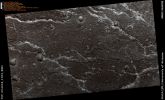
PSP_004018_1505_RED_abrowse.jpgLayers in Columbus Crater (Natural Colors; credits for the additional process. and color.: Dr Paolo C. Fienga - Lunexit Team)87 visiteThis HiRISE image shows bright Layers on the Floor of Columbus Crater, a large Impact Basin in the Southern Highlands of Mars.
The Crater is very old and has gone through much modification. Its Rim is relatively low and the Floor is flat, and it is likely that material has been eroded from the Rim and deposited on the Crater Floor.
The bright stripes that appear in this image at low resolution are likely Sedimentary Deposits. This bright material also includes dark patches which may be embedded within it, or the dark material could be covering the light one. The small-scale topography is rugged, likely an erosional characteristic of the dark material which covers much of the Surface.
Bright materials like those visible here are found in many places on Mars. In this case, it is likely that they are part of the Sediments that have filled the Basin, but it is not certain how they were deposited.
In many places, bright Sediments exhibit fine horizontal banding, suggesting that they were once part of more extensive, flat-lying Layers of rock. In the bright materials here, Layering is rare and the original geometry somewhat more obscure. Impact Craters in the scene have excavated the Dark Surface, but in several cases this has neither exposed layering nor bright material.MareKromiumDic 26, 2010
|
|
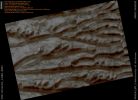
PSP_004230_1080_RED_abrowse.jpgDefrosting Dunefield inside Richardson Crater (Absolute Natural Colors; credits for the additional process. and color.: Dr Paolo C. Fienga - Lunexit Team)85 visiteCovered by Seasonal CO2 Frost, the Dunefield here in Richardson Crater has only partially defrosted, although the image was acquired late in Mars' Southern Spring.
Large patches of Carbon Dioxide Frost can be observed, linked in some places by Channels possibly carved into the ground by the erosion of CO2 gas, as blocks dry ice slide down slope and sublimate.
Numerous Dust Devil Tracks (or DDT for short) have left their mark.
MareKromiumDic 26, 2010
|
|

PSP_001552_1410_RED_abrowse-02.jpgFrost Covered Gullies in Terra Sirenum (CTX Frame + EDM - Absolute Natural Colors; credits: Dr Paolo C. Fienga - Lunexit Team) 87 visitePSP_001552_1410 shows Gullies in a Unnamed Crater located in Terra Sirenum (Southern Hemisphere of Mars).
This image was acquired during the Winter, which explains the abundant frost (the bright material) seen throughout the image. The frost is likely water frost, as opposed to CO2, because temperatures at this latitude probably do not get cold enough for Carbon Dioxide to condense.
The formation mechanism of Gullies is much debated. Several theories support erosion by liquid water, while others favor dry debris flows or Carbon Dioxide. A major unknown is, if the Gullies are formed by liquid water, does the water originate from the Surface or Subsurface?
Also interesting about this scene is the fact that the Gullies occur at multiple elevations along the same Crater Wall. This is uncommon on Mars. Gullies, whether or not they are found in conjunction with an obvious horizontal layer, usually form at the same elevation on a given slope. It is unknown what caused these Gullies to form at multiple elevations. Their locations are suggestive of a distributed water source, which also favors a Surface, rather than a confined Subsurface origin of water, such as an Aquifer.
Acquisition Date: November, 25th, 2006
Mars Local Time (M.L.T.): 15:40 (Middle Afternoon)
Latitude (centered): 38,9° South
Longitude (East): 195,9 °
Range to Target Site (or Spacecraft Altitude as to the pictured area): 250,5 Km (such as approx. 156,6 miles)
Original Image Scale Range: 50,1 cm/pixel (with 2 x 2 binning) so objects ~150 cm across are resolved
Map Projected Scale: 50 cm/pixel and North is up
Map projection: EQUIRECTANGULAR
Emission Angle: 2,4°
Phase Angle: 76,9°
Solar Incidence Angle: 75° (with the Sun about 15° above the Local Horizon)
Solar Longitude: 140,6° (Northern Summer)MareKromiumDic 26, 2010
|
|

PSP_003077_1530_RED_abrowse-1.jpgThe "White Cliffs" of Holden Crater (Absolute Natural Colors; credits for the additional process. and color.: Dr Paolo C. Fienga - Lunexit Team)92 visitenessun commentoMareKromiumDic 25, 2010
|
|

PSP_003086_2015_RED_abrowse.jpgFeatures of Nili Fossae (Absolute Natural Colors; credits for the additional process. and color.: Dr Paolo C. Fienga - Lunexit Team:)116 visitenessun commentoMareKromiumDic 24, 2010
|
|
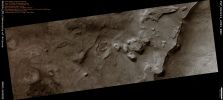
PSP_003231_2095_RED_abrowse-00.jpgRocky Mesas in Nilosyrtis Mensae (CTX Frame - Absolute Natural Colors; credits for the additional process. and color.: Dr Paolo C. Fienga - Lunexit Team)129 visiteMareKromiumDic 24, 2010
|
|
| 2237 immagini su 187 pagina(e) |
 |
|
|
|
|
67 | |
|
|
|
|





